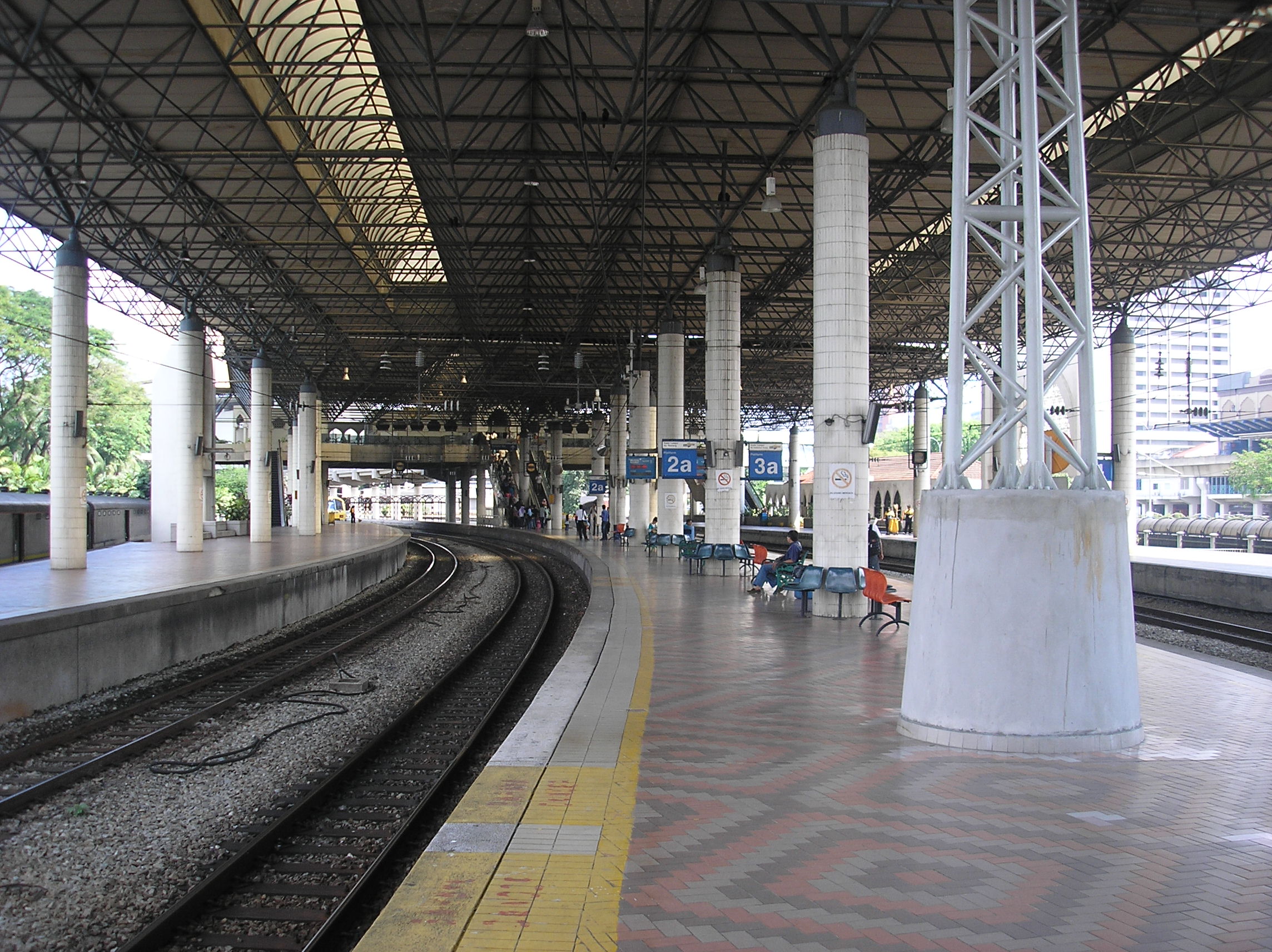
Kuala Lumpur Railway Station
Kuala Lumpur's first railway station was built from wood and roofed with nipah palm leaves. Completed in the 1880s opposite the Royal Selangor Club, it connected the young mining town to the port at Klang via the peninsula's first railway line, inaugurated on 22 September 1886. That modest wooden shed is long gone. What replaced it, three decades later, is a building so extravagantly designed that newcomers sometimes mistake it for a palace. The Kuala Lumpur railway station, with its horseshoe arches, towering chhatris, and cream-plastered facade, was the work of British architect Arthur Benison Hubback, and it remains one of Southeast Asia's most striking pieces of colonial-era architecture.
An Architect of Empires
Hubback was the Architectural Assistant to the Director of Public Works, and his fingerprints are all over early Kuala Lumpur. He designed the Old City Hall, completed in 1904, and the Jamek Mosque, finished in 1909. For the railway station, he drew on the Indo-Saracenic style that British architects had popularized across the colonial world, blending Mughal domes and Moorish arches with European engineering. The result was not unique to Kuala Lumpur; the Sultan Abdul Samad Building, completed in 1897, already stood nearby in the same idiom. But Hubback's station, begun in 1910 and fully completed in 1917, took the style further. Its facade is entirely plastered rather than left in exposed brick, giving it a luminous, almost confectionery quality. Six chhatris originally crowned the roofline, with two more added during later renovations. The cost at completion was $23,000 in Straits dollars.
Hub of a Growing Nation
For most of the twentieth century, the station was the gateway to and from Kuala Lumpur. The Federated Malay States Railways and its successor, Keretapi Tanah Melayu, ran intercity services through its platforms, connecting the capital to Penang, Singapore, and the east coast. A railway hotel occupied the upper floors of the north wing, eventually growing to 170 rooms and earning the name Heritage Station Hotel in 1996. Below it, the main hall buzzed with ticket counters, waiting passengers, and the peculiar energy of a building that served as both transit hub and social crossroads. When KTM Komuter suburban services launched in 1995, the station adapted again, adding faregates and new platform designations.
The Quiet After Sentral
On 15 April 2001, Kuala Lumpur Sentral opened less than a kilometer to the south, and the old station's role changed overnight. Intercity trains still passed through but no longer stopped. Staffed ticket counters closed. Business tenants vacated. The Heritage Station Hotel limped along until 2011, reopened briefly in 2014, then shut for good. It was a melancholy decline for a building designed to impress. But the architecture ensured the station could not be forgotten. The horseshoe arches, the ornate lobby, the underground passageways connecting platforms to the main hall, all survived because they were too beautiful and too historically significant to demolish.
Museum Beneath the Arches
In the months before 31 August 2007, the 50th anniversary of Malaya's independence, old railway equipment began arriving at the station: a restored shunter, an antique fire engine, carriages from a previous era. The station reopened that day as a railway museum, with exhibitions placed in the main hall and along the platforms. Limited intercity service returned in 2009, when the station was designated a stop for KTM ETS electric trains. Today it functions as both a working commuter stop and a memorial to the age of steam. The steel-framed platform shelters, whose roofs were once glazed to let locomotive smoke escape, still arch overhead. Beneath them, modern electric trains pull in alongside displays of rolling stock from the days when this building was the most important address in Malaysian rail.
Anchoring the Heritage Quarter
The station sits on Jalan Sultan Hishamuddin, once called Victory Avenue, in a cluster of historically significant buildings. Directly across the street stands the Railway Administration Building, designed in the same style. Nearby are the National Mosque of Malaysia, the Islamic Arts Museum, and the Hotel Majestic. To the north, the Dayabumi Complex connects to the station via an elevated walkway added during the 1986 refurbishment. Across the Klang River, a pedestrian bridge leads to the Pasar Seni station and Central Market. The old station anchors this quarter, a physical reminder that Kuala Lumpur's growth was shaped by railways long before highways and airports took over.
From the Air
Located at 3.139°N, 101.693°E along Jalan Sultan Hishamuddin in central Kuala Lumpur. The station's distinctive white Indo-Saracenic facade and chhatri-topped roofline are visible from low altitude when approaching from the west. The Railway Administration Building sits directly across the road. Sultan Abdul Aziz Shah Airport (WMSA) is 25 km west; Kuala Lumpur International Airport (WMKK) is 50 km south. The Klang River runs just east of the station.