Kudara-dera: The Lost Temple of a Fallen Kingdom
In 660 AD, the kingdom of Baekje on the Korean Peninsula ceased to exist. The Silla-Tang alliance crushed it, and the last king, Uija of Baekje, was shipped to China as a prisoner. But his sons escaped. One, Buyeo Pung, fled to Japan and tried to reclaim the kingdom with the help of a Yamato general. He failed. Another son, named Zenkō, took a different path. He settled in Japan, accepted the family name Kudara no Konikishi -- literally, "king of Baekje" -- from the Japanese emperor, and watched his lineage fold into the aristocracy. Ninety years later, his great-grandson struck gold in a northern province and used it to help complete the Great Buddha at Tōdai-ji in Nara. The temple he built to mark that moment carried the same kanji as the fallen kingdom: Kudara. It still does, even though the temple itself has been ruins for nearly a thousand years.
Gold from the Northern Province
Kudara-no-Konishiki Kyōfuku was a man with a powerful name and a complicated inheritance. As the great-grandson of Baekje's prince Zenkō, he belonged to the Kudara no Konikishi clan, a lineage that the Japanese court initially treated with special privilege before absorbing into the aristocratic ranks in 691. In his capacity as nominal governor of Mutsu Province -- a remote territory in Japan's northeast -- Kyōfuku discovered a significant deposit of gold. Rather than keep it, he donated the gold to the imperial court, which used it to complete the gilding of the Daibutsu, the colossal Buddha statue at Tōdai-ji in Nara. The gesture cemented his standing, and shortly after, around 750 AD, he founded Kudara-ji in Hirakata, Osaka. The name was deliberate. Written with the same kanji as Baekje, the temple stood as a monument to a kingdom that no longer existed, built by the descendants who had survived its fall.
A Temple in the Yakushi-ji Mold
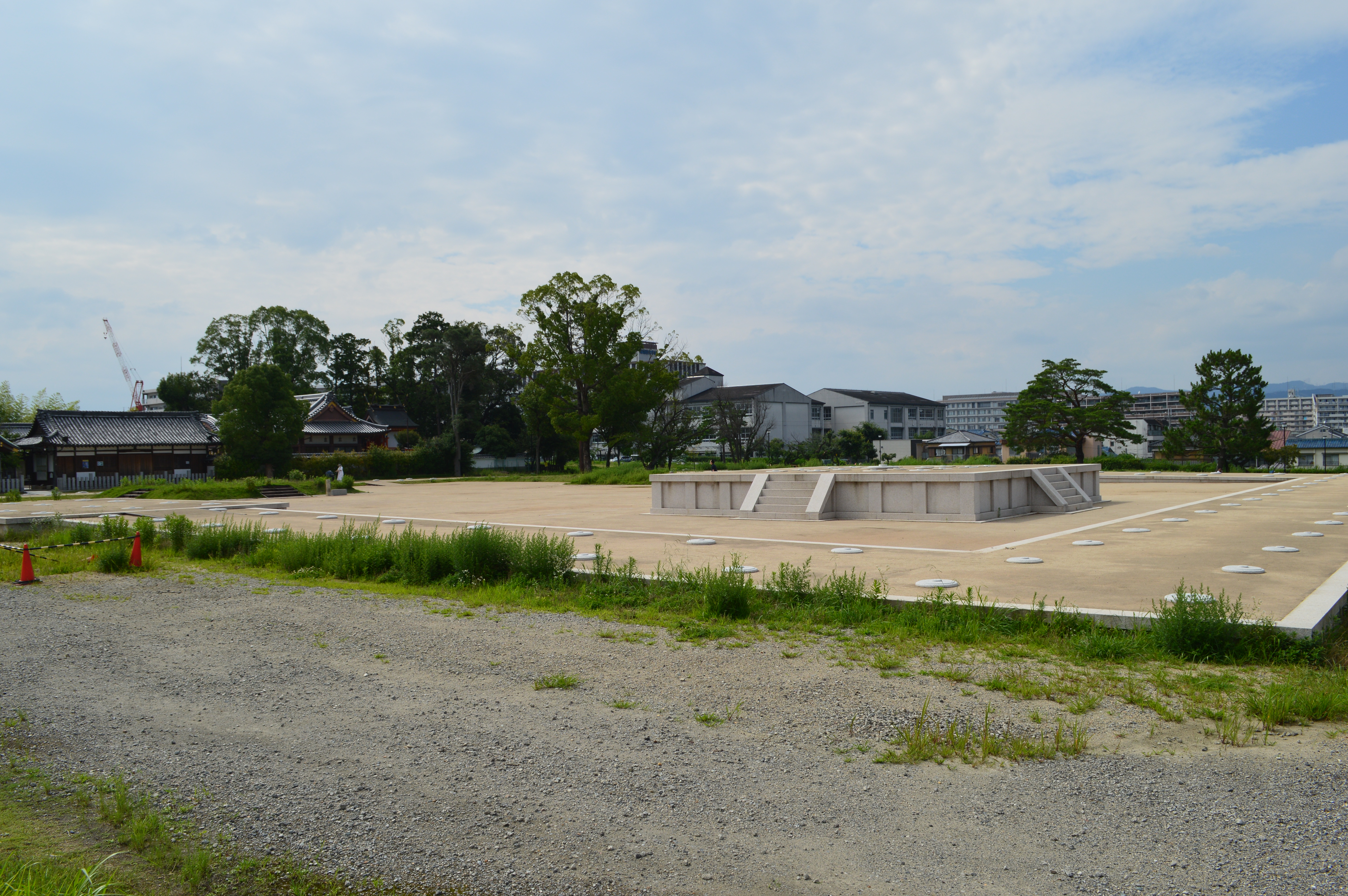
When archaeologists first excavated the site in 1932, they uncovered foundation stones that revealed a grand layout: a South Gate, a Middle Gate, twin pagodas standing side by side, a Main Hall, and a Lecture Hall, all contained within an area approximately 200 meters on each side. The arrangement was initially identified as a "Yakushi-ji style" layout, matching the famous temple in Nara. This discovery was significant enough to earn the site protection as a National Historic Site in 1941. But the story shifted in 1965 when a second excavation revealed a cloister connecting the Main Hall to the Middle Gate -- a feature that made the layout closer to the Kanon-ji temple ruins in Silla, the very kingdom that had conquered Baekje. The temple built by Korean exiles, it turned out, owed its architecture to both sides of the conflict that had driven them from their homeland.
Silence Falls on the Precinct
Kudara-dera was destroyed by fire sometime during the 11th or 12th century. The timing is telling: the Kudara no Konikishi clan disappears from Japan's political records around the same period. Without patrons, the temple was never rebuilt. The forest reclaimed the site, tree roots slowly prying apart the foundation stones that had supported twin pagodas and a lecture hall. By the time modern scholars turned their attention to the ruins, centuries of vegetation had obscured the layout entirely. The 1941 historic site designation offered legal protection, but the physical site continued to deteriorate under tree growth. It took the 1965 excavation -- and the decision to open the site as one of Japan's first archaeological parks -- to transform Kudara-dera from a neglected ruin into a place the public could walk through and understand.
Fragments from the Earth
A third excavation in 2005 brought new discoveries. Archaeologists repairing damage and filling gaps left by the earlier surveys unearthed fragments of a large bas-relief-shaped Buddha statue, a find that deepened understanding of the temple's artistic ambitions. The site today is a quiet park in Hirakata, Osaka, where visitors can walk among the exposed foundation stones and read the plan of a temple that once rivaled Nara's greatest. Adjacent to the ruins stands the Kudaraō Jinja, a Shinto shrine dedicated to the Kudara no Konikishi clan -- a reminder that the family's legacy outlived their temple by centuries. The ruins are about a ten-minute walk from Miyanosaka Station on the Keihan Electric Railway's Katano Line. The designation was upgraded to Special National Historic Site in 1952, placing Kudara-dera among Japan's most significant archaeological treasures.
A Kingdom Remembered in Stone
From the air, the site reads as a rectangular clearing in Hirakata's urban fabric -- a conspicuous absence of buildings where foundation platforms mark the footprints of structures that have not stood for nearly a millennium. The twin pagoda platforms are the most striking features, sitting side by side in an arrangement that once echoed the grandest temples of the Nara period. The story of Kudara-dera is ultimately about survival through transformation: a Korean kingdom preserved in Japanese kanji, a royal lineage reborn as Japanese aristocracy, a gold offering that helped create one of the world's largest bronze statues, and a ruined temple that became a park where anyone can stand on the stones and trace the outline of what exile built.
From the Air
Located at 34.82°N, 135.66°E in Hirakata, Osaka Prefecture, on the eastern edge of the Osaka metropolitan area. The archaeological park appears as a rectangular green clearing amid dense urban development. Best viewed at 2,000-3,000 feet AGL for layout detail. Osaka Itami Airport (RJOO) lies approximately 12 nautical miles to the west-southwest. Kansai International Airport (RJBB) is roughly 40 nautical miles to the south. The site sits in relatively flat terrain along the Keihan Railway corridor between Osaka and Kyoto.