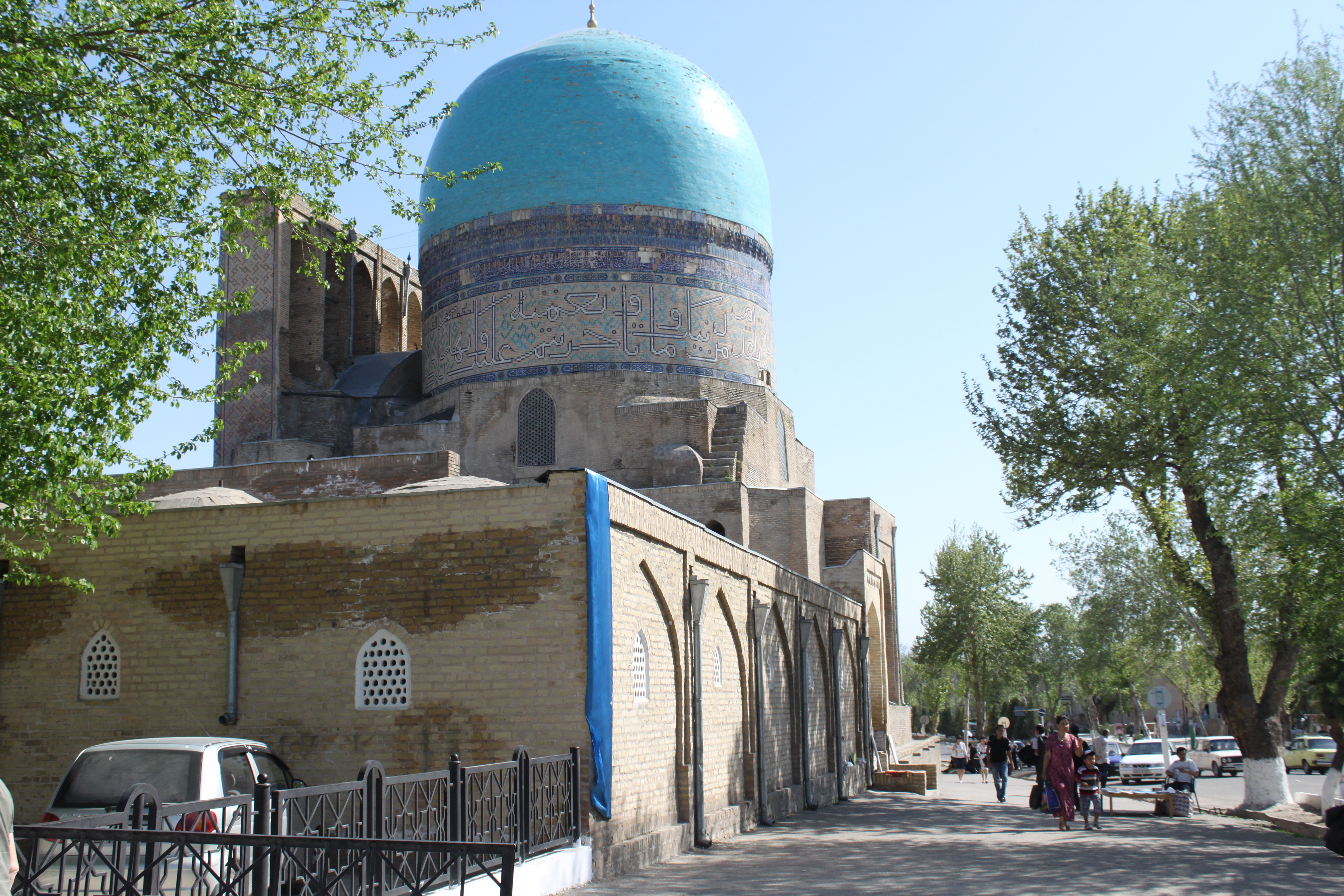
Kuk Gumbaz Mosque
The name says everything you need to know before you walk through the door. Kuk Gumbaz -- Blue Dome. Built in 1434-1435 by Ulug Beg Mirzo, the Timurid prince better known as an astronomer than as a builder, the mosque rises in the southern quarter of Shahrisabz as the centerpiece of the Dorut Tilavat complex. Ulug Beg commissioned it in honor of his father, Shah Rukh Mirzo, and the historical inscriptions in the porch still carry the names of the Timurid dynasty alongside the date of construction. It is a family monument disguised as a house of worship -- or perhaps the reverse.
The Astronomer Builds
Ulug Beg is remembered primarily for the observatory he built in Samarkand, where he produced a star catalog of unprecedented accuracy. But he was also a prolific architectural patron, and the Kuk Gumbaz Mosque demonstrates a different facet of his ambition. The building sits within the Dorut Tilavat ensemble, directly opposite the Gumbazi Sayidon Mausoleum and the Shamsuddin Kulol Mausoleum. The positioning is deliberate: the mosque faces the tombs of revered figures, creating a dialogue between prayer and remembrance. The complex occupies the southern part of Shahrisabz, near the Chorsu shopping complex, grounding Timurid grandeur in the daily commerce of the town.
Geometry in Blue and White
The mosque is square in plan, measuring roughly 12.5 by 12.6 meters, crowned by the dome that gives it its name. Blue tiles cover the outer dome in patterns of blue and white, interspersed with Quranic verses. Inside, the space opens to 12.7 by 12.7 meters. Eight small arches in the interior hall interconnect through rhombic shield-shaped arches, all supported by sixteen structural arches. Four spiral staircases occupy the corners of the brick walls. The building is entered from the east through a 10-meter-wide porch, its pediment thick with geometric decoration. Floral ceramics dress the columns and arches. The tiles are single-layered on both facade and interior, a technique that creates a flatter, more graphic effect than the deeply modeled tilework found on larger Timurid monuments.
Sacred Text as Architecture
The mosque's inscriptions are its most remarkable feature. The dome is lined with mosaic brick tiles bearing text in Kufic script -- the angular, early Arabic calligraphy that lends itself to architectural integration. Verses 1 through 3 of the Quranic Surah al-Fath appear in large white letters against a yellow background in the border band. Below the dome, the text of Surah al-Juma is inscribed in smaller letters on a blue background. On the exterior pediments, the phrase "Allah is great" repeats in Kufic Bannai script, a decorative style where bricks of different colors form the letterforms. Verses 127 and 128 of Surah al-Baqarah appear in thuluth script on a blue field. The building is, in effect, a three-dimensional page of scripture -- text wrapping around the worshiper from dome to doorway.
Repairs That Wounded
The mosque has been renovated several times, not always well. Work in the 1970s addressed structural concerns, but repairs carried out in 1975 and again between 1992 and 1999 damaged some of the original inscriptions. The problem is common in historic Islamic architecture: well-meaning restoration that replaces authentic material with modern substitutes, losing the patina and craft of the original. A more careful renovation in 1995-1996, timed to coincide with the 660th anniversary of Amir Temur's birth, attempted to honor the building's original character. The result is a mosque that carries visible scars from its own preservation -- some inscriptions crisp and clearly modern, others faded and genuine, the two types sitting uneasily side by side. It is an honest record of a difficult truth: keeping old buildings alive sometimes means accepting that parts of them are new.
From the Air
Kuk Gumbaz Mosque is located at 39.05N, 66.83E in the southern quarter of Shahrisabz, Uzbekistan, within the Dorut Tilavat complex. The blue dome is the most prominent feature from above, visible against the surrounding urban grid. Nearest airport: Karshi Airport (UTSL) approximately 89 km southwest. The mosque sits about 1 km south of the Ak-Saray Palace ruins; both sites can be observed in a single low pass over the city. Shahrisabz lies in a valley -- approach from the south for the best view of the dome against the mountain backdrop.