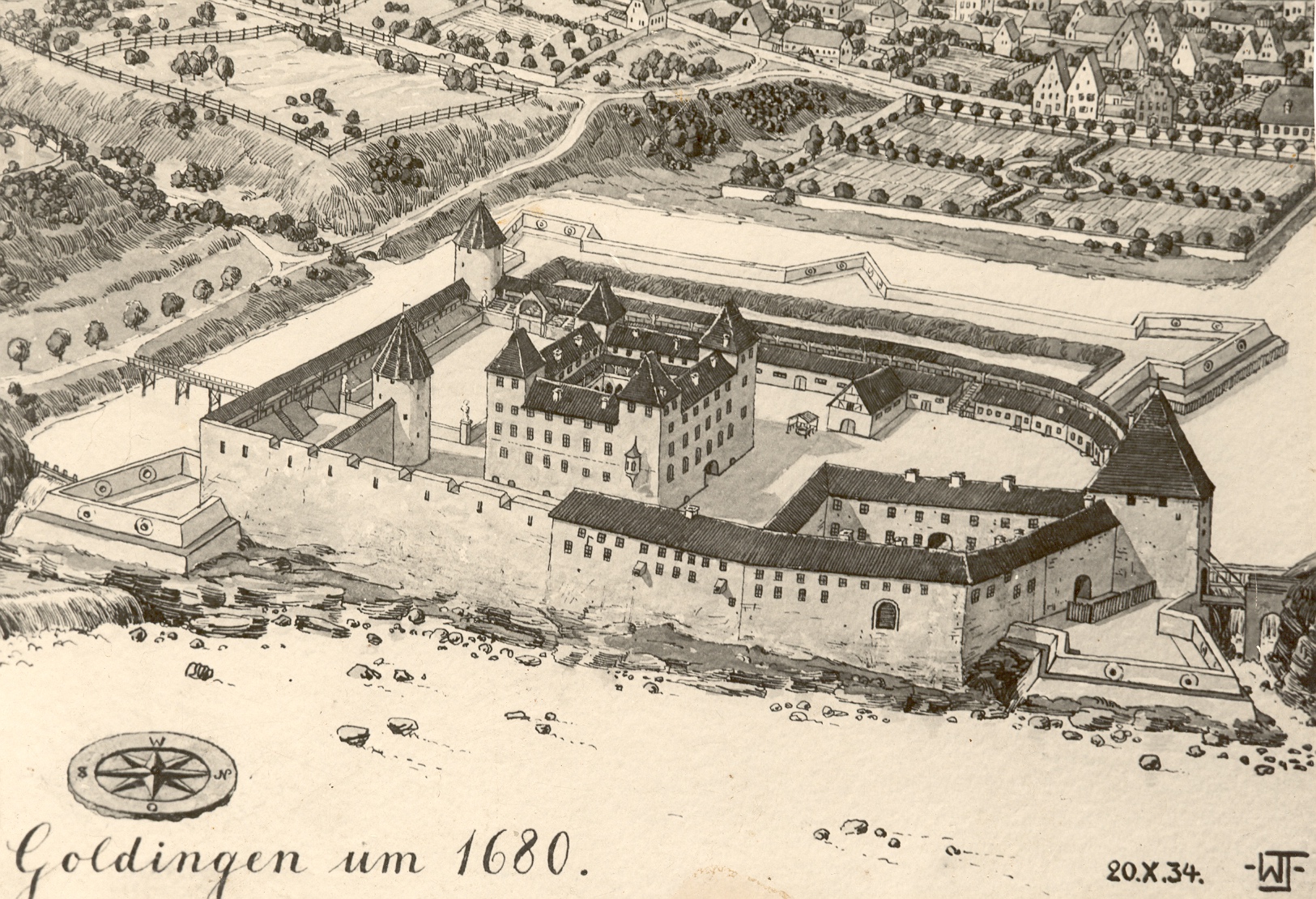
Kuldiga Castle
The Duchess Sophie of Prussia gave birth to a son named Jacob in Kuldiga Castle on October 28, 1610, but never recovered from the ordeal and died nearly a month later on November 24. Her husband, Duke Wilhelm Kettler, buried her beneath the fortress on a cold December day, and decades later, when the castle's glory had faded, Jacob himself ordered his mother's remains transferred to another resting place. Today, nothing visible remains of the castle where Sophie died and Jacob was born. The old Livonian Order stronghold, once the administrative heart of medieval Courland, has vanished so completely that visitors standing in the quiet city park on Rumba Hill might never guess they are walking atop centuries of buried history.
Fortress at the Edge of Christendom
Between 1242 and 1245, crusading knights of the Livonian Order raised a castle they called Jesusburg on the banks of the Venta River, establishing their southernmost outpost against the unconquered peoples of Courland. The Curonians who lived nearby called the place Goldingen, and that name eventually stuck. By 1252, a commander governed from here, and by the end of the century, all friars in Courland answered to the Goldingen Commander. The castle grew into something formidable. During the Livonian Crusades, it served as a military base for campaigns against the Baltic peoples who refused conversion. Regiments assembled here, provisioned with food and ammunition before marching into battle. Five subordinate court districts fell under its jurisdiction, stretching from Aizpute to Durbe. Commanders held the power of life and death over their subjects.
A Duchy's Gilded Residence
When the Livonian Order collapsed and the Duchy of Courland and Semigallia rose in its place, Kuldiga Castle transformed from a crusader outpost into a ducal residence. After Duke Gotthard Kettler died in 1587, his sons divided the realm, and Wilhelm chose Kuldiga as his seat. The castle witnessed lavish entertainments and grim tragedies in equal measure. Duke Jacob, who survived his mother's death in childbirth there, later appointed ambassadors to the court of Louis XIV of France. His son Frederick Casimir Kettler renovated the castle extensively, ordering over 50,000 tiles and 10,000 floor tiles prepared for construction. He even built a zoo in the castle gardens, stocking it with reindeer for hunting parties. The animals survived war and occupation until 1720, when Anna of Russia ordered the last twenty deer transported to Saint Petersburg. All but one died along the frozen autumn roads.
Plundered by Swedes and Abandoned
The Great Northern War wrote the castle's death sentence. In 1701, sensing the approaching storm, Duke Ferdinand Kettler loaded eighteen large carts with furniture, wallpaper, and luxuries, sending them west to Memel under armed guard. He would not return for thirty-seven years. Swedish troops arrived anyway, looting everything left behind so thoroughly that when King Charles XII himself visited in January 1702, he found the castle uninhabitable and lodged instead at a mayor's house on Baznīcas Street. Swedish officers occupied the ruins until 1707. Russian soldiers followed in 1708 and 1709, destroying what the Swedes had missed. By 1711, the surviving objects filled only a single locked room on the third floor. Rain, frost, and mold claimed the rest.
The Slow Dissolution
Abandoned castles near settlements rarely survive intact, and Kuldiga proved no exception. Locals used the crumbling walls as a quarry. The castle mill collapsed first. In 1727, the roof of the northern wing caved in, and cannons still sat rusting on walls that had already partially fallen. The gate tower, forecourt buildings, and sections of the outer wall lay in rubble. A solitary guard lived in a log house in the courtyard, watching over nothing. By 1743, the great ship hall of the convent had collapsed. Yet inside a sealed room on the second floor, forgotten treasures remained: wood carvings bearing the ducal coat of arms, sixteen paintings, gilded leather wallpaper, and an arsenal of 1,014 muskets. By 1801, only towering ruins stood. The governor ordered them demolished, and by 1826, even those had vanished from drawings of the town.
Memory in the Landscape
In the 1960s, Kuldiga's city authorities transformed the former castle grounds into a public park. Today, visitors can find the old castle mill, a guard's house, and the park itself spreading across Rumba Hill near the Venta Rapid. The neighborhood called Putnudarzs, meaning Bird Garden, preserves the memory of Duke Frederick Casimir's zoo, where reindeer once grazed behind 882 fence sections. Somewhere beneath the grass and trees lie the foundations where crusaders prayed, where dukes entertained visiting royalty, and where Duchess Sophie was buried in a basement vault before her son moved her bones. It is possible, the sources suggest, that the ancient glories of Kuldiga Castle survive somewhere in Poland or Germany, carted away on those eighteen wagons in 1701 and never seen again.
From the Air
Located at 56.97N, 21.98E in western Latvia, near the town of Kuldiga. The castle site is now a city park on Rumba Hill, visible near the Venta River and the famous Venta Rapid waterfall. Approaching from the west, follow the Venta River inland. The nearest significant airport is Liepaja (EVLA), approximately 75 km southwest. Ventspils Airport (EVVA) lies about 60 km northwest. Best viewed at 2,000-3,000 feet AGL in clear weather.