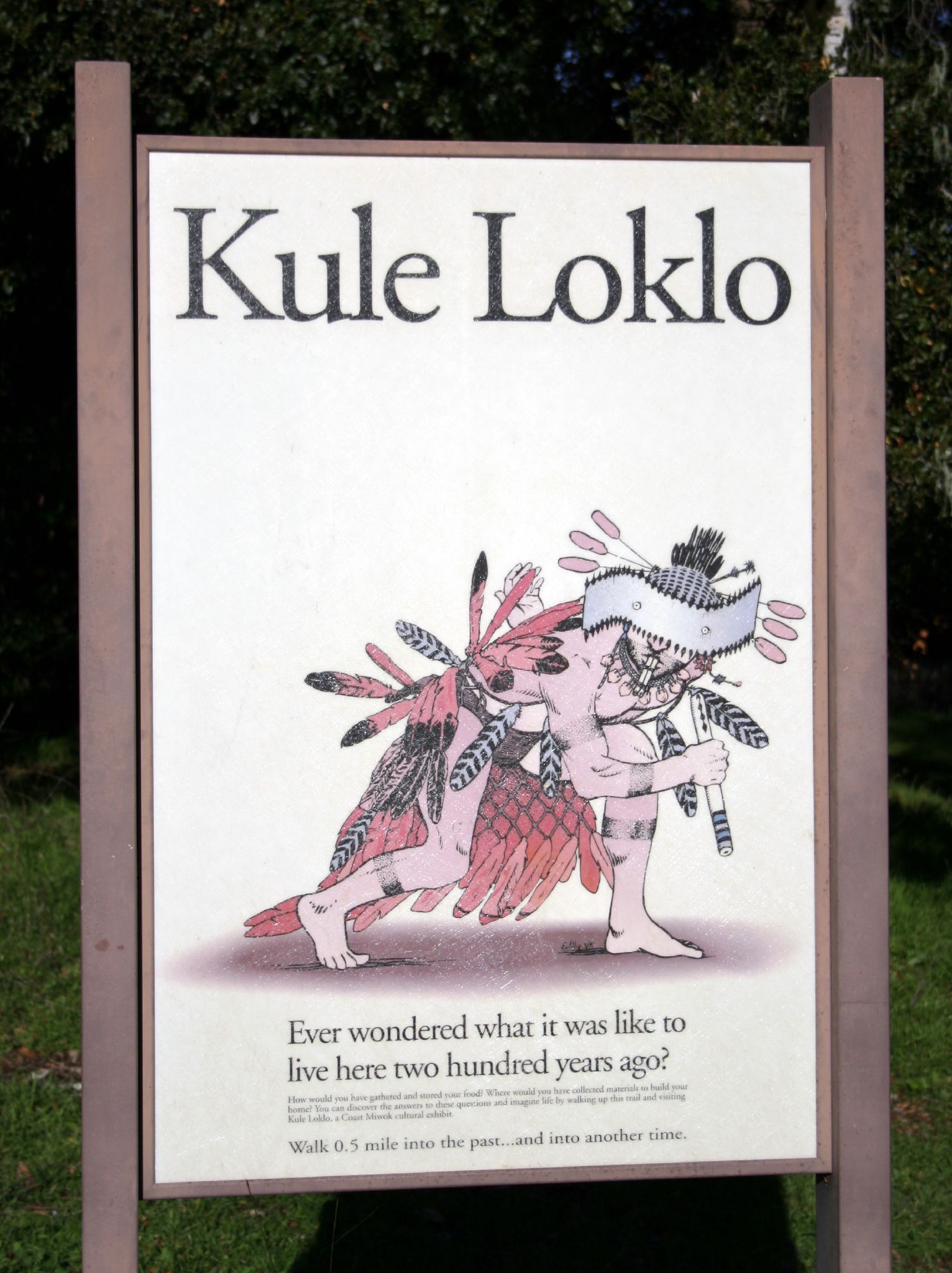
Kule Loklo: The Village That Keeps Returning
The name means "Bear Valley" in the Coast Miwok language, and for thousands of years before Europeans arrived, Miwok people lived in this landscape of oak woodlands and coastal grasslands at the foot of Inverness Ridge. Kule Loklo is a recreated village that attempts to preserve a fragment of that deep history -- tule reed shelters, an acorn granary, a sweat lodge, and a ceremonial roundhouse built using traditional methods. It sits a short walk from the Bear Valley Visitor Center at Point Reyes National Seashore, unassuming enough that many visitors walk past without stopping. Those who do stop find a place that has been built, burned, rebuilt, and left to weather -- a cycle that mirrors the Coast Miwok story itself.
People of the Peninsula
The Coast Miwok occupied the Point Reyes peninsula and much of Marin County for thousands of years before Spanish colonization. They lived in small, semi-permanent villages near the coast, harvesting acorns, fishing, gathering shellfish, and hunting deer and elk. Their territory stretched from Bodega Bay south to the Golden Gate. When Francis Drake landed at nearby Drakes Bay in 1579, the Miwok were likely the Indigenous people he encountered -- his chroniclers described them bringing feathered baskets and other gifts. Spanish missionaries arrived in the late eighteenth century, and the mission system devastated Miwok communities through disease, forced labor, and cultural suppression. By the mid-nineteenth century, the Coast Miwok population had collapsed. The survivors were eventually organized into the Federated Indians of Graton Rancheria, which received federal recognition in 2000.
Built by Hand, Burned by Arson
In the 1970s, the Miwok Archeological Preserve of Marin -- known as MAPOM -- began constructing Kule Loklo as a tribute to Marin County's Indigenous heritage. Volunteers built the village structures by hand using traditional materials and methods: tule reeds bundled and lashed into conical shelters, a semi-subterranean sweat lodge, storage structures for acorns. The centerpiece was a ceremonial roundhouse, the most important structure in Miwok spiritual life, where dances, healing ceremonies, and community gatherings took place. In 1992, an arsonist destroyed the roundhouse. The loss was devastating -- not just as the destruction of a building, but as an attack on a cultural lifeline. The community responded with an outpouring of support, and by 1993 a new, larger roundhouse had been built in its place.
Big Time
Each year in late July, Kule Loklo comes alive during the Big Time festival, an annual gathering that has run for decades. California Indian dancers perform traditional dances in regalia, and Native artisans demonstrate basket weaving, flint knapping, and other crafts that connect present-day Indigenous communities to ancestral skills. The festival draws Coast Miwok descendants and members of other California tribes, along with visitors who come to watch and learn. Big Time is not a reenactment or a museum program -- it is a living cultural event organized by and for Indigenous people, held in a place built to honor their ancestors. The festival's persistence, year after year, is itself a statement: the culture that colonization tried to erase is still here.
Weathering and Memory
As of recent years, Kule Loklo has fallen into disrepair. The roundhouse rebuilt after the 1992 arson now shows its age -- sagging walls, weathered tule, structural concerns. The National Park Service has acknowledged the deterioration but restoration has been slow. The village sits in a meadow surrounded by Douglas fir and bishop pine, quietly returning to the landscape. There is something fitting, if bittersweet, about a place built from natural materials slowly being reclaimed by nature. Tule shelters were never meant to last forever; the Miwok built and rebuilt them as needed. Kule Loklo's cycle of construction, destruction, and decay is not a failure of preservation. It is, in its way, an authentic expression of the material culture it was built to represent -- temporary structures in a landscape that endures.
From the Air
Kule Loklo is located at 38.05N, 122.80W in the Bear Valley area of Point Reyes National Seashore, Marin County, California. The village site is nestled in a meadow near the Bear Valley Visitor Center, not visible from altitude due to tree cover, but the Bear Valley trailhead parking area is identifiable. The Point Reyes peninsula itself is distinctive from the air -- a triangular headland separated from the mainland by the linear trace of the San Andreas Fault visible as Tomales Bay to the north and Olema Valley to the south. Nearest airport is Gnoss Field (KDVO) in Novato, approximately 18 nm east. San Francisco International (KSFO) is about 28 nm southeast. Fog is common on the outer coast but Bear Valley is often sheltered.