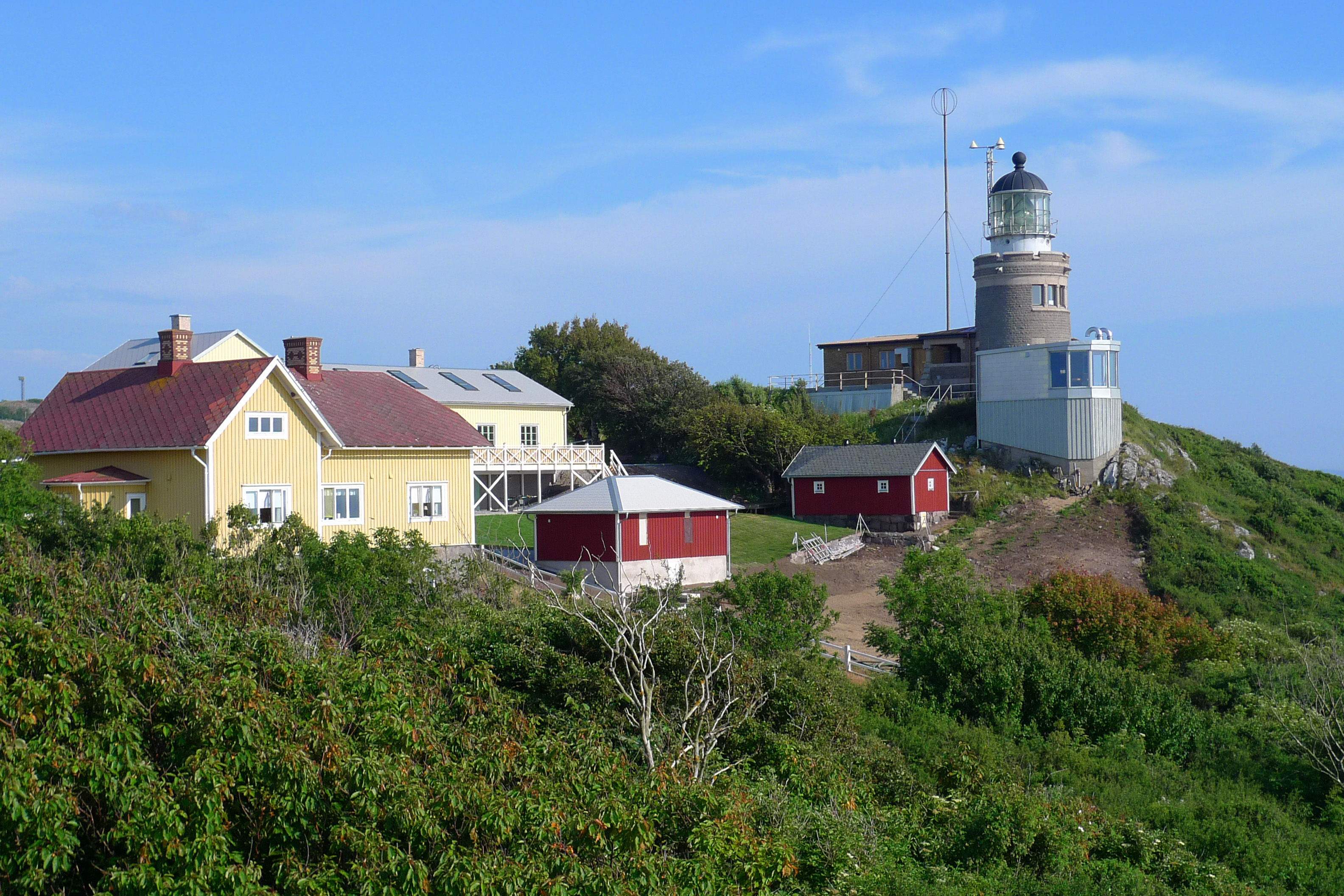
Kullen Lighthouse
Every five seconds, a flash of white light reaches out across 27 nautical miles of dark water. The Kullen Lighthouse stands where it has stood for over four centuries, perched on the dramatic cliffs of the Kullaberg peninsula, watching over the mouth of the Oresund where the Baltic Sea meets the Kattegat. This is Scandinavia's oldest lighthouse location and its most powerful beacon, a 1,000-watt eye that never sleeps.
A Light Through the Ages
Danish King Fredrik II ordered the first beacon lit here in 1561, a simple 'parrot lighthouse' with an iron fire casket mounted twenty feet above the ground. By 1563, the Danes had built a stone tower with twelve candles. Then came covered lanterns in 1585, coal fires from 1624, and eventually oil and kerosene. The technologies changed, but the mission remained constant: guide ships safely through one of the world's busiest maritime corridors. Sweden gained this coastline from Denmark in 1658, but the light kept burning regardless of which crown claimed the cliffs below.
French Engineering on Swedish Stone
The present lighthouse arrived in pieces during the summer of 1900. The French company Barbier & Barnard had built something extraordinary: three massive first-order Fresnel lenses, each 2.58 meters in diameter, weighing six metric tons combined. Named for physicist Augustin-Jean Fresnel, whose lens design revolutionized lighthouse technology in the 1820s, the assembly originally rotated on a bath of 50 liters of liquid mercury, completing four revolutions per minute. The mercury was finally replaced with modern bearings in September 2016, ending over a century of quicksilver spinning in the lantern room.
The Highest Light in Sweden
The lighthouse itself stands just 15 meters tall, but the Kullaberg cliffs do the heavy lifting. The focal plane sits 78.5 meters above sea level, making Kullen the highest-located lighthouse in Sweden. That elevation, combined with the massive Fresnel lenses and the 1,000-watt electric bulb, produces a beam visible from distances that seem almost impossible. Ships approaching the Oresund from the North Sea can pick up Kullen's flash long before they see the Swedish coast. The lighthouse was automated in 1979 and is now remotely controlled from Norrkoping. The last keeper departed in 1996.
Where the Cliffs Meet the Sea
The Kullaberg Nature Reserve surrounds the lighthouse, a rugged landscape of sea cliffs and ancient forest that harbors rare species found nowhere else in Sweden. Hiking trails crisscross the peninsula, leading to dramatic overlooks and hidden coves. Three kilometers to the southeast lies the harbor town of Molle, a former fishing village that became a fashionable bathing resort in the early 1900s. The combination of natural beauty and maritime heritage makes this corner of Scania one of Sweden's most visited coastal destinations, though the lighthouse itself remains the undisputed star.
From the Air
Located at 56.30N, 12.45E on the tip of the Kullaberg peninsula in southwestern Sweden. The lighthouse is clearly visible from the air, positioned on dramatic cliffs overlooking the Oresund strait. Look for the distinctive white tower at the peninsula's point. The resort town of Molle lies just southeast. Nearest airports include Angelholm-Helsingborg (ESTA) approximately 20 nautical miles southeast, and Copenhagen (EKCH) across the water to the south. Best viewed at lower altitudes to appreciate the cliff formations and the contrast between the white lighthouse and the dark forested peninsula.