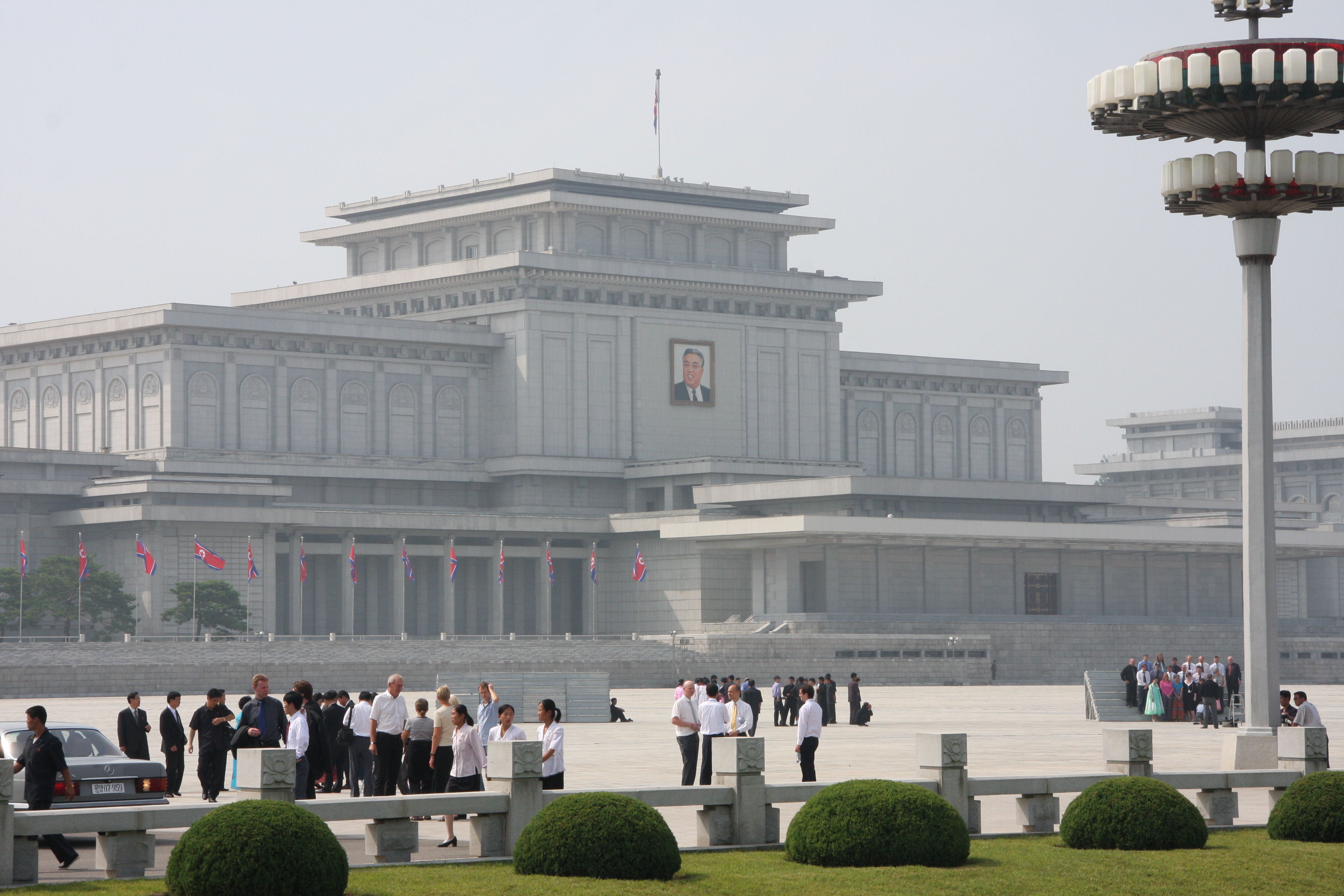
Kumsusan Palace of the Sun
Before you reach the bodies, you pass through a machine that blows dust off your clothes. This detail -- clinical, absurd, deeply revealing -- captures the nature of the Kumsusan Palace of the Sun better than any architectural description. Built in 1976 as Kim Il Sung's official residence and transformed after his death in 1994 into a mausoleum costing an estimated $100 million to $900 million, the palace now preserves the embalmed remains of both father and son in crystal sarcophagi. It is the largest mausoleum dedicated to a Communist leader in the world, and the only one that houses two.
From Residence to Reliquary
The building began as the Kumsusan Assembly Hall, Kim Il Sung's official home and government center. When the elder Kim died on July 8, 1994, after collapsing from a heart attack at the age of 82, his son Kim Jong Il ordered the building transformed into a permanent memorial. The news of Kim Il Sung's death was withheld from the public for two days. What followed was a period of intense national mourning and a conversion project of extraordinary expense. Kim Il Sung was embalmed and placed in a glass sarcophagus, his head resting on a traditional Korean buckwheat pillow, his body draped with the flag of the Workers' Party of Korea. He was posthumously designated 'Eternal President,' a title that remains constitutionally enshrined.
The Ritual of Entry
Visiting the palace is less a museum tour than a secular pilgrimage with strictly enforced liturgy. Foreign visitors are permitted only on official government tours. Photography is forbidden inside. Upon entering through an underpass near a tram stop, visitors walk over shoe-cleaning devices, check all personal belongings except wallets, and receive numbered claim tickets. They then proceed along a series of long moving walkways -- travelators stretching through halls up to one kilometer long, some of the marble corridors seemingly endless. Visitors pass a three-dimensional portrait of the Kims with Mount Paektu in the background, then stop at a yellow floor line for a moment of imposed contemplation. Small speaker devices narrate the grief of the Korean people. Bronze busts of mourning figures line the walls.
Two Fathers, One Palace
When Kim Jong Il died in December 2011, the ritual was repeated. His body lay in state for ten days, then anchored a 40-kilometer funeral procession lasting three hours. Russian embalming experts were brought in, just as they had been for Lenin, Mao, and Ho Chi Minh before. On February 16, 2012 -- the 70th anniversary of Kim Jong Il's birth -- the building was formally renamed the Kumsusan Palace of the Sun. A military parade celebrated the relaunch. Kim Jong Il's remains now occupy a separate room on a lower level, positioned in a sarcophagus nearly identical to his father's, surrounded by his personal vehicles, outfits, and medals. The symmetry between the two displays is deliberate: father and son, eternal president and eternal general secretary, their cult of personality preserved literally in perpetuity.
Gifts from an Implausible World
Adjoining rooms display awards and gifts Kim Il Sung received from around the world, a collection that maps the strange geometry of Cold War diplomacy. Photographs show meetings with Mao Zedong, Fidel Castro, Josip Broz Tito, Erich Honecker, and Jimmy Carter. A peace medal from Japan sits next to a Soviet medal for victory over Japan. Among the degree certificates on display, only one comes from a Western university: Kensington University in California, an unaccredited institution that was eventually shut down by state regulators. The detail is unintentionally revealing -- a reminder that the curated grandeur of the palace, at 115,000 square feet bordered by a moat, rests on foundations that do not always bear close examination.
From the Air
The Kumsusan Palace of the Sun is located at 39.063°N, 125.789°E near the northeast corner of Pyongyang. The large white building is surrounded by extensive grounds and bordered by a moat on its northern and eastern sides. It is one of the city's most prominent structures from the air. Nearest airport: Pyongyang Sunan International Airport (ZKPY/FNJ). North Korean airspace is heavily restricted.