Kunduchi Ruins
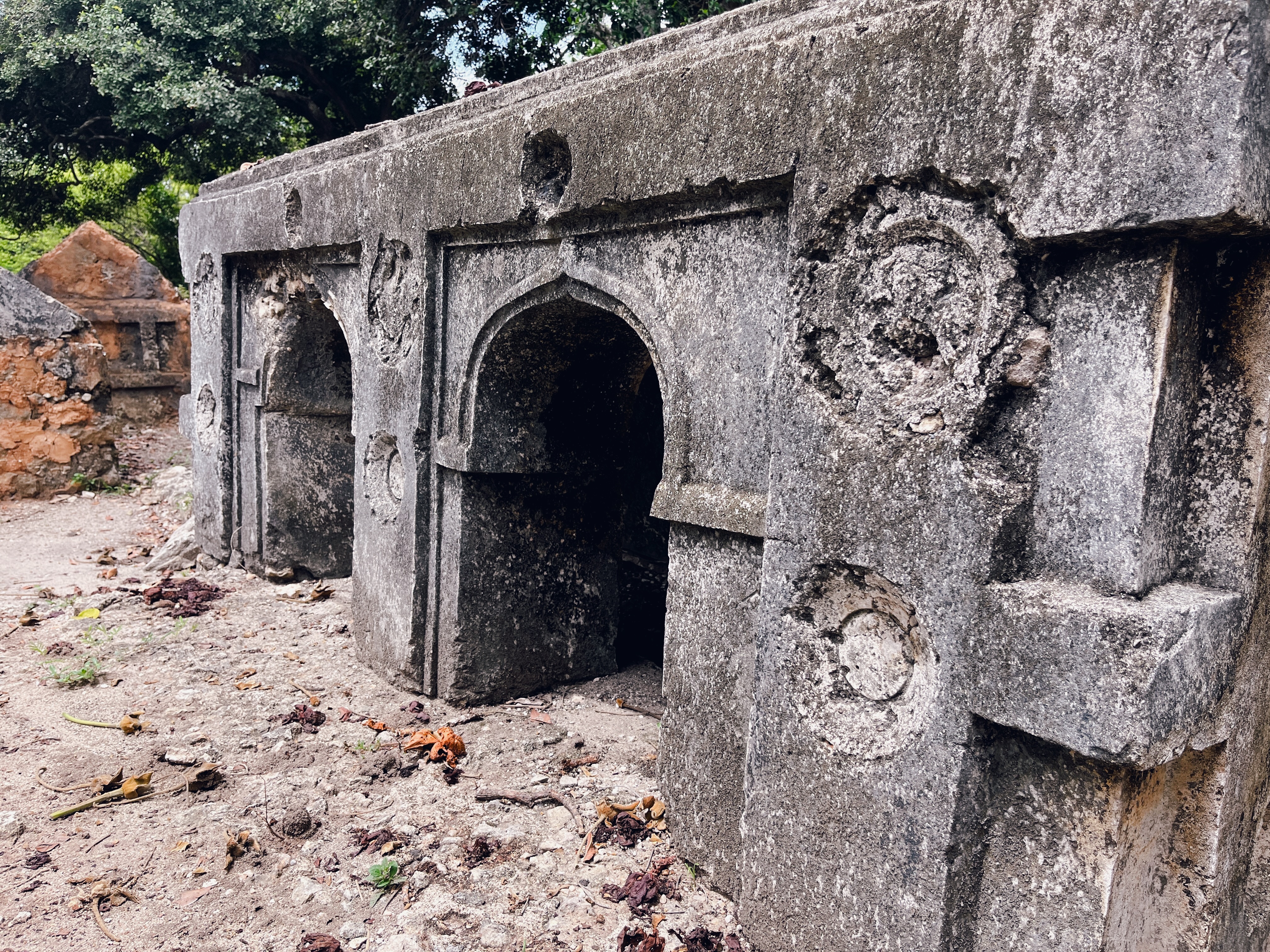
Embedded in the weathered stone of a pillar tomb at Kunduchi, a piece of Ming dynasty porcelain catches the equatorial light. It has been there for centuries, set into the tomb's surface as a mark of honour for the person buried beneath. Dozens more pieces -- bowls, plates, fragments of blue-and-white ceramic -- adorn the graves scattered through a baobab woodland on the outskirts of Dar es Salaam. They are not museum pieces behind glass. They are part of the architecture itself, mortared into coral stone tombs that constitute the largest collection of pillar tombs in East Africa. Each piece of porcelain is evidence of a medieval trade network that connected this stretch of Tanzanian coast to the imperial court of China.
Iron, Coral, and the Debli Mystery
Kunduchi's earliest inhabitants were ironworkers, farmers, fishers, and herders who were part of the broader Swahili coast cultural world stretching from the Rufiji Delta to Mafia Island. Archaeological evidence -- slag deposits and Early Iron Working pottery -- confirms iron production on the site. Oral traditions attribute Kunduchi's founding to the Debli people, a Bantu Muslim community whose origins and fate remain unknown. The Debli are said to have built mosques at several locations along the Tanzanian coast, including Kunduchi, Tongoni, and Mbweni. A tantalising connection survives in the name Makunduchi, a settlement in southern Zanzibar whose Hadimu residents claim their ancestors came from the mainland settlement and carried its name across the water. Kunduchi's mosque dates to approximately 1500 CE. Stone construction appears to have ended around the start of the 16th century, when the Portuguese arrived and established a monopoly on luxury trade goods like gold and ivory, disrupting the commercial networks that had sustained the settlement.
Porcelain from the Middle Kingdom
Chinese texts document several Ming dynasty expeditions to the East African coast, including voyages in 1417-1419 and 1421-1422 CE that describe African territories, coastal towns, and the boats connecting interior and shoreline. Kunduchi was part of this trading world. The porcelain adorning its tombs is not merely decorative -- it was a statement of wealth, status, and connection to distant powers. Different tomb styles reflect different ways of honouring the dead: some have pillars topped with porcelain bowls, some feature stepped platforms, others carry star-shaped stone embellishments. One tomb alone bears approximately 35 pieces of Chinese porcelain in various sizes. The earliest certain written record of the Swahili language comes from this site -- the tomb of Sultan Shaf la-Haji, dated to 1670-1671 CE, inscribed with the name of his father Mwinyi Mtumaini. This predates the earliest Swahili manuscripts of definite date, letters written by the Sultan of Kilwa between 1711 and 1728, by nearly half a century.
Buried and Forgotten, Then Found Again
When Richard Burton passed through this area in the 19th century, he mentioned Kunduchi but said nothing about its mosque, its tombs, or the Chinese pottery adorning them. Vegetation had likely swallowed the ruins. The site's only major archaeological investigation came in the late 1980s, when Adria LaViolette and colleagues from the University of Dar es Salaam ran field school excavations over two seasons in 1987-1988. They dug test pits in the northwest corner of the mosque, surveyed old Swahili sites between Dar es Salaam and Bagamoyo, and documented the tombs in detail. What they found pushed Kunduchi's habitation back to at least the 10th century: potsherds from the Tana ware tradition, Sasanian Islamic ceramics, bead grinders, slag, and a copper coin from an early Sultan of Kilwa. Earlier settlement layers, evidenced by daub with pole and stick impressions, suggest human presence from the first millennium CE. Glass beads, spindle whorls, pendants, and imported pottery from pre-Islamic through 10th-century periods confirm cultural continuity across centuries.
A Thousand Years in Baobab Shadow
Kunduchi's timeline reads like a condensed history of the Swahili coast itself. Early ironworking communities gave way to a trading settlement connected to Sasanian Persia, Near Eastern markets, and eventually Ming China. The settlement flourished from the 12th through the 16th century, fell into isolation for roughly two hundred years after the Portuguese disrupted Indian Ocean commerce, then revived in the 18th century when the majority of its stone tombs were constructed. Today the ruins sit within Kunduchi ward in Dar es Salaam's Kinondoni District, a National Historic Site of Tanzania managed by the Department of Antiquities. Baobab trees -- some of them centuries old themselves -- shade the tomb precinct, their swollen trunks dwarfing the coral stone pillars. It is one of the most significant and least visited archaeological sites on the Tanzanian coast, a place where a single fragment of blue-and-white porcelain tells you more about medieval globalisation than any textbook could.
From the Air
Located at approximately 6.66S, 39.22E in Kunduchi ward, Kinondoni District, on the coast north of central Dar es Salaam. From altitude, the ruins are situated in a baobab woodland near the shoreline, north of the city's urban sprawl. Nearest airport is Julius Nyerere International Airport (HTDA), approximately 25 km to the south. The Msasani Peninsula and Kunduchi Beach are nearby landmarks. Bagamoyo lies further north along the coast. The site is close to the Indian Ocean shoreline and may be partially obscured by vegetation from high altitude.