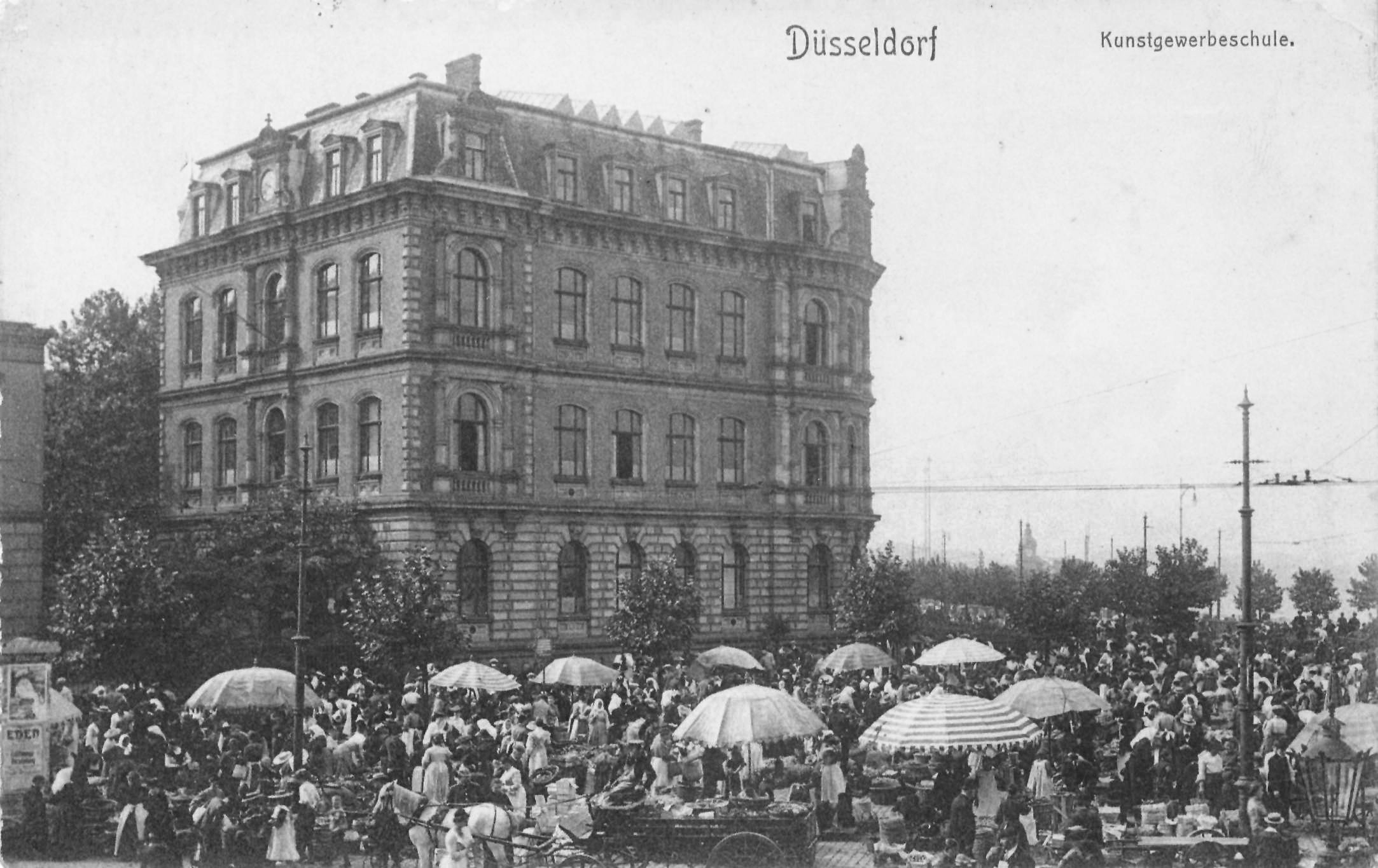
Kunstgewerbeschule Düsseldorf
Most schools of applied arts in the late 19th century taught the same patient curriculum: freehand drawing, geometric drawing, ornamental form theory. Dusseldorf's was no exception when it opened on 3 April 1883. What set the Kunstgewerbeschule on Burgplatz apart was a four-year stretch beginning in 1903, when a young architect named Peter Behrens arrived as director and quietly turned a craft school into a laboratory for the 20th century.
Burgplatz, 1883
The school occupied a new building on Burgplatz in the Dusseldorfer Altstadt, just steps from the old castle tower and the Rhine. Funding came from the city of Dusseldorf, with a state subsidy that grew from 7,830 marks a year at the start to 30,000 marks by 1900. Three departments handled the work — a pre-school, a technical school, an evening school — and the curriculum stayed close to the craft tradition: lettering courses started in 1905, taught by a student of the British calligrapher Edward Johnston, drawing from across the German Reich. The first director, the architect Hermann Stiller, ran the place from 1884 to 1903 with the kind of steady competence that almost no history book remembers.
Peter Behrens Walks In
In 1903 Behrens was 35, a former painter turning toward design and architecture, and Dusseldorf hired him as director. He overhauled the teaching staff almost immediately, bringing in Rudolf Bosselt, Fritz Helmuth Ehmcke, and Max Benirschke. He repositioned the school against the Dusseldorf Art Academy across town. He kept the place for only four years. In 1907 the industrialist Emil Rathenau hired him away to AEG, where Behrens designed everything from electric kettles to factory buildings to corporate logos — work now recognized as the founding act of modern industrial design. The Dusseldorf years are easy to skip in his biography. They shouldn't be. Behrens was already arguing in his classrooms that the designer's job was to give industry a coherent visual language, and he was training students to do it.
Wilhelm Kreis and the Architecture School
Behrens's successor was Wilhelm Kreis, who took over in 1908 and stayed until 1919. In 1909 Kreis established a Special Architecture Department within the school — three classes, each with a focus. Fritz Becker ran the class for simple bourgeois construction: workers' housing, country houses, small town halls, churches for small towns. Emil Fahrenkamp took the interior design and building detailing class. Kreis taught monumental architecture himself. Around these he layered four more classes — architectural history and urban planning, sculpture under Hubert Netzer, garden art that required prior attendance at a state gardening school, and a separate drawing class for women led by Josef Bruckmuller. Almost without intending to, the Kunstgewerbeschule had stopped being an arts-and-crafts school and become a school of architecture.
The War, and What Survived
The First World War gutted the institution. Teachers were drafted; Kreis himself went into military service. Student numbers collapsed. In 1917 the art historian Richard Klapheck was called away to the Kunstakademie, and although several teachers including Fahrenkamp returned from the front, the damage was done. Several departments closed. The school's last year was 1918. In 1919 its most valuable remaining piece — the architecture program — was absorbed into the Kunstakademie Dusseldorf, lecturers, students, and all. The Burgplatz building survived. Since 2005 the Akademie-Galerie, a venue of the Kunstakademie, has used about 650 square meters of it for exhibitions, including shows on the academy's professors after 1945. The Kunstgewerbeschule lasted 35 years. What Peter Behrens started in four of them lasted considerably longer.
From the Air
The former Kunstgewerbeschule building stands on Burgplatz at 51.2268 N, 6.7715 E, in the Dusseldorf Altstadt on the east bank of the Rhine. From low altitude look for the old castle tower (Schlossturm) at the river's edge — the school's brick building is directly adjacent on the inland side, a few hundred meters south of the Kunstakademie. Nearest airport is Dusseldorf International (EDDL/DUS) about 7 km north.