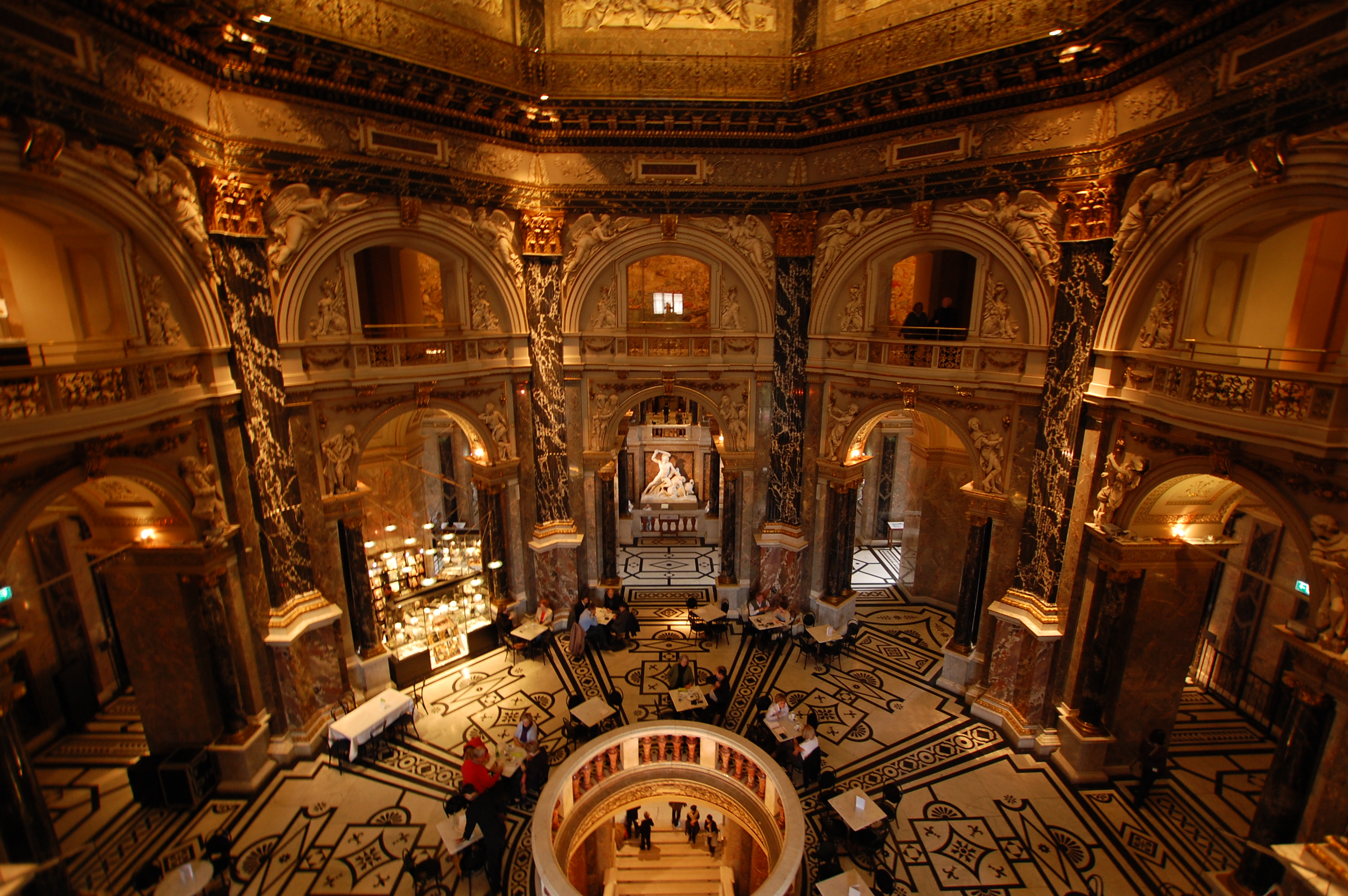
Kunsthistorisches Museum
Vermeer's The Art of Painting hangs in a room where Gustav Klimt painted the ceiling. That single juxtaposition captures what makes the Kunsthistorisches Museum extraordinary - it is not merely a container for art but a work of art itself, a building where the architecture competes with the collection for the viewer's attention. Emperor Franz Joseph I opened the museum in 1891, fulfilling a promise to house the Habsburg family's centuries of acquisitive obsession under one roof and make it available to the public. The twin building across Maria-Theresien-Platz holds the Natural History Museum, a mirror image in sandstone and dome. Together they frame a monument to the idea that an empire's greatness is measured by what it collects.
A Palace for Paintings
Gottfried Semper and Karl von Hasenauer designed both museums between 1871 and 1891, working in a Renaissance Revival style that announced its ambitions through sheer scale. The rectangular buildings feature sandstone facades lined with arched windows, topped by octagonal domes rising 60 meters high. Inside, marble, stucco, gold leaf, and murals create an environment that makes the act of looking at art feel ceremonial. The grand stairway is the building's most photographed interior - and for good reason. Gustav Klimt, his brother Ernst, and Franz Matsch painted the spandrel and intercolumnar pictures between 1890 and 1891, early works that show Klimt before he broke with academic convention. These murals depicting the history of art from Egypt to the Renaissance are themselves now among Vienna's most valued artworks, inseparable from the building they adorn.
The Habsburg Eye
The collection reflects the tastes and rivalries of generations of Habsburgs. Ferdinand of Tyrol assembled portraits and armor. Emperor Rudolf II gathered one of history's great curiosity cabinets, though much of it was later scattered. Archduke Leopold Wilhelm built the Italian painting collection so systematically that he commissioned David Teniers the Younger to document it in the Theatrum Pictorium, one of art history's first illustrated catalogs. The result is a picture gallery that spans the breadth of European painting. Bruegel dominates an entire room: The Tower of Babel, The Hunters in the Snow, Children's Games, The Peasant Wedding - the museum holds the world's largest collection of his work. Raphael's Madonna of the Meadow, Caravaggio's Madonna of the Rosary, Vermeer's The Art of Painting, and Velazquez's portraits of the Spanish Habsburgs represent just the most famous canvases in a collection that runs to thousands.
The Salt Cellar Caper
On May 11, 2003, someone climbed scaffolding on the museum's exterior, smashed a window, and stole the Cellini Salt Cellar - a gold-and-enamel sculpture by Benvenuto Cellini valued at over 50 million euros. The theft of the Saliera, as Austrians call it, became the country's greatest art heist and a national obsession. Police recovered it nearly three years later, on January 21, 2006, buried in a box in a forest near the town of Zwettl. The thief, a security alarm technician, had acted alone and eventually led investigators to the hiding spot. The salt cellar returned to display with new security measures and considerably more fame than it had enjoyed before. Sometimes theft is the best publicity.
Contested Canvases
The museum's collection carries the weight of 20th-century history. In 2010, an Austrian government panel recommended restituting two altar panels by Maerten van Heemskerck to the heirs of Richard Neumann, a Jewish art collector in Vienna whose works were plundered during the Nazi era. Five years later, a dispute erupted between Poland and Austria over Bruegel's The Fight Between Carnival and Lent. Poland presented evidence that the painting had been seized by Charlotte von Wachter, wife of Krakow's Nazi governor, during the German occupation. The museum countered that it had owned the painting since the 17th century and that the seized work was a different picture. These cases illustrate how Europe's great museums continue to reckon with wartime looting, a process that remains legally complex and emotionally charged decades after the fact.
Once in a Lifetime
From October 2018 through January 2019, the museum staged Bruegel - Once in a Lifetime, the largest exhibition of Pieter Bruegel the Elder's work ever assembled. The event drew visitors from around the world to see paintings that almost never travel - many are too fragile, too valuable, or too central to their home institutions' identities. The exhibition underscored the Kunsthistorisches Museum's unique position: because the Habsburgs collected Bruegel so early and so extensively, Vienna is the only city where such a show could be mounted from primarily its own holdings. The documentary filmmaker Johannes Holzhausen captured the museum's inner workings in The Great Museum in 2014, revealing the labor behind those calm galleries - the conservators, curators, and craftspeople whose work ensures that what the Habsburgs gathered over centuries survives for centuries more.
From the Air
The Kunsthistorisches Museum sits at 48.204°N, 16.362°E on the Ringstrasse in central Vienna. Its octagonal dome and that of its twin, the Natural History Museum, are visible landmarks from altitude, flanking Maria-Theresien-Platz. Vienna International Airport (LOWW/VIE) lies 18km southeast. The museum is within the Ringstrasse loop on the southwestern side, near the Hofburg Palace complex. The distinctive paired domes help orient viewers to the Burgring section of the Ring.