The Art Circle That Outlasted Its Empire
The stained glass was looted in 1999. That single fact tells you everything about the journey of the Kunstkring Art Gallery -- a building designed to be the cultural heart of early twentieth-century Batavia, reduced to a gutted shell during the turmoil of the Asian financial crisis, and then painstakingly restored to something approaching its original purpose. Standing at the gateway to Jakarta's Menteng neighborhood, the Kunstkring was built in 1914 by Dutch architect P.A.J. Moojen as a civic landmark -- a place where the colonial elite could gather, view exhibitions, and affirm that their outpost in the East Indies was as cultured as any European capital. Today the building houses both a fine dining restaurant and an art gallery, and one of its rooms is dedicated to Raden Saleh, the pioneering Indonesian romantic painter who proved, long before the Kunstkring existed, that the colony's artistic ambitions ran deeper than its colonizers imagined.
Concrete and Ambition
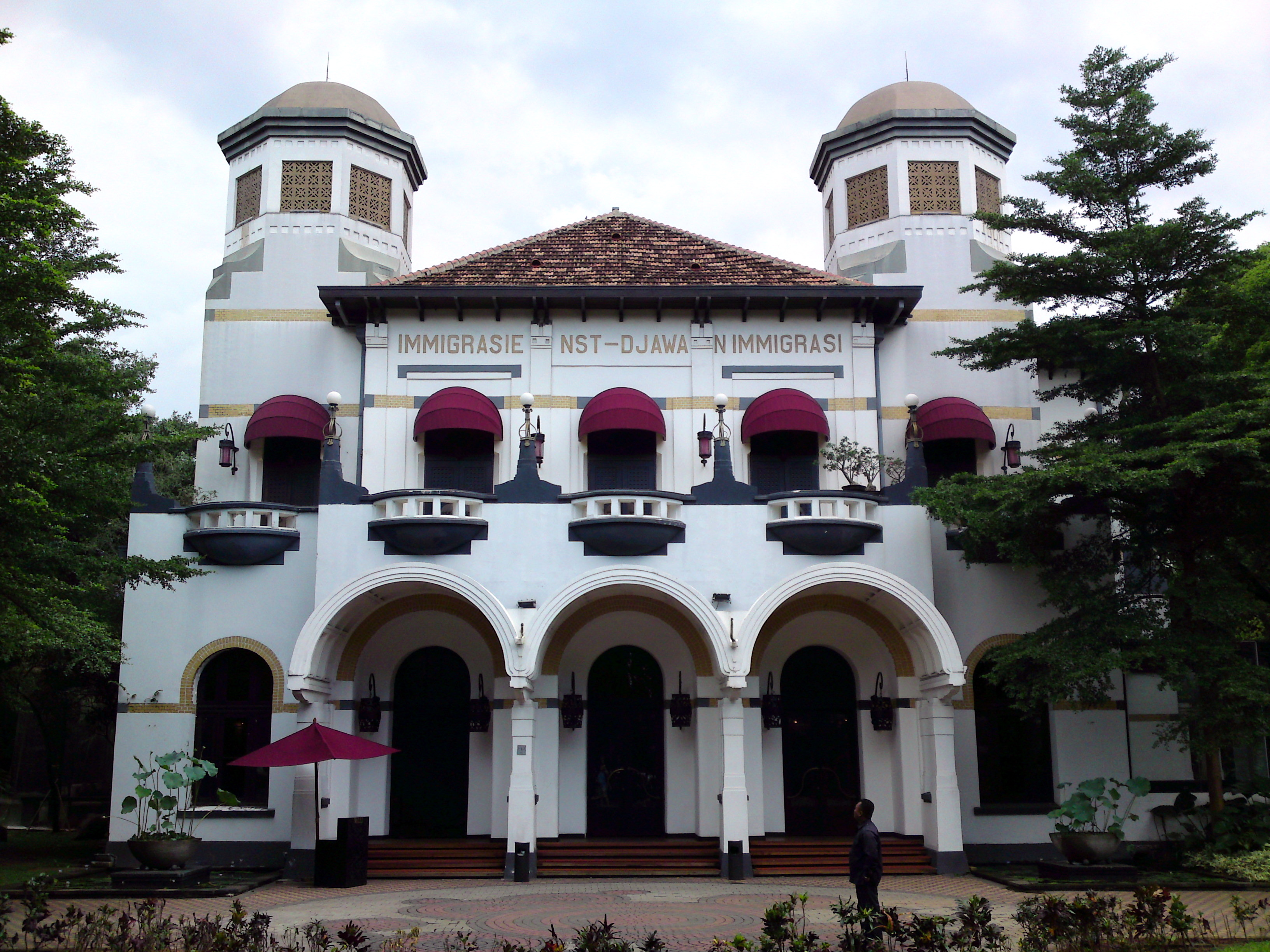
The Kunstkring was the second building Moojen designed in Jakarta, and it was meant to announce something. Positioned to welcome visitors entering the new Menteng residential area -- the leafy, planned neighborhood that housed the colonial upper class -- the gallery declared that Batavia was no mere trading post. It was a city with an art circle, a kunstkring, and the building to prove it. Architecturally, Moojen employed what would become known as the New Indies Style, a rationalist approach that broke with the older Dutch Indies country houses with their deep verandas and tropical adaptations. The Kunstkring was emphatically modern: it was the first building in Indonesia to use reinforced concrete. Its main facade featured three entrance doors flanked by symmetrically designed windows, with five balconied openings on the upper floor connected by balustrades that unified the composition. Two towers anchored the structure. The business model was pragmatic beneath the cultural veneer -- the lower floor was rented to commercial tenants, generating the cash flow that kept the art circle operating upstairs.
A Century of Changed Hands
The Nederlandsch Indische Kunstkring -- the Dutch East Indies Art Circle -- administered the building for decades, using the lower floor's smaller rooms as offices while the upper floor hosted exhibitions and receptions. Independence changed the building's context but not immediately its function. The real damage came later. In 1999, during the social upheaval that followed the fall of Suharto, the interior was looted. The original decorative lamps vanished. The stained glass windows were smashed and carried off. The lower floor, which had consisted of a large room surrounded by smaller offices, was gutted and converted into a single open space -- an act of renovation that erased the original spatial logic. The dark wood paneling that once lined the interior survived in fragments. For years the Kunstkring sat diminished, its towers intact but its purpose hollowed out.
Restoration and the Ghost of Raden Saleh
In 2011, restoration began. Two years later, the Tugu Group reopened the building as Tugu Kunstkring Paleis, understanding -- or at least claiming to understand -- the original purpose of the space. The upper floor was reconverted into a gallery exhibiting works by Indonesian artists, completing a circle that had been broken for over a decade. Downstairs, the commercial logic Moojen built into the design reasserted itself: the main hall became a fine dining restaurant, decorated with antiques and art collections that the Tugu Group describes as embodying the soul and romance of Indonesia. One room on the gallery floor is dedicated to Raden Saleh, the nineteenth-century Javanese painter who studied in Europe, exhibited alongside Delacroix and Vernet, and returned to the Dutch East Indies as proof that Indonesian artistic talent needed no colonial permission to flourish. That his work now hangs in a building originally designed for the Dutch art circle adds a layer of irony the architect could not have anticipated.
Standing at the Gateway
Menteng remains one of Jakarta's most prestigious neighborhoods, its tree-lined streets and colonial-era houses a world apart from the traffic-choked arteries that surround it. The Kunstkring still anchors the approach, though the visitors it welcomes today bear no resemblance to the colonial society that once paraded through its doors. The large staircase on the building's side still connects the two floors. The towers still stand. The reinforced concrete -- revolutionary in 1914 -- still holds. What the building lost to looting and neglect it has partially recovered through restoration, though the missing stained glass and lamps are permanent absences. The Kunstkring is neither ruin nor pristine landmark. It is something more interesting: a building that has been broken and reassembled, its function restored but its scars visible, a testament to how culture persists in a city that reinvents itself relentlessly.
From the Air
Located at 6.19S, 106.83E in Central Jakarta's Menteng neighborhood. The building is a relatively small heritage structure not individually visible from high altitude, but the Menteng area is identifiable as a green, tree-lined residential district south of Merdeka Square. The National Monument (Monas) is approximately 1.5 km to the north-northwest. Nearest major airport is Soekarno-Hatta International Airport (WIII), roughly 25 km northwest. Halim Perdanakusuma International Airport (WIIH) is about 12 km southeast. At lower altitudes, look for the two towers and the distinctive colonial facade amid Menteng's residential streets.