
Kunstmann
Valdivia smells of rain and river water, and somewhere underneath that, of malt. The city sits where three rivers braid together near the Chilean coast, a place that Germans began settling in the 1850s, hauling their language, their architecture, and their thirst for good beer across an ocean. The first brewer here was Carlos Anwandter, who opened his Cervecería Anwandter in 1851. More than a century later, in a house on the edge of town, another German-Chilean family started experimenting in their kitchen. The neighbors approved. So did the relatives. That kitchen hobby became Kunstmann, and Kunstmann became the beer that most of Chile now pictures when it pictures the rainy south.
An Ocean Carried Across in Recipes
The German colonization of Valdivia, Osorno, and Llanquihue reshaped southern Chile in the second half of the 19th century. The settlers cleared forest, built timber houses with steep roofs to shed the relentless rain, and recreated the institutions of home, including the brewery. Anwandter's operation became a fixture of Valdivian life, a working link to the Bavarian and northern-German traditions the immigrants had left behind. Then, on a Sunday afternoon in May 1960, the largest earthquake ever recorded struck just offshore. The magnitude 9.5 Valdivia earthquake leveled much of the city and destroyed the old Anwandter brewery. The tradition survived in memory and habit, waiting for someone to pick it back up.
From the Kitchen to Torobayo
In the late 1980s and early 1990s, the Kunstmann family began brewing at home, the way thousands of enthusiasts do, except that the results kept getting better. By 1997 the operation had outgrown the family house. The Kunstmanns moved production to Torobayo, on the outskirts of Valdivia, and opened a small restaurant and factory they simply called "La Cervecería." The location mattered as much as the recipe. Kunstmann brews according to the spirit of the Reinheitsgebot, the German purity law that limits beer to malt, water, hops, and yeast, and the clean water that drains out of the surrounding hills became part of the product. What started as a side road brewery with a few tables would, within a few years, sit at the center of a craft beer movement Chile hadn't really had before.
Patagonia, Then a Name of Its Own
Exports began almost immediately. In 1998, Kunstmann shipped its first bottles abroad to Germany and the United States, and by 2001 the beer had reached the demanding Japanese market. For a while those exports carried the label "Patagonia," a romantic, geographic name aimed at foreign shelves. In 2002 the family dropped it. They wanted one identity, recognizable everywhere, and that identity was the family surname itself. The bet paid off. By 2003 Kunstmann had taken a measurable slice of the Chilean market and was brewing tens of thousands of hectoliters a month. That same year, the giant Compañía de Cervecerías Unidas bought a 49 percent stake and folded its distribution muscle behind the brand, creating the modern Compañía Cervecera Kunstmann S.A. while the family kept its name on every label.
A Festival in the Rain
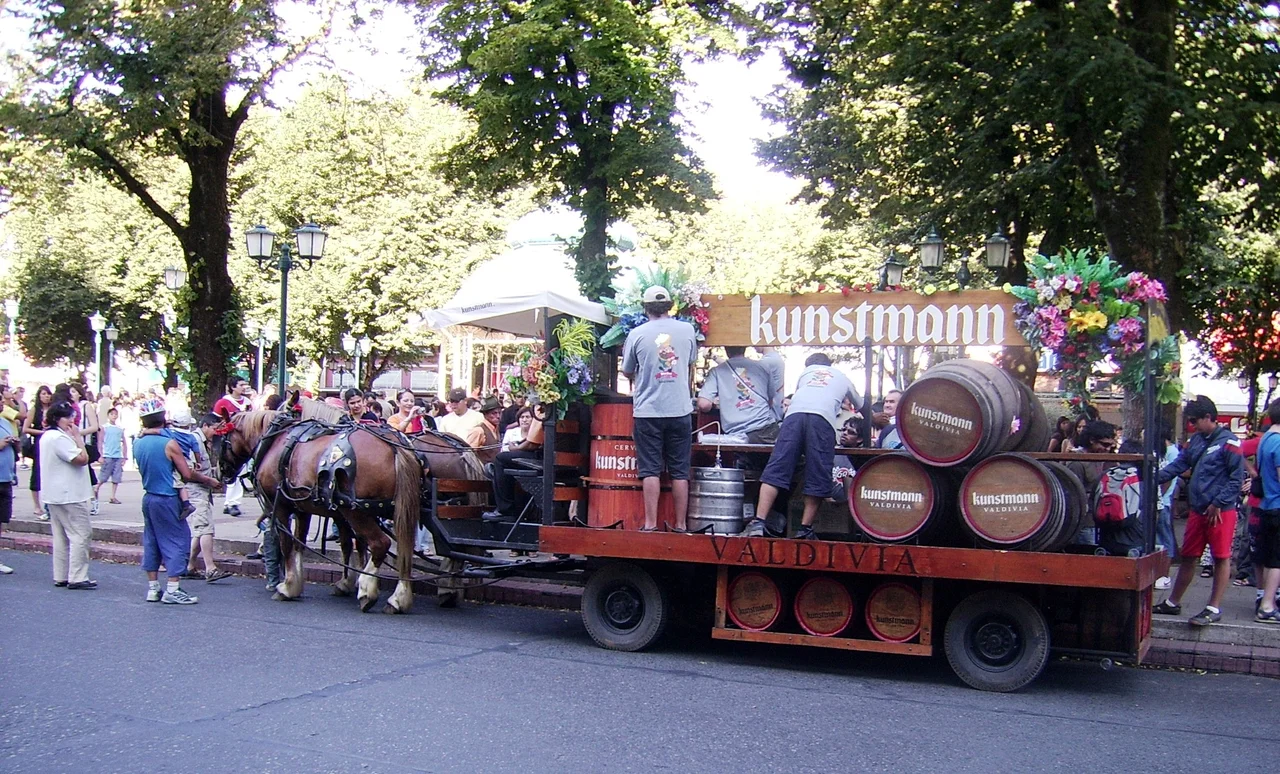
Kunstmann never stopped trading on heritage, and its clearest expression is a party. Since 2002 the brewery has thrown the Bierfest Kunstmann each summer, usually at the turn of January into February, modeled openly on Munich's Oktoberfest and drawing crowds from across Chile and beyond. It is a deliberate act of cultural preservation dressed up as a good time, a way of keeping the German thread in Valdivia's identity bright and visible. The beers themselves tell the same story in miniature, from the original Lager and the copper-red Torobayo pale ale to the dark Bock, plus seasonal oddities sweetened with local Ulmo honey or blueberries. A brewery that began as a family experiment now functions as one of the city's loudest reminders of where its people came from.
From the Air
Kunstmann's brewery sits in Torobayo on the edge of Valdivia at roughly 39.84 degrees south, 73.28 degrees west, in Chile's Los Ríos Region. The nearest airport is Pichoy Airport (ICAO: SCVD), about 32 km northeast of the city, with scheduled flights from Santiago, Puerto Montt, and Temuco. From the air, look for the broad braided rivers and estuary that define Valdivia where the Calle-Calle, Cau-Cau, and Valdivia rivers meet before reaching the Pacific. The region is famously wet and often overcast, so the best visibility comes in the drier summer months of December through March.
Nearby Stories
- Riñihuazo 24 km away
- Lago Ranco 35 km away
- Villarrica 57 km away
- Sinking of Janequeo and Leucotón 91 km away
- La Imperial 95 km away
- Puyehue-Cordón Caulle 115 km away
- Isla Mocha 131 km away
- Battle of Agüi 224 km away