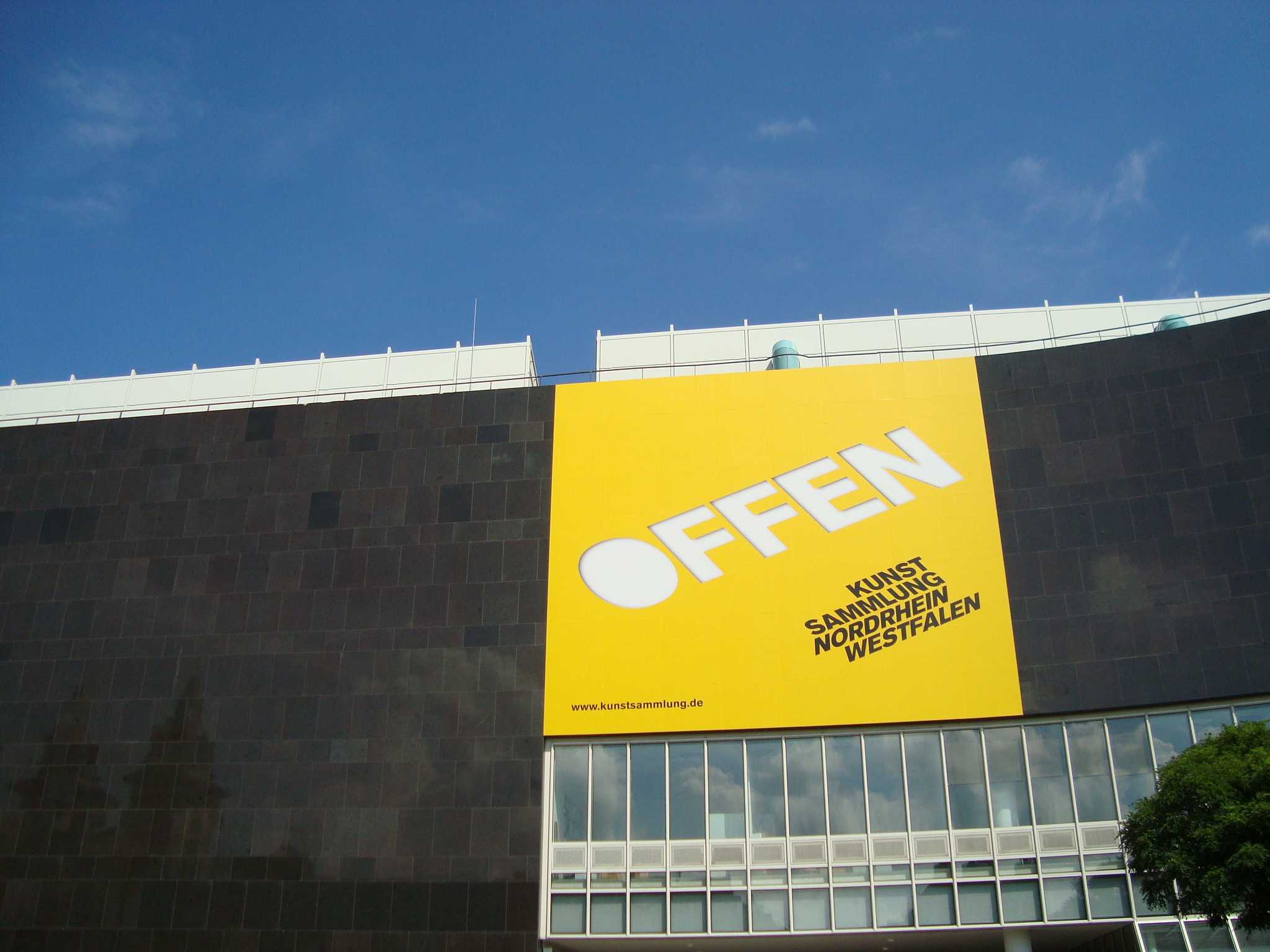
Kunstsammlung Nordrhein-Westfalen
In 1960, the state of North Rhine-Westphalia spent 6 million Deutsche Marks on 88 works by Paul Klee. The seller was the estate of G. David Thompson, a Pittsburgh steel manufacturer; the dealer brokering it was Ernst Beyeler of Basel. At the time, the price seemed extravagant. Today it looks like the bargain of the century. Those 88 Klees — drawings, paintings, color studies on paper — became the nucleus of an institution that critics at Der Spiegel would later call the heimliche Nationalgalerie, the secret National Gallery.
Black Granite on Grabbeplatz
Walk to the corner of Grabbeplatz and the K20 announces itself in a single sweep: a curved facade of polished black Bornholm granite that the Copenhagen office of Dissing+Weitling drew in the early 1980s, working in the tradition of Arne Jacobsen. The building opened on 14 March 1986 with President Richard von Weizsacker in attendance, and ever since the dark stone curve has been an emblem of the city. Inside, the Grabbe Halle rises 14 meters with no supporting pillars, holding 600 square meters of unbroken floor for the largest temporary shows. A 2010 extension added the Klee Halle and the Konrad und Gabriele Henkel Galerie, about 2,000 square meters more. During the first two weeks after the reopening, nearly 60,000 visitors came through on free admission.
K21 in a Parliament Building
On 18 April 2002 the collection got a second home, and its history is the kind a city only gets once. The Standehaus am Kaiserteich was built between 1876 and 1880 by Julius Raschdorff in heavy neo-Renaissance style, originally as the seat of the Provincial Diet of the Prussian Rhine Province. After 1949 it became the parliament of the new state of North Rhine-Westphalia, and lawmakers met there for nearly forty years until 1988, when the Landtag moved to its modern building down by the harbor. The Standehaus sat empty for fourteen years. Then the Munich architects Kiessler+Partner threaded an elongated cloister-vault dome of 1,919 glass panels over the central piazza, stripped the interior, and turned the old parliament into a museum of contemporary art with 5,300 square meters of exhibition space.
What Hangs on the Walls
The collection's range surprises people who only know the building from outside. Before 1945 it spans Fauvism, Expressionism, Cubism, Pittura Metafisica, Dada, Surrealism, and the Blaue Reiter. There are twelve Picassos covering almost every phase of his career, with works by Braque, Leger, and Juan Gris filling out the Cubist room. The American postwar wing holds about 40 major pieces — Rothko, Warhol, Rauschenberg, Judd, and Pollock's mural-sized Number 32 from 1950, one of the few drip paintings of that scale. European postwar is equally deep: Markus Lupertz, Per Kirkeby, Gerhard Richter, Emil Schumacher, and Joseph Beuys, whose late Palazzo Regale was acquired in 1992. The Klee count has grown from 88 to about 100. The Bechers and the rest of the Dusseldorf School of Photography are well represented.
Schmela Haus, Hornet, and a Third Door
A third venue arrived in 2009 when the Kunstsammlung took over the former Galerie Schmela in the Altstadt. The five-story building, made of gray pumice and finished in 1971, was designed by the Dutch architect Aldo van Eyck — the first structure in West Germany built specifically as a private art gallery, now under landmark protection. It operates as a rehearsal stage and lecture venue, with exhibitions resuming in 2011. Outside the K20's rear facade, on the newly created Paul Klee Platz, runs Hornet, a 27-meter mosaic mural by the American artist Sarah Morris, installed in 2010 from colorful tiles. Three buildings, more than 10,000 square meters of exhibition floor, and a library of more than 100,000 volumes now bearing the name of founding director Werner Schmalenbach, who built the whole thing — beginning with those Pittsburgh Klees.
From the Air
The K20 sits at Grabbeplatz in central Dusseldorf at roughly 51.2272 N, 6.7756 E, near the Altstadt and a short walk from the Rhine. The K21 in the Standehaus is about 1.5 km south at the Kaiserteich. The Schmela Haus is at Mutter-Ey-Strasse 3 in the Altstadt. From low altitude look for the dark curved facade of K20 north of the Kunsthalle on the same square. Nearest airport is Dusseldorf International (EDDL/DUS) about 7 km north.