Kuon-ji
Two hundred and eighty-seven stone steps, worn smooth by centuries of sandaled feet, climb straight up the forested slope of Mount Minobu. The stairway is called the Bodaitei -- the stairway to enlightenment -- and it has been here since 1652. Pilgrims chant as they ascend, their voices mingling with the rustle of cedar and the distant ringing of the temple's great bell. At the top, the massive Hondo main hall and the five-story pagoda of Kuon-ji appear through the trees, the spiritual heart of Nichiren Buddhism and the place where its founder spent the last nine years of his life writing, teaching, and shaping a religious tradition that endures across Japan today.
A Hermit's Retreat Becomes a Seminary
Nichiren arrived in this remote mountain valley in 1274, fresh from banishment on the island of Sado and a fruitless return to Kamakura, the seat of Japan's military government. He came at the invitation of the magistrate Nambu Sanenaga, one of his converts, whose clan held ancestral estates in Kai Province. What began as a simple hermitage quickly outgrew itself. Disciples gathered, and in 1281 Nichiren formally founded the temple he named Minobu-san Hokke-in Kuon-ji. More than half of all surviving letters written by Nichiren date from these years at Minobu, ranging from personal counsel to followers to two of his five major theological writings: the Senji Sho and the Hoon Sho. The mountain retreat became the intellectual engine of his movement, a place of both contemplation and rigorous scholarship.
Ashes Carried Home
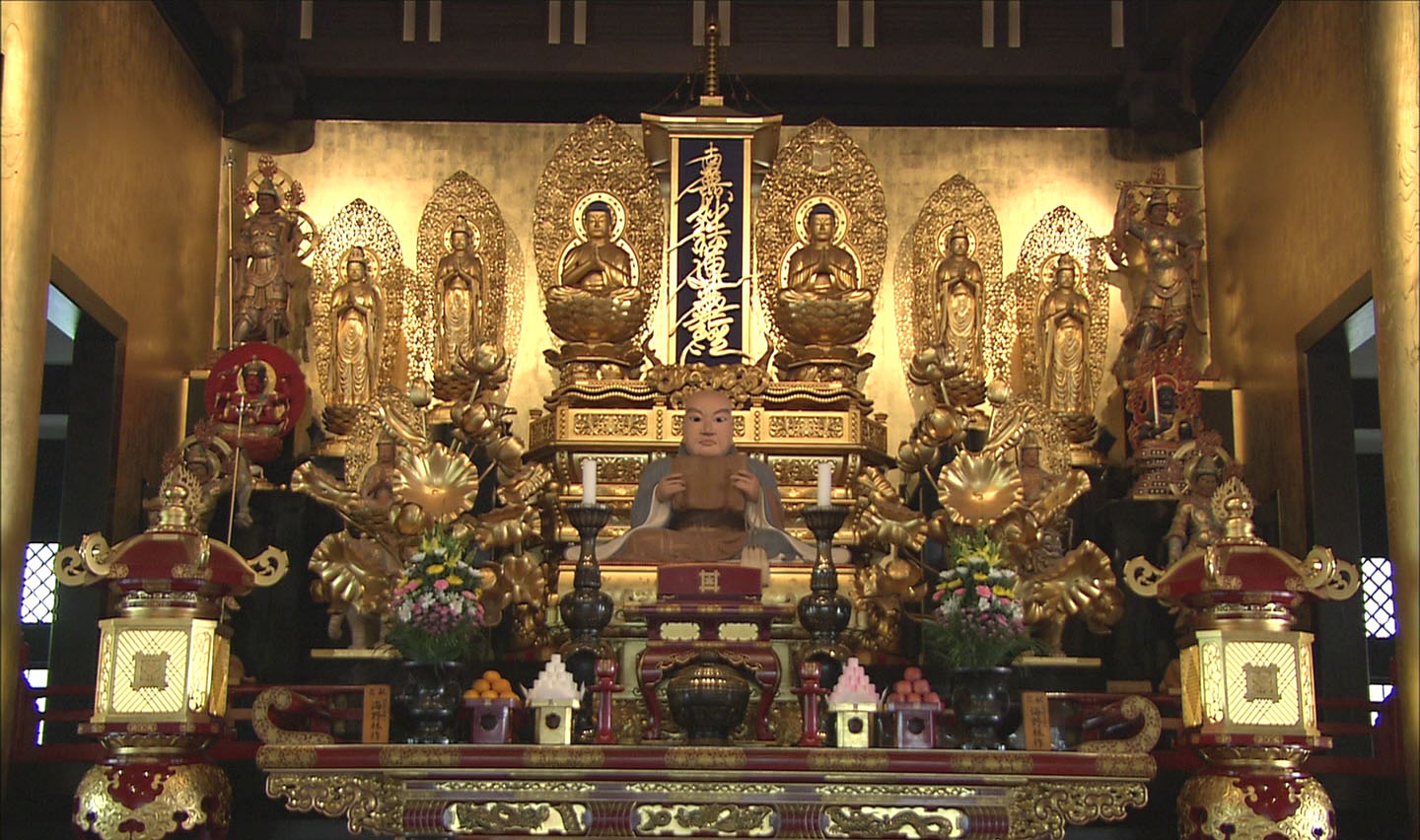
In 1282, Nichiren fell gravely ill. His followers urged him to travel to a hot spring for treatment, and he set out from Minobu. He made it only as far as the home of a disciple in Ikegami, on the outskirts of what is now Tokyo, where he died. Following his explicit wishes, his ashes were carried back up the mountain to Kuon-ji and enshrined in a mausoleum on the temple grounds. That mausoleum remains the most sacred site in Nichiren Buddhism. The temple at Ikegami, known as Ikegami Honmon-ji, serves as the sect's administrative center today, but Kuon-ji holds the founder's remains and his spiritual authority. The seminary continues to train Nichiren Shu priests, carrying forward a teaching lineage that began in a mountain hermitage more than seven centuries ago.
A Hundred and Thirty-Three Chapels, Then Fire
Through the Sengoku and Edo periods, Kuon-ji grew into a sprawling pilgrimage complex. By 1712, the temple grounds contained 133 separate chapels. Then fire came, again and again: in 1744, 1776, 1821, 1824, 1829, 1865, and 1875. Seven devastating blazes in little more than a century destroyed much of the original architecture. What stands today is rebuilt but no less grand. The present Hondo is an enormous wooden structure housing the inner sanctuary. The five-story pagoda rises above the cedar canopy. The great belfry's bell carries across the valley. In 2018, nineteen of the temple's buildings were designated as Registered Tangible Cultural Properties of Japan, acknowledging that even the reconstructed structures represent centuries of craft and devotion.
Treasures from Song China
Among the temple's most remarkable possessions is a 13th-century hanging scroll painting on silk attributed to the Southern Song dynasty artist Hu Zhifu, designated a National Treasure of Japan and now kept at the Tokyo National Museum. The temple library holds a 1276 manuscript of 13 volumes of Chinese poetry from the Heian period, copied from a text once owned by the regent Hojo Tokimune at the Kanazawa Bunko library. A Song dynasty copy of the Book of Rites, discovered in the Kuon-ji collection by the journalist and historian Tokutomi Soho, fills a gap in a manuscript held at Kanazawa Bunko. Three Kamakura-period hanging scrolls depicting the eight phases of Buddha's life round out the collection. These artifacts reveal a temple that served not only as a place of worship but as a crossroads of East Asian literary and artistic culture.
Cherry Blossoms and Chanting Pilgrims
Over 1.5 million people visit Kuon-ji each year. Most arrive by bus or car at the base of the Bodaitei stairway and begin the climb, though a ropeway also ascends to the summit of Mount Minobu behind the temple. In spring, thousands of cherry trees bloom across the grounds, including a century-old weeping cherry that draws photographers from across Japan. The blossoms drift down like pink snow over the stone paths and weathered wooden buildings. But the temple's deepest draw remains spiritual. Each morning, the sound of sutra chanting fills the Hondo as priests and pilgrims recite passages from the Lotus Sutra, the central text of Nichiren Buddhism. The rhythm of those voices, rising through incense smoke into the vaulted ceiling, connects the present moment to a tradition Nichiren set in motion on this same mountainside in 1274.
From the Air
Located at 35.382°N, 138.425°E on the slopes of Mount Minobu in the Fuji River valley of Yamanashi Prefecture. The temple complex and its five-story pagoda sit within dense forest cover on the mountain's eastern face. The Fuji River corridor running north-south is a key visual landmark. Mount Fuji rises prominently to the east-southeast. Nearest airports: Matsumoto Airport (RJAF, ~100 nm northwest) and Mt. Fuji Shizuoka Airport (RJNS, ~50 nm south). Tokyo Haneda (RJTT) is approximately 65 nm east. Best viewed at lower altitudes following the Fuji River valley, where the temple grounds and surrounding cedar forest become visible against the mountainside.