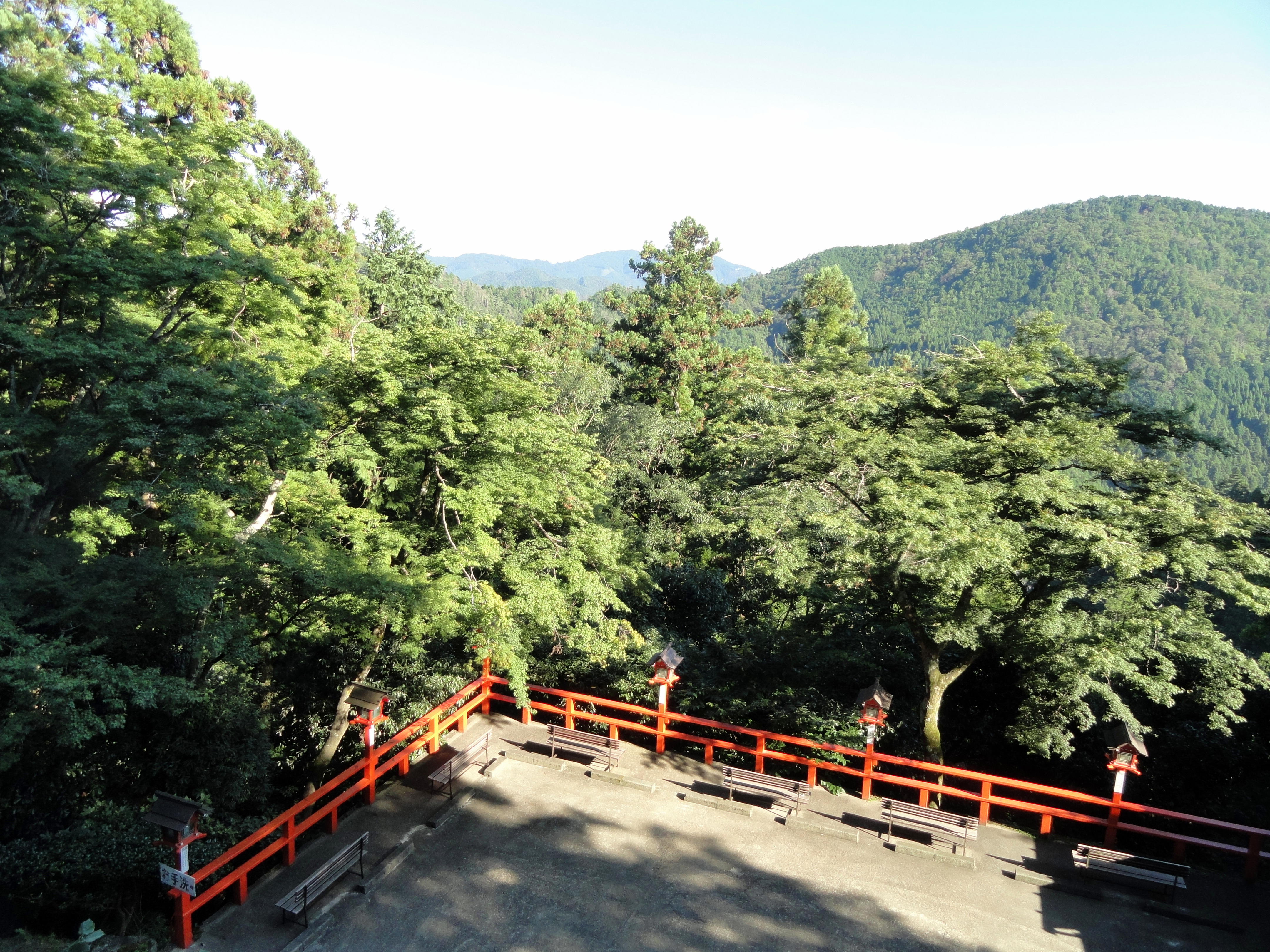
Kurama-dera: Where Tengu Guard the Mountain and a God Came from Venus
The Defender Lord arrived from Venus 6.5 million years ago and is eternally sixteen years old. At least, that is what the priests of Kurama-dera will tell you. The temple perched on Mount Kurama in the far north of Kyoto has always traded in the extraordinary. Founded in the 8th century, burned down repeatedly, home to National Treasures rescued from the flames each time, it spent centuries as a Buddhist monastery before its postwar abbot decided Buddhism was too confining and invented his own religion. The temple's cable car deposits visitors at the base of a steep mountain path through ancient cedar forest, a landscape the Japanese have associated with tengu -- the long-nosed, winged supernatural beings of folk legend -- since long before the temple existed.
A Dream on the Mountain
The founding of Kurama-dera traces back to 772, when a disciple of the Chinese monk Jianzhen received a vision that Mount Kurama possessed concentrated spiritual power. He climbed the mountain and built an esoteric temple to harness and channel that energy. The origins are historically murky -- multiple traditions claim different founders -- but the temple's connection to Jianzhen, the legendary Tang dynasty monk who braved shipwrecks and blindness to bring Buddhist precepts to Japan, gave it deep roots in the transmission of continental Buddhism. From the beginning, Kurama-dera existed at the boundary between orthodox religion and mountain mysticism, a place where institutional Buddhism met older, wilder beliefs about the spiritual power dwelling in Japan's forested peaks.
Fires, Sects, and Sacred Survivors
Through the medieval era, Kurama-dera burned down repeatedly. Fires claimed its wooden halls again and again, but each time, the temple's Buddhist statues and sacred objects were carried to safety. Those rescued treasures are today classified as National Treasures of Japan, their survival across centuries of destruction adding to their mystique. The temple's religious identity proved equally volatile. It shifted between three different Buddhist sects over the centuries, including a long affiliation with the Tendai school under the authority of Shoren-in from the 12th century onward. The sectarian wandering reflected a deeper tension: Kurama-dera's mountain location and esoteric practices never fit comfortably within any single orthodox Buddhist tradition.
The Sonten Trinity
The temple's most distinctive feature is its object of worship. Under the old Tendai order, the primary deities were Bishamonten, the guardian of the north, and the Thousand-Armed Kannon, bodhisattva of compassion. But the current leadership added a third figure to create a unique trinity they call the Sonten, or "Spiritual Kings of the World." Bishamonten represents the Sun, Kannon represents Love, and the third statue -- the Defender Lord -- represents Power. According to temple teaching, the Defender Lord came to Earth from Venus 6.5 million years ago and remains eternally sixteen years old. Some New Age writers identify this figure with Sanat Kumara, a being from Theosophical tradition. The actual statues are hidden from public view, but visitors can see replicas in the main hall. The Defender Lord's replica depicts a figure with a long beard, a prominent nose, wings, and a halo made of leaves -- an image strongly reminiscent of the tengu that local tradition says inhabit the mountain's forests.
Breaking Free
In 1949, abbot Kouun Shigaraki made a radical decision: he severed Kurama-dera's ties with Tendai Buddhism entirely and founded his own religious body. The split freed the temple to fully embrace its eclectic mountain-worship heritage. The yamabushi -- mountain ascetics who had long been among the temple's most devoted patrons -- could now be openly welcomed without the constraints of sectarian orthodoxy. Today, Kurama-dera occupies a unique religious space, neither fully Buddhist nor Shinto nor anything else with an easy label. Mount Kurama is also claimed as the birthplace of reiki, the energy-healing practice that spread worldwide in the 20th century. The Shinto shrine Yuki-jinja, founded on the temple grounds in the year 940, adds yet another layer to the mountain's spiritual complexity. Lonely Planet lists the temple as a Kyoto Highlight, and Japanese visitors flock here drawn by the accumulated mysteries: the tengu sightings, the Venusian deity, the National Treasures pulled from burning halls, and the raw atmosphere of a mountain that has been considered sacred for well over a thousand years.
From the Air
Located at 35.118N, 135.771E on Mount Kurama in the far northern reaches of Kyoto. The temple sits on a densely forested mountainside, accessible by cable car from the Kurama area. From the air, Mount Kurama's peak and surrounding ridgeline are visible north of the Kyoto basin, with the Kibune valley running parallel to the west. The Kurama-dera Cable line ascending the slope may be visible at lower altitudes. Nearest major airport is Osaka Itami (RJOO), approximately 28 nautical miles southwest. The mountainous terrain north of Kyoto offers dramatic forested landscapes when viewed from 3,000-6,000 feet AGL.