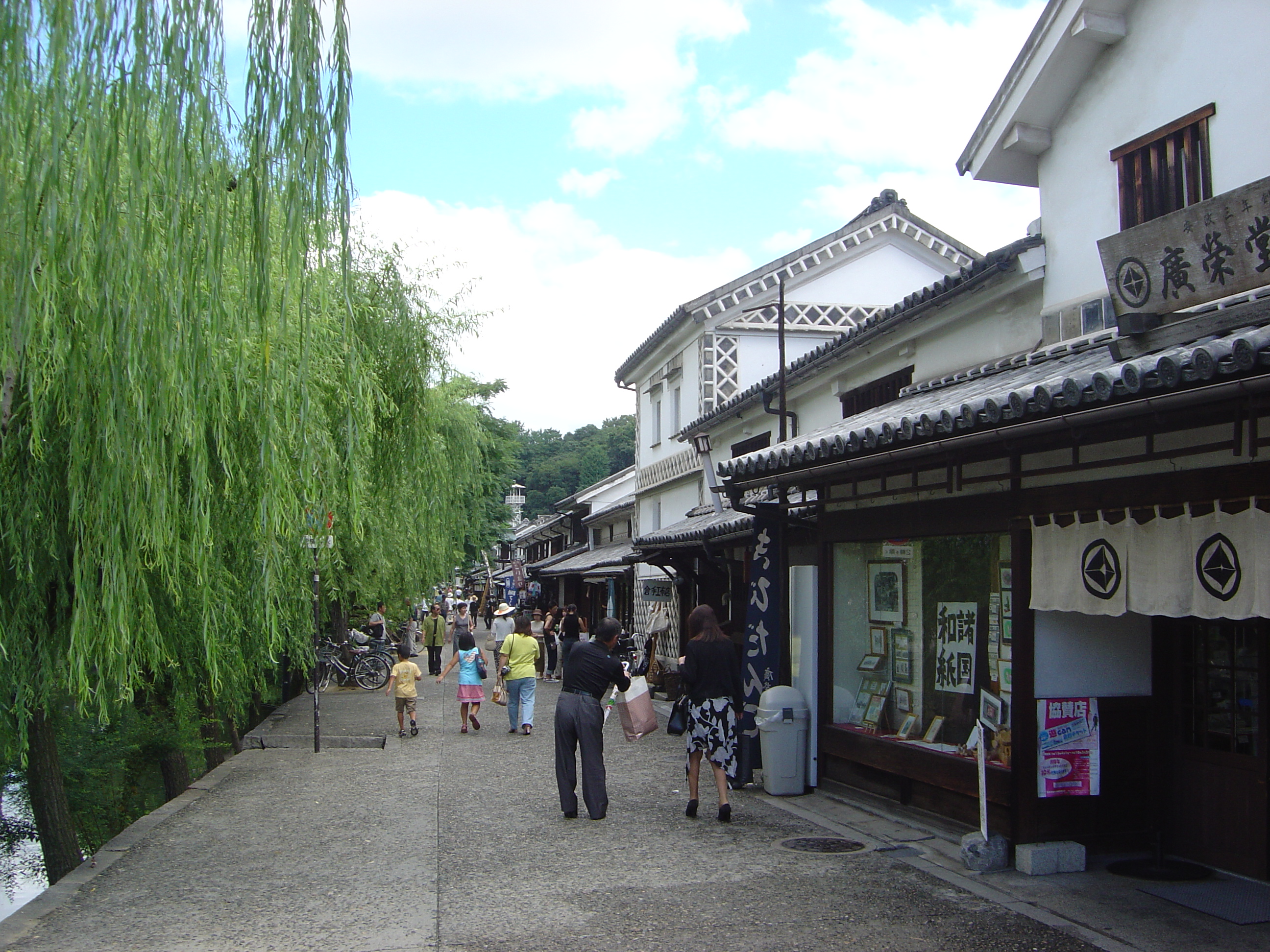
Kurashiki
The name gives it away. Kurashiki derives from kura -- storehouse -- and the city earned that name honestly. During the Edo period, this stretch of Okayama Prefecture belonged directly to the Tokugawa shogunate as tenryō territory, a collection point for annual rice taxes from the surrounding provinces. Distinctive white-walled, black-tiled warehouses rose along the canals where goods were loaded onto boats for transport. The warehouses survive. So do the canals, now draped with weeping willows and stocked with koi, forming the Bikan historical district -- a pocket of seventeenth-century Japan preserved inside a modern industrial city.
Twenty Thousand Years of Habitation
Human settlement in the Kurashiki area reaches back more than 20,000 years, to the Japanese Paleolithic period. The city sits near the center of the ancient Kingdom of Kibi, and its archaeological record reads like a textbook of Japanese prehistory: Jomon period shell middens, Yayoi period settlement remains, Kofun period burial mounds, Nara period temple ruins. From the Heian period onward, the estuary of the Takahashi River served as a port, and the surrounding terrain was contested in numerous battles. This depth of history gives Kurashiki a layered quality -- beneath the Edo-era merchant town lies a landscape shaped by millennia of human activity, including the Tatetsuki Site and the Yata Otsuka Kofun, both designated National Historic Sites.
The Merchant Town That Governed Itself
Under the shogunate's administration, Kurashiki's merchants enjoyed unusual autonomy. The magistrate's office recognized their self-governance and gave them preferential treatment, a pragmatic arrangement that increased both population and tax revenue. Local industries thrived: cotton cloth weaving and salt production fed the regional economy, while the warehouses along the canal filled with rice, cotton, and other goods bound for Osaka and Edo. The white walls and black tiles of those storehouses were not merely decorative -- the thick plaster walls resisted fire, a constant threat in wooden Japanese cities, while the tile roofs shed rain. Today, in the Bikan district, electric poles have been removed to preserve the historical atmosphere, and the old warehouses serve as museums, shops, and restaurants.
El Greco on the Inland Sea
In 1930, businessman and philanthropist Magosaburo Ohara opened the Ohara Museum of Art, Japan's first museum dedicated to Western art. The main building, designed in Neoclassical style, stands along the canal in the Bikan district and houses paintings by El Greco, Monet, Matisse, Gauguin, and Renoir, alongside collections of Asian and contemporary art. Ohara's ambition was extraordinary for the time -- bringing European masterworks to a provincial warehouse town -- and the museum remains one of Japan's most important cultural institutions. Pritzker Prize-winning architect Kenzo Tange added to the city's architectural legacy by designing the former Kurashiki City Hall in 1960, bringing modernist vision to a place already defined by historical beauty.
Bridge to Shikoku
Kurashiki is a city of contrasts. The Bikan district preserves seventeenth-century Japan in amber, but the Mizushima Rinkai Industrial Area -- spanning the Mizushima and Tamashima coastal zones -- is one of Japan's largest industrial complexes, with factories producing petrochemicals, steel, automobiles, and ships. The Great Seto Bridge, which connects Kurashiki to Sakaide in Kagawa Prefecture, stretches across the Inland Sea and links Honshu to Shikoku, making the city a gateway between Japan's two largest islands. This juxtaposition of old and new, of warehouse canals and petrochemical plants, defines Kurashiki more honestly than either image alone. It is a place where the past is preserved not as a relic but as a living counterweight to relentless industrial modernity.
From the Air
Located at 34.59N, 133.77E in Okayama Prefecture on the Seto Inland Sea coast. The Great Seto Bridge, connecting Honshu to Shikoku, is a prominent visual landmark extending south from the city. Nearest airports are Okayama Airport (RJOB) approximately 20 km to the northeast and Takamatsu (RJOT) across the Inland Sea. The Mizushima industrial complex is visible along the coast. The Bikan historical district is in the city center near the rail station. Recommended viewing altitude: 3,000-8,000 feet for bridge and city context.