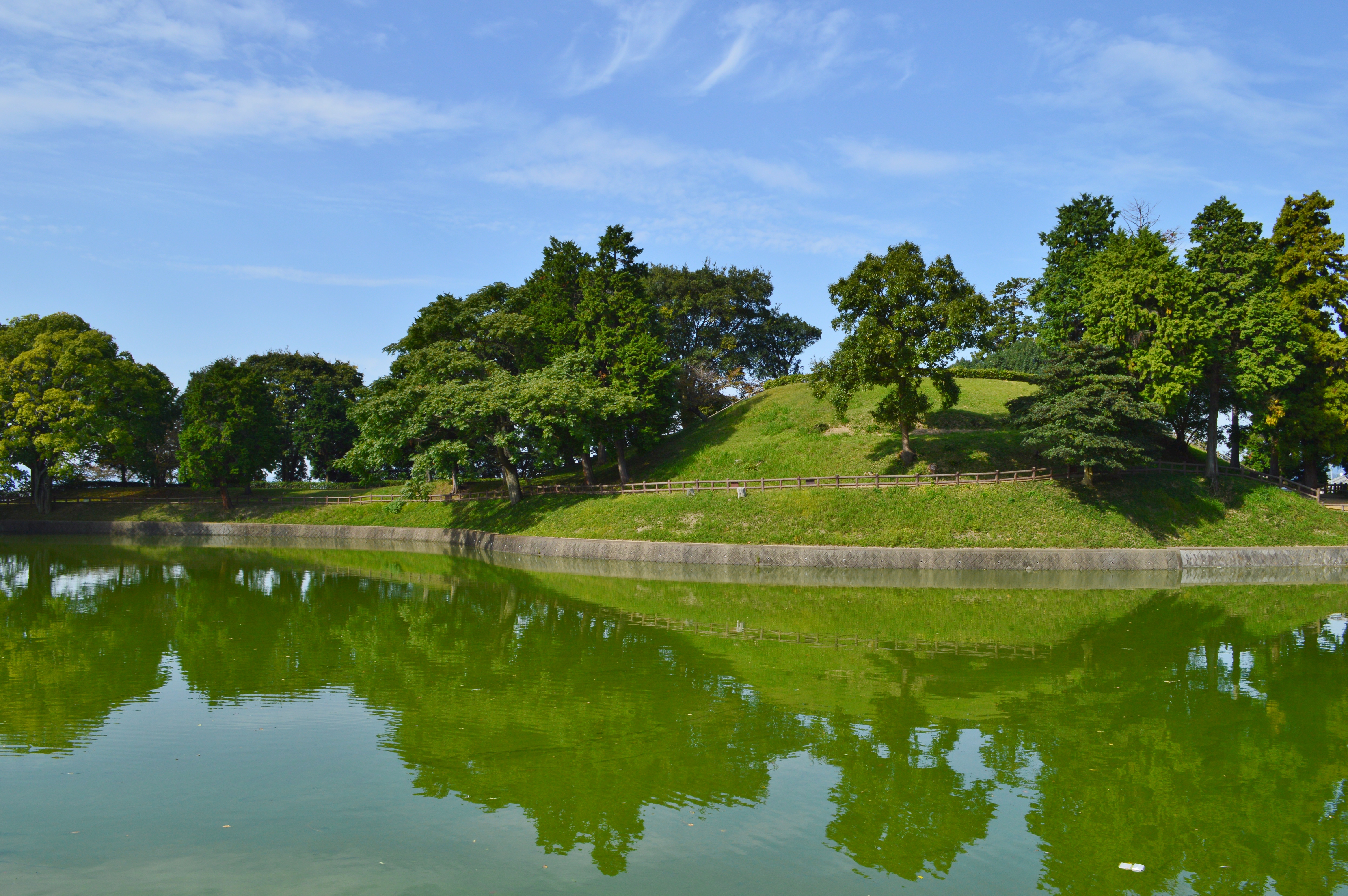
Kurozuka Kofun
Thirty-three bronze mirrors, each cast with images of gods and mythical beasts, lay face-inward against the walls of a stone burial chamber, arranged in a precise U-shape around the upper body of the deceased. They had not shifted in seventeen centuries. When archaeologists from the Kashihara Archaeological Institute opened the Kurozuka Kofun in 1997, they found one of the most extraordinary intact burial arrangements ever documented in Japan -- grave goods positioned exactly as they were on the day the tomb was sealed, sometime in the early 3rd or 4th century. The discovery transformed understanding of Kofun-era funeral ritual and reignited debate about the powerful figures buried in the Nara Basin's great mound tombs.
Shaped Like a Keyhole, Built for Eternity
Seen from above, Kurozuka Kofun has the distinctive keyhole shape -- called zenpokoenfun in Japanese -- that defines the great burial mounds of the Kofun period. The tomb measures 130 meters in total length. Its circular rear mound rises 11 meters high with a diameter of 72 meters, constructed in three stepped tiers. The rectangular front portion extends 48 meters with a height of 6 meters in two tiers. A slight arc-shaped bulge at the front of the circular mound gives it a drumstick silhouette, a hallmark of the earliest Kofun tombs. A moat encircles the entire structure. Notably absent are fukiishi, the decorative facing stones found on many kofun, and haniwa, the terracotta figures that typically lined later tomb ridges. Their absence reinforces the early dating of this burial.
A Ring of Mirrors and Swords
The burial chamber told a story of deliberate, ritual precision. Inside the wooden coffin, a single bronze mirror -- an older "picture-and-text belted divine beast" type -- was placed at the head of the deceased. One sword lay on each side of the body. Outside the coffin, in the narrow gap between wood and stone wall, the 33 triangular-rimmed "divine beast" mirrors were arranged facing inward: 15 on the east wall, 17 on the west, and one atop a vermilion-painted wooden shield propped against the north wall. The upper body of the deceased was effectively enclosed in a U-shaped ring of reflected sacred imagery. Eleven swords and spears were grouped near the coffin's western side, their blades pointing south. A bundle of arrowheads with tips also facing south occupied the northwest corner. The southern end of the coffin held roughly 600 small metal plates -- the remains of a coat of plates armor bound with leather -- along with axes, spearheads, and Haji ware pottery. The complete absence of jewels or arm ornaments makes the assemblage distinctly martial.
Mirrors That Speak of Power
Triangular-rimmed bronze mirrors with divine beast motifs are among the most studied artifacts in Japanese archaeology. They are thought to originate from Chinese bronze-casting traditions, and their distribution across Kofun-period tombs has been used to map networks of political alliance and ritual authority in early Japan. Finding 33 of them in a single tomb, undisturbed and in their original arrangement, was unprecedented. The mirrors confirmed theories that grave goods were not simply piled into tombs but placed with careful symbolic intent. The U-shaped arrangement around the body's upper half suggests a protective or spiritually charged enclosure, with the reflective surfaces of gods and beasts directed toward the person they were meant to guard. The Kurozuka Kofun belongs to the Yanagimoto Kofun Group in the southeastern Nara Basin, a cluster of early keyhole tombs that some researchers associate with the earliest political elites of the Yamato state.
Walking the Mound Today
The Kurozuka Kofun was designated a National Historic Site of Japan in 2001. The mound sits in the Yanagimoto-cho neighborhood of Tenri city, about a five-minute walk from Yanagimoto Station on the JR West Sakurai Line. The surrounding landscape is flat Nara Basin farmland, punctuated by the green humps of other kofun -- a landscape where ancient tombs serve as neighborhood landmarks, their slopes shaded by trees and their moats home to herons. The mirrors and other excavated artifacts are displayed at the Kashihara Archaeological Museum, where visitors can see the intricate divine beast patterns up close. Standing on the path beside the mound, the 130-meter shape is too large to comprehend from ground level. Only from above does the keyhole reveal itself -- the circular and rectangular portions locked together in a form that the builders of early Japan chose, for reasons still debated, to house their most powerful dead.
From the Air
Located at 34.560N, 135.843E in the city of Tenri, Nara Prefecture, in the southeastern Nara Basin. The keyhole-shaped mound is 130 meters long and visible as a distinctive tree-covered shape among flat agricultural fields. Part of the Yanagimoto Kofun Group -- multiple keyhole mounds are visible in the area. Nearest major airports: Kansai International Airport (RJBB) approximately 45nm southwest, Osaka Itami (RJOO) approximately 25nm northwest. Best viewed at 2,000-4,000 feet AGL to appreciate the keyhole shape and the clustering of nearby kofun along the basin's eastern edge. Mount Miwa rises prominently to the south-southeast.