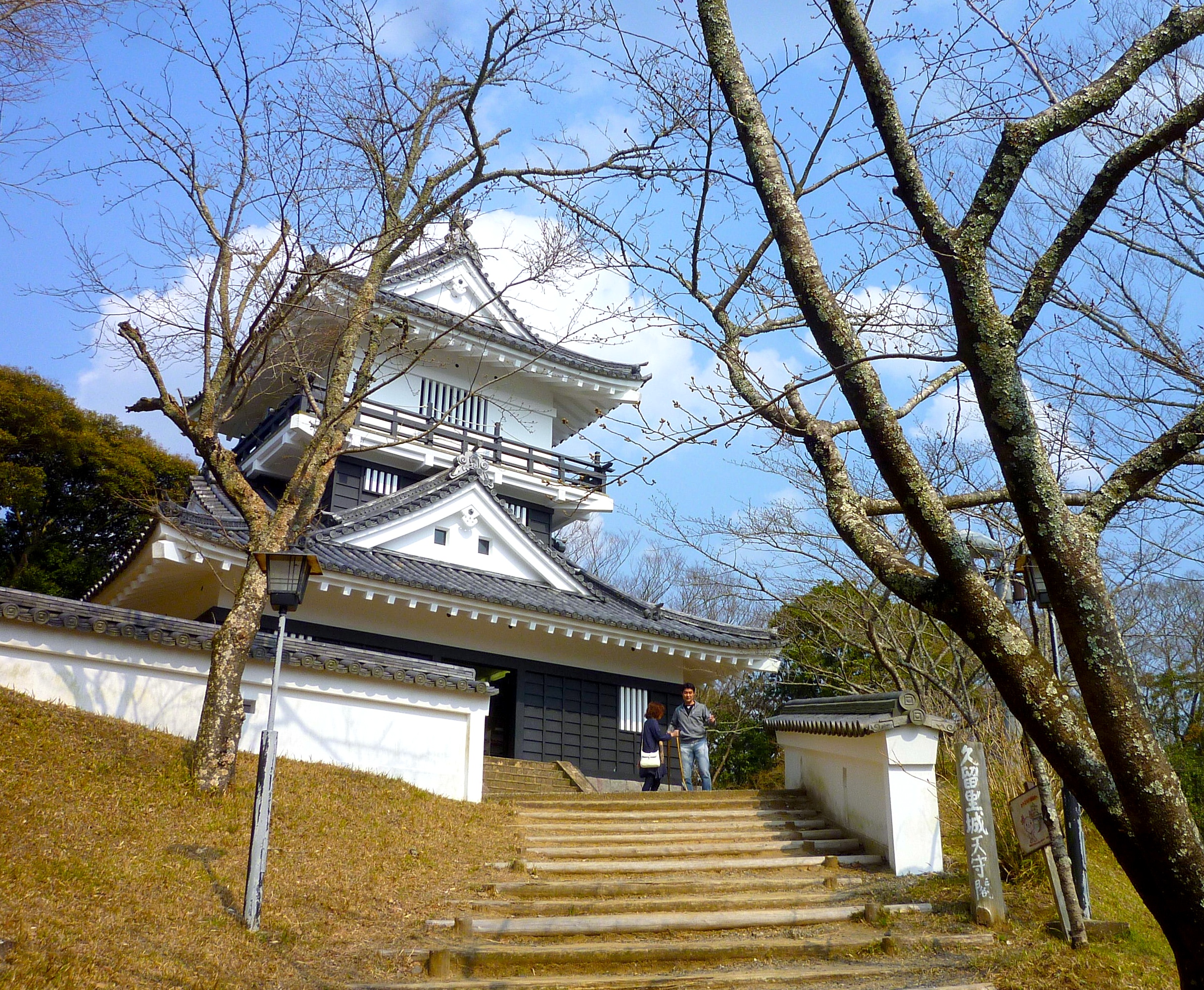
Kururi Castle
Legend says it rained twenty-one times during the construction of Kururi Castle -- once every three days on average -- earning it the nickname Rain Castle. Whether the weather was really that persistent or the builders simply needed a good excuse for delays, the name stuck across five centuries. Perched on a 227-meter hill in Kimitsu, on the green spine of the Boso Peninsula in southern Chiba Prefecture, this small mountain fortress spent its entire existence caught between larger powers: seized, lost, rebuilt, abandoned, destroyed by government order, and finally reconstructed in concrete for tourists. It is a castle that never stopped being fought over, even by time itself.
A Mountaintop in the Warring States
The original Kururi Castle was built during the Muromachi period by Takeda Nobunaga (1401-1477) -- not the famous Oda Nobunaga of unification fame, but a local warlord of the same given name whose descendants, the Mariyatsu branch of the Takeda clan, held the hilltop from 1540. When the Satomi clan expanded northward from Awa Province during the Sengoku period, Satomi Yoshitaka captured Kururi and turned it into his forward base against the powerful Hojo clan, whose stronghold at Odawara Castle controlled much of the Kanto region. The Hojo tried and failed to take Kururi on several occasions before finally seizing it in 1564. They held it for just three years. By 1567, the Satomi had clawed it back. On this remote Boso hilltop, the seesaw battles of the Sengoku era played out in miniature: raid, siege, betrayal, reconquest.
The Tokugawa Settlement
The game of musical chairs ended after the Siege of Odawara in 1590, when Toyotomi Hideyoshi crushed the Hojo and punished the Satomi by stripping them of their territories in Kazusa Province. When Tokugawa Ieyasu moved into the Kanto region, he assigned Kururi to his retainer Matsudaira (Osuga) Tadamasa and appointed him daimyo of the newly created 30,000-koku Kururi Domain. Tadamasa built most of the fortifications that defined Kururi Castle in its mature form and established a castle town at its base. After the Battle of Sekigahara in 1600, the Osuga clan was transferred to Yokosuka Castle in Suruga Province, replaced by the Tsuchiya clan at a reduced revenue of 20,000 koku. But the domain was suppressed entirely in 1679, and the castle was abandoned to the forest. For over sixty years, rain fell on empty walls.
Revival and Ruin
In 1742, Kururi Domain was reinstated when Kuroda Naozumi transferred in from Numata Domain. He rebuilt the old fortifications, and his descendants -- a branch of the Kuroda clan -- governed Kururi through the final century of the Edo period and into the turbulence of the Meiji Restoration. But the new Meiji government had no use for feudal castles. In 1872, orders came down to destroy the surviving structures. Walls were pulled down. Timbers were hauled away. What remained were earthen foundations, the outlines of moats, and a single well -- quiet evidence of the hundreds of years of habitation that had shaped this hilltop.
A Castle Rebuilt for Memory
The hilltop became a public park in 1955, and in 1979 the city of Kimitsu reconstructed the donjon as a local history museum. The modern tower is honest about its compromises: the original Edo-period donjon was a two-story, two-roofed structure, but the reconstruction has three interior floors and is built from reinforced concrete rather than timber. It stands adjacent to -- not on top of -- the earthen foundation of the original keep. Inside, exhibits trace the tangled history of the castle and its succession of owners, from the Takeda builders through the Satomi warriors and the Tokugawa-era daimyo to the Meiji demolition. The surrounding park preserves remnants of the moats and earthworks, and on clear days the hilltop offers views across the forested hills of the Boso interior -- the same landscape that made this position worth fighting over for centuries.
From the Air
Located at 35.288N, 140.090E on a 227-meter hilltop in the interior of the Boso Peninsula, Kimitsu, Chiba Prefecture. The castle site is visible from altitude as a wooded hilltop with a small reconstructed tower amid the forested ridgelines of central Boso. The surrounding terrain is hilly and green, distinct from the flat coastal plains to the west. Nearest military airfield is Kisarazu (RJTK), approximately 18 km to the northwest on Tokyo Bay. Tokyo Haneda (RJTT) is about 55 km to the northwest across the bay. Narita International (RJAA) lies approximately 60 km to the north. The Tokyo Bay Aqua-Line bridge-tunnel is visible to the northwest connecting Kisarazu to Kawasaki.