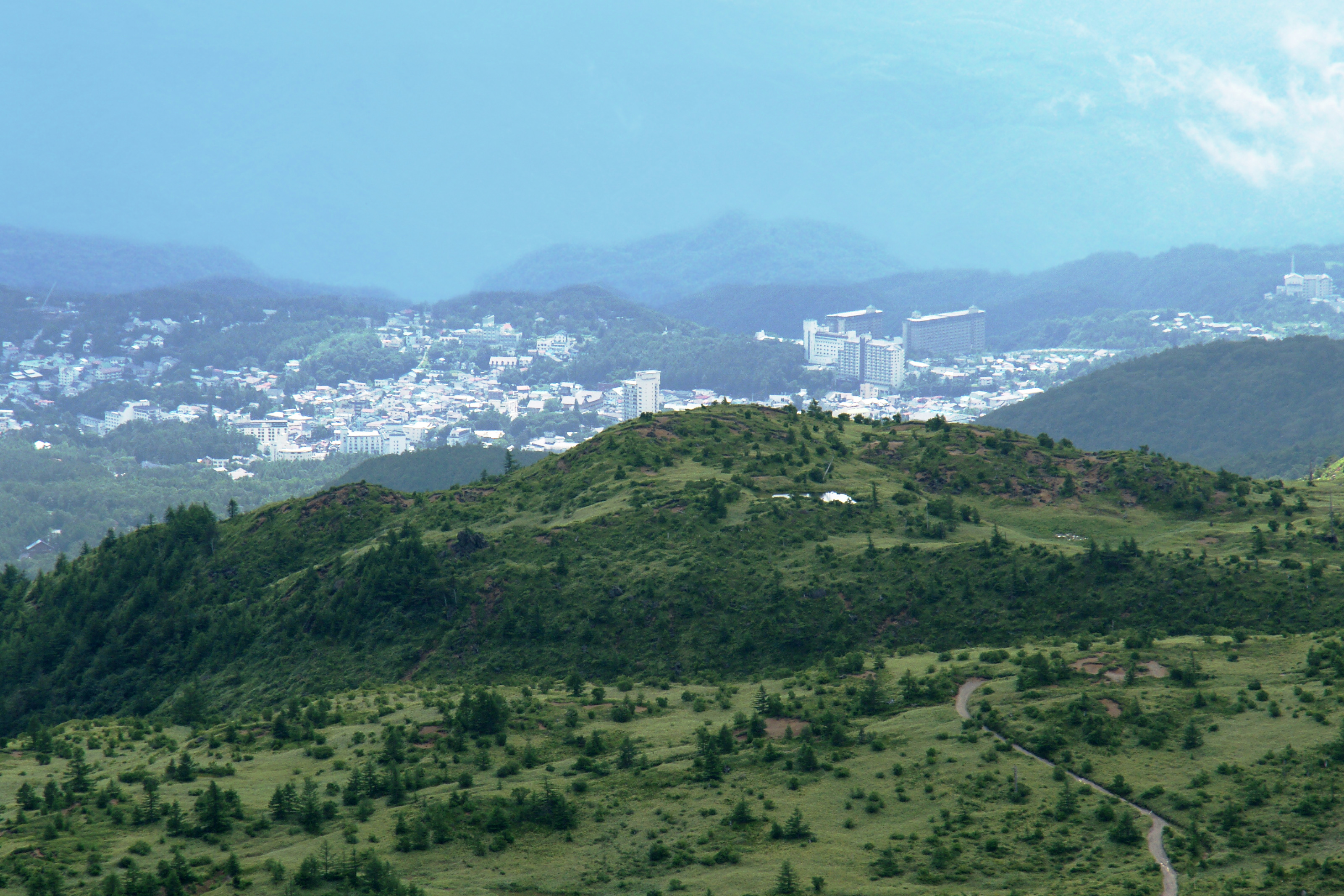
Kusatsu Onsen
The locals have a saying: the hot springs of Kusatsu can cure every ailment except lovesickness. They have had centuries to test the claim. Records place the first shogun of the Kamakura period, Minamoto no Yoritomo, bathing here in 1193 during a hunting expedition. By the Edo period, the eighth shogun Tokugawa Yoshimune thought so highly of the water that he had it carried all the way to Edo Castle for his personal use. Perched at 1,200 meters above sea level in the mountains of Gunma Prefecture, Kusatsu Onsen produces more hot spring water than any other source in Japan: over 32,300 liters per minute gushing from its six main springs. The volume is staggering, the temperatures punishing, and the town that grew up around all that scalding, sulfurous water is unlike anywhere else.
The Yubatake: A Hot Field in the Town Square
Most towns have a park or a plaza at their center. Kusatsu has the Yubatake, a steaming open-air hot spring source that functions as both town landmark and practical infrastructure. The name translates to 'hot water field,' and the sight is exactly that: a cascade of near-boiling water flowing through a grid of long wooden chutes made from thick pinewood, still containing enough resin to resist the corrosive acidity. The Yubatake alone produces up to 4,000 liters per minute, its waters emerging at temperatures above 70 degrees Celsius. The wooden channels serve a dual purpose, cooling the water to usable temperatures while allowing dissolved minerals, particularly sulfur, to settle and be collected. The smell of sulfur hangs permanently in the air. At night, the Yubatake is illuminated, its steam rising through colored lights into the mountain darkness.
Yumomi: Stirring the Waters by Hand
When the hot spring water arrives too hot for human skin and too precious to dilute with cold water, what do you do? In Kusatsu, the answer dates back to the Edo period: you stir it. The practice of yumomi involves rows of people kneeling beside long wooden troughs, rhythmically churning the scalding water with wide paddles measuring 1.8 meters long. The stirring introduces air and accelerates cooling without adding cold water, which the locals believe would diminish the therapeutic properties of the minerals. The water in Kusatsu can emerge at temperatures ranging from 51 to 94 degrees Celsius, so the cooling process is no small task. Today, yumomi demonstrations are performed for visitors, accompanied by traditional songs, but the technique remains a working method of temperature control, not merely a tourist attraction.
The German Doctor's Prescription
Kusatsu's transformation from regional resort to internationally recognized destination traces to one man: Erwin von Balz, a German physician who arrived in Japan in 1876 to teach medicine at Tokyo University. Balz became an advisor to the imperial family and, during his decades in Japan, made a thorough study of the country's hot springs. He declared Kusatsu a world-class therapeutic resort, and his endorsement carried enormous weight in a Meiji-era Japan eager for Western scientific validation. Balz recognized what the locals had known for centuries: the mineral-rich, highly acidic waters had genuine medicinal properties. There are 13 public bathhouses in Kusatsu today, and the small neighborhood baths remain free for both residents and visitors, managed by the townspeople themselves in a tradition of communal care.
Fire Beneath the Surface
The source of all this thermal abundance is Mount Kusatsu-Shirane, an active volcano rising to 2,160 meters just north of town. The mountain's heat drives the hot springs, and its mineral-laden geology gives the waters their distinctive character. Different springs in Kusatsu draw from different underground sources, which is why the water's appearance ranges from milky white to perfectly clear. The volcanic connection is a constant presence: the mountain's crater lakes, including the acid-green Lake Yugama, are visible reminders that the same forces powering the town's bathhouses also have a more destructive potential. Kusatsu sits within the boundaries of Joshin'etsu-kogen National Park, surrounded by the volcanic highlands that define this corner of central Honshu.
From the Air
Located at 36.64N, 138.59E at an elevation of 1,200 meters in the mountains of Gunma Prefecture. The town sits in a valley below Mount Kusatsu-Shirane (2,160m), whose distinctive green crater lake (Lake Yugama) is visible from altitude. The Yubatake steam plume in the town center may be visible in cool, calm conditions. The terrain is mountainous and volcanic throughout the surrounding area. Nearest airport is Matsumoto Airport (RJAF), approximately 80 km to the southwest. The area lies within Joshin'etsu-kogen National Park. Clear weather recommended for visual identification of the volcanic features.