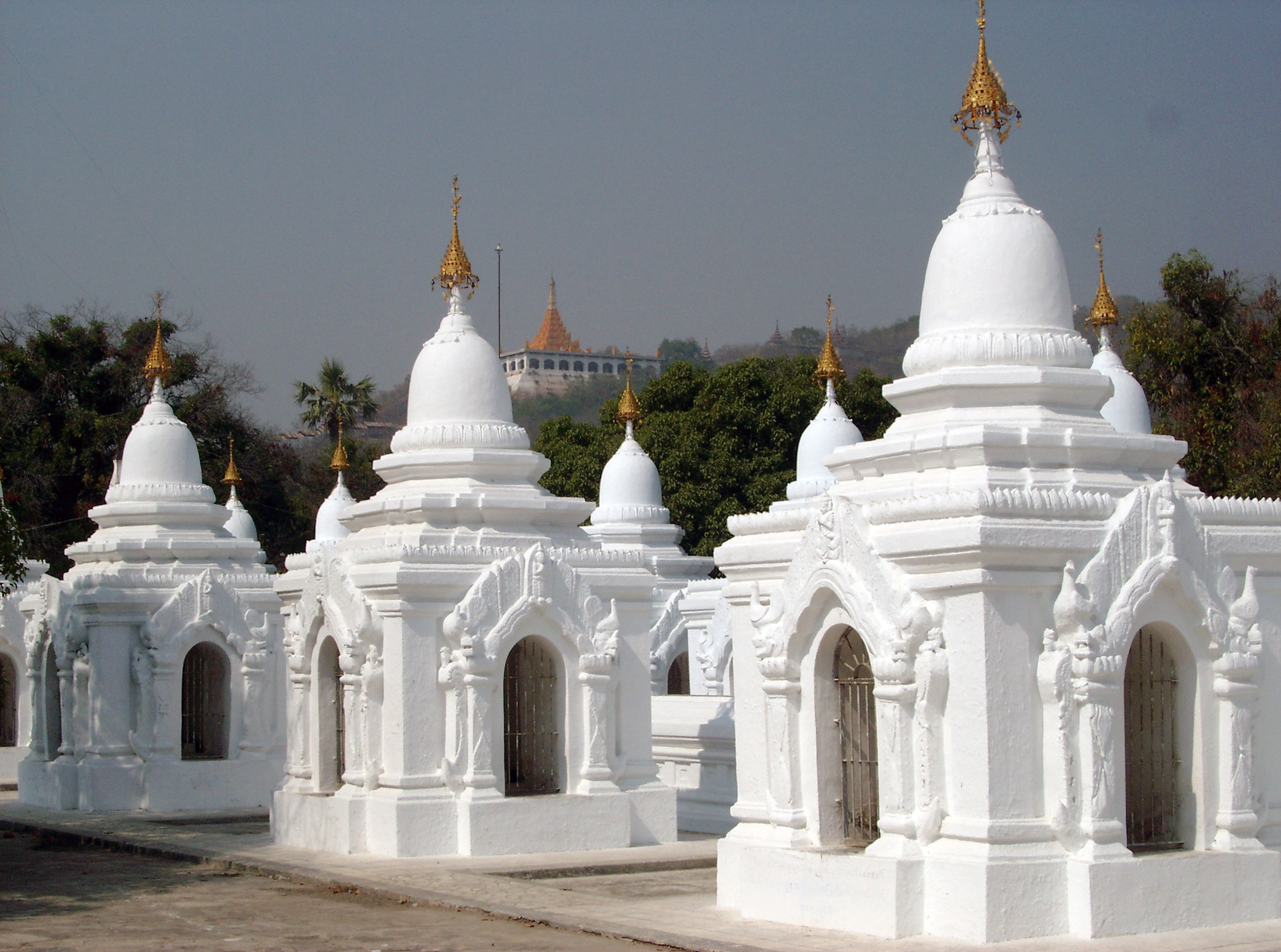
Kuthodaw Pagoda
Seven hundred and twenty-nine marble slabs, each inscribed on both sides with sacred text, each sheltered inside its own small white stupa -- this is how King Mindon chose to preserve the teachings of the Buddha. Not on paper, not on palm leaf, but in stone, meant to last five thousand years. Kuthodaw Pagoda, formally titled Mahalawka Marazein, sits at the foot of Mandalay Hill in Myanmar, and its grounds hold what UNESCO has recognized as the world's largest book. The central gilded stupa rises 188 feet, modeled after the Shwezigon Pagoda near Bagan, but it is the orderly rows of smaller white stupas radiating outward that make this place extraordinary -- a library you walk through rather than read at a desk.
A King's Act of Merit
Mindon Min had the pagoda built in 1857 as part of the traditional foundations of his new royal city of Mandalay. He was already planning the Fifth Buddhist Synod, which he would convene in 1871, but the Kuthodaw was something grander: an attempt to set the entire Tipitaka -- the Pali Canon of Theravada Buddhism -- in imperishable stone. Construction began in 1860. The gilded hti, or umbrella crown, was mounted on 19 July 1862, and the inscriptions were opened to the public on 4 May 1868. The 729 slabs were arranged in three concentric enclosures: 42 in the innermost ring, 168 in the middle, and 519 in the outermost. A 730th stone, standing at the southeast corner of the first enclosure, records the story of how the entire project came to be. Thirty-four brick rest houses called zayats once lined the grounds, and the main southern entrance opened through massive teak doors carved with floral scrolls and celestial figures.
Star Flowers and Picnic Shade
Between the rows of inscription stupas grow mature star flower trees -- Mimusops elengi -- whose jasmine-like fragrance perfumes the entire complex. Burmese families spread picnic blankets under their canopies, children play hide and seek among the white stupas, and visitors weave star flower chains to offer at the Buddha's shrine or tuck into their hair. On the southwest inner terrace, one tree is believed to be 250 years old, its low-spreading boughs propped up with wooden supports like a grandmother resting on canes. The covered southern approach, or saungdan, still bears frescoes beneath its roof, and the contrast between the sacred ambition of the inscriptions and the casual domesticity of families at leisure gives Kuthodaw its particular warmth. This is not a museum behind glass. It is a living space where scripture and daily life share the same shade.
Looted to the Last Brass Bell
After the British annexed Mandalay in 1885, the walled city became Fort Dufferin and troops occupied monasteries, temples, and pagodas across Mandalay Hill, barring the Burmese public from their own religious sites. A revenue surveyor named U Aung Ban devised an appeal directly to Queen Victoria, invoking her promise to respect the religions of her subjects. The queen ordered the troops withdrawn from religious precincts in 1890 -- but what the Burmese found when they returned was devastating. The hti had been stripped of its gold, silver, diamonds, rubies, and bells, then left lying on the ground. Italian marble tiles had been pried from the terraces. Every one of the 6,570 brass bells -- nine per stupa -- had vanished. The gold ink from the sacred inscriptions was gone. The brick rest houses lay in ruins, their materials repurposed for a military road. The stone guardians along the corridors had been decapitated, and the marble eyes and claws of the masonry chinthes had been chiseled out.
Rebuilding What Was Taken
In 1892, a restoration committee formed that reads like a roll call of Burmese society: the Abbot of Atumashi Monastery, the chancellor Kinwon Min Gyi U Kaung, the minister of the royal fleet, Shan chieftains, and a general of the royal army. They worked alongside public donors and the families of the original contributors. The looted gold lettering was replaced with practical black ink -- easier to read, if less resplendent. Stone hti crowns replaced the stolen metal ones, funded by 155 members of the royal family, 58 former army officers, 102 Shan chiefs, and 414 public donations. In 1913, a rice trader from Rangoon named Sir Po Tha paid to repair and regild the main pagoda. Gates arrived in stages: an iron south gate in 1914, the west gate donated by the famous theatre performer U Po Sein in 1915, and the north and east gates from King Mindon's grandchildren in 1932. Each act of restoration was itself an act of merit, turning destruction into devotion.
Pages That Outlast Empires
In 2013, UNESCO inscribed the Kuthodaw Inscription Shrines on its Memory of the World Register, affirming what Mindon Min had intended: that stone outlasts the forces arrayed against it. The 729 marble slabs remain legible, their text the entire Tripitaka preserved in a form no fire can burn and no army can easily carry away. Walking among the neat rows of white stupas, shaded by star flower trees, visitors encounter a paradox. The world's largest book cannot be read in a single visit, or even a hundred visits. It was never designed for convenience. It was designed for permanence -- a king's wager that stone and faith together could survive whatever the centuries brought. So far, the wager holds.
From the Air
Kuthodaw Pagoda sits at 22.00N, 96.11E at the southwestern foot of Mandalay Hill. From the air, the complex is identifiable as a central golden stupa surrounded by concentric rows of small white stupas, forming a distinctive geometric pattern visible even from moderate altitude. Mandalay International Airport (ICAO: VYMD) is approximately 35 km to the south. Best viewed at 2,000-4,000 feet for the striking pattern of the 729 white stupas. Mandalay Hill rises immediately to the northeast.