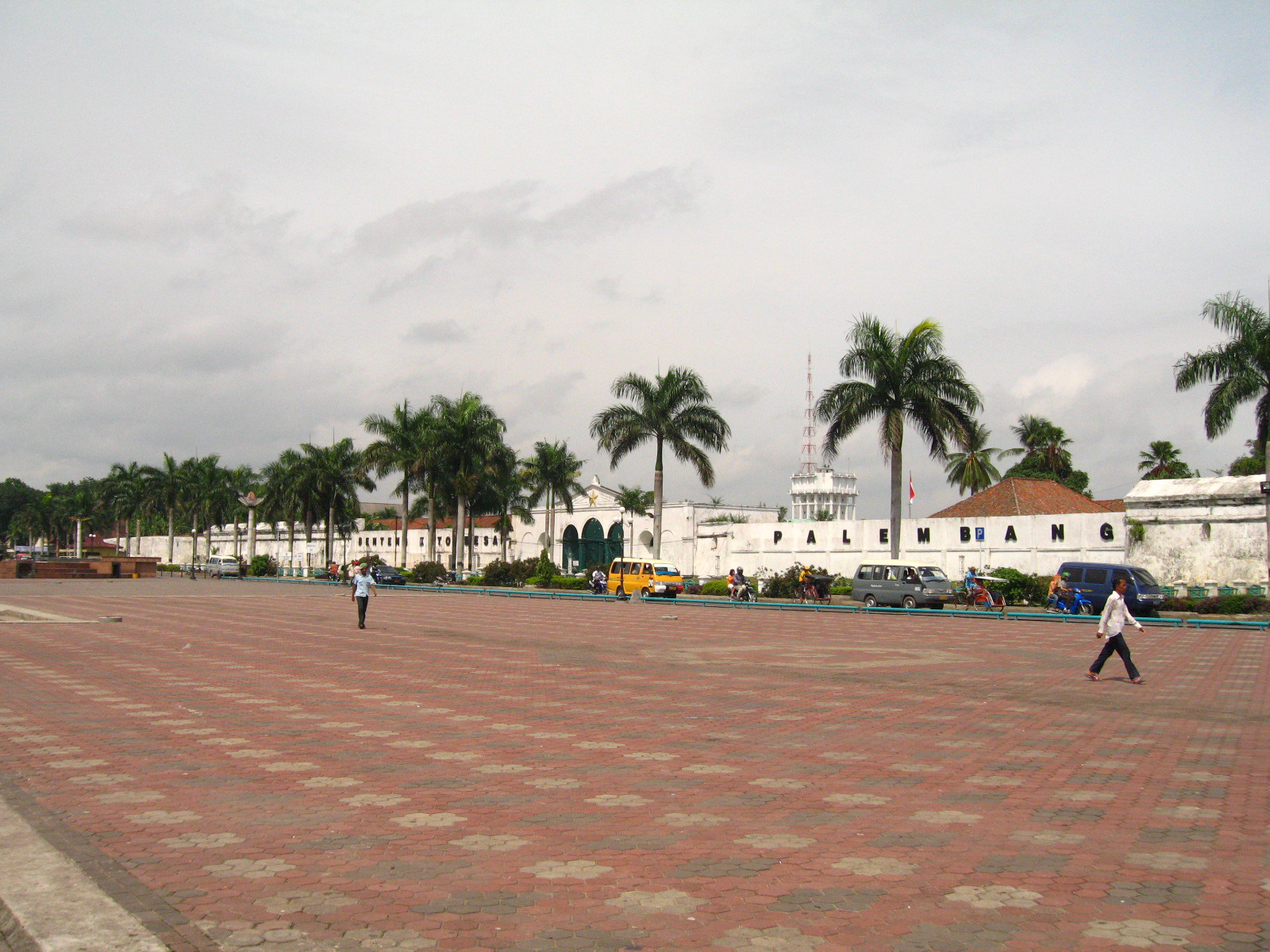
Kuto Besak
The mortar that holds Kuto Besak together contains egg whites. Thousands of them, mixed with limestone hauled from quarries far upstream on the Ogan River, bonding brick to brick across walls that rise roughly thirty feet above the Musi River. Construction began in 1780, and it took seventeen years to finish. When the fortress was finally inaugurated in 1797, the sultan transferred his royal residence from the older Kuto Lamo, and Kuto Besak became the beating heart of the Sultanate of Palembang. The name itself means "Great Fortress" in the Palembang language, and for a brief, turbulent era, it lived up to that title.
A Palace That Kept Moving
Kuto Besak was actually the fourth seat of power for the Palembang sultans, each relocation driven by violence or vulnerability. The original kraton stood at Kuto Gawang, on a site now occupied by the headquarters of Pupuk Sriwidjaja, a state-owned fertilizer company. In 1651, the Dutch East India Company attacked Kuto Gawang to monopolize Palembang's trade, devastating the fortified palace. The royal court retreated to Kraton Beringin Janggut, at what is now the market area of Pasar 16 Ilir. During the reign of Sultan Mahmud Badaruddin I, between 1724 and 1758, the court moved again to Kraton Kuto Lama. Each move represented both a wound and an adaptation, the sultanate rebuilding itself around a new center while the old one passed into the city's layered geography.
Walls, Bastions, and Sapodilla Trees
The fortress sits on the northern bank of the Musi, its main gate, the lawang kuto, facing the river as both a greeting and a warning to anyone approaching by water. A rectangular compound stretching 288 meters long and 183 meters wide, the kraton bristles with bastions: three trapezoid-shaped at the east, south, and west walls, and a pentagonal one guarding the northwest corner. Two additional gates, both called lawang borotan, pierce the east and west walls. When the complex was completed in the late 18th century, it sat amid a web of waterways. The Sekanak stream flanked the west, the Tengkuruk the east, and the Kapuran flowed to the north. Inside, the palace proper, the dalem, stood within a square courtyard where two small sapodilla trees grew. The sultan's private quarters occupied one walled-off section; the noble women's quarters filled the other. A pond with small boats, surrounded by fruit trees, completed a scene that was equal parts fortress and garden.
The Sultan's Last Act of Defiance
On June 25, 1821, the Palembang Sultanate fell to the Dutch. The colonial government formally took possession of Kuto Besak on July 1. But the handover was not clean. Before the Dutch could breach the walls, Sultan Mahmud Badaruddin II ordered the destruction of everything valuable inside the kraton. When Dutch soldiers finally entered, they found little of worth: some books, a handful of coins and gold, and 74 cannons. The sultan had denied them the spoils of conquest. On July 13, Badaruddin and his family were exiled to Ternate in the remote Maluku Islands, where he remained until his death on September 26, 1852. The Dutch repurposed his palace without ceremony. Kuto Besak became a residence for the colonial Resident and mess halls for 400 Dutch soldiers.
Buried Streams and Closed Gates
The waterways that once defined the kraton's setting have largely disappeared. The Tengkuruk stream was buried in 1928 and paved over to become Jalan Lintas Timur Sumatera, the road that now leads to the Ampera Bridge, Palembang's most recognizable modern landmark. The fortress itself passed from colonial military use to Indonesian military use without interruption. Today, Kuto Besak serves as the headquarters of Kodam II/Sriwijaya, an army command whose name ironically invokes the ancient Srivijaya empire that predated the sultanate by centuries. The inner buildings of the 18th-century compound have deteriorated from decades of minimal maintenance. Despite its historical significance as the last seat of the Palembang sultans, Kuto Besak remains closed to the public, its white-washed walls and egg-white mortar visible from outside but inaccessible to the citizens of the city it once ruled.
From the Air
Located at 2.99S, 104.76E on the northern bank of the Musi River in central Palembang. The rectangular fortress compound is visible from low altitude, sitting just south of the Ampera Bridge. Sultan Mahmud II International Airport (WIPP) is approximately 12 km to the north. The nearby Ampera LRT station provides a modern reference point. Best viewed at 2,000-4,000 ft where the fortress outline against the river is most distinct.