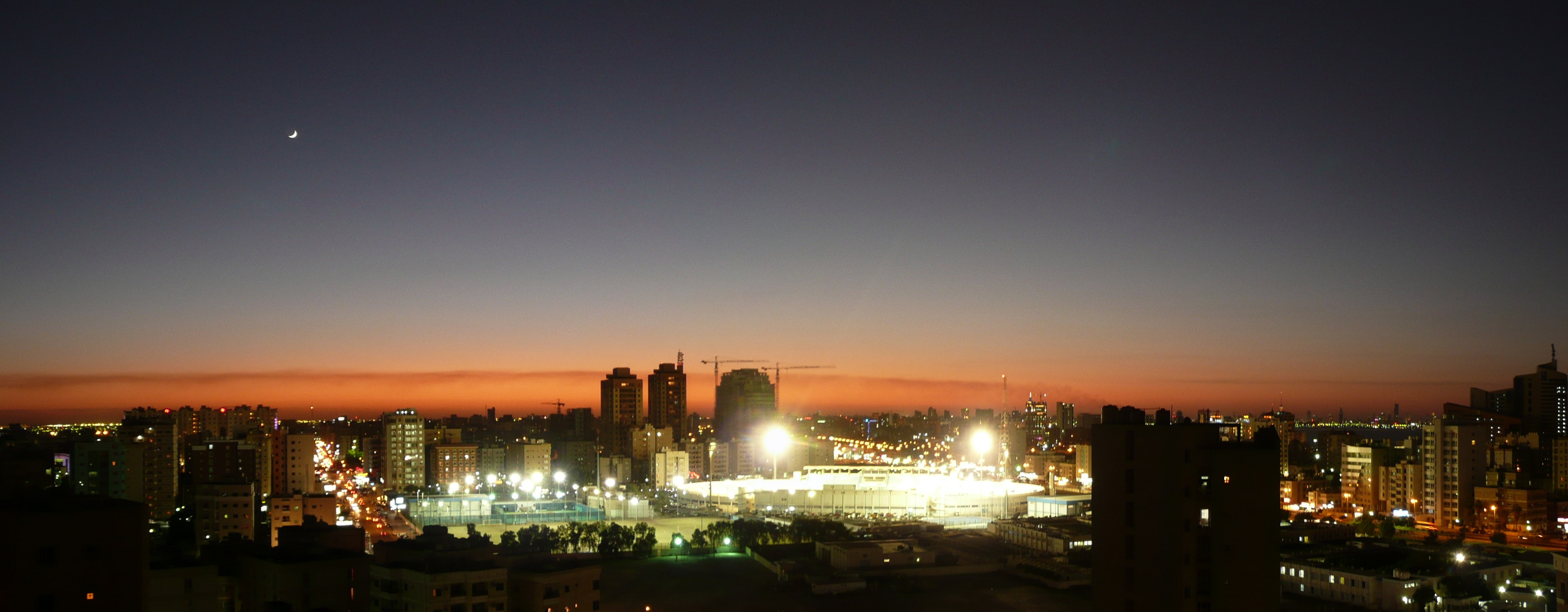
Kuwait
The pearl divers used to descend on a single breath, weighted stones pulling them to the Gulf floor where they pried oysters from the seabed with bleeding fingers. For centuries, this was Kuwait's economy: men risking their lives in warm, shallow water from June to September, surfacing with treasures that connected this small peninsula to markets across India, Persia, and Mesopotamia. Then came oil. The Burgan field, one of the largest reserves ever discovered, made pearl diving obsolete and Kuwait fabulously rich. What the pearl divers could never have imagined was that the same wealth would nearly destroy the country.
A Trading Post Between Empires
Kuwait sits at the northwestern corner of the Persian Gulf, wedged between Iraq to the north and Saudi Arabia to the south. The country is small, roughly the size of New Jersey, and almost entirely flat desert. Summers push past 50 degrees Celsius. Rain is rare. Yet this inhospitable strip of coast has attracted settlement for millennia precisely because of its position. Traders from Aleppo and Syria passed through on routes connecting Mesopotamia to the Indian Ocean. The Al Sabah family has ruled since 1756, originally chosen by merchant families to govern what was then a modest port town. British protection formalized in 1899 kept the Ottomans at bay, and later kept the newly formed Kingdom of Iraq from absorbing its smaller neighbor. Geography made Kuwait strategically valuable long before anyone drilled for oil.
Black Gold and the End of Pearls
Oil exports began in earnest after World War II, and the transformation was swift. Kuwait became one of the wealthiest countries per capita on Earth. The Kuwaiti dinar remains the highest-valued currency unit in the world. The government provides citizens with free healthcare, free education, and subsidized housing. There is no income tax. But the wealth brought complications. By 2012, the population stood at roughly 3.8 million, with Kuwaitis forming only 45 percent. The remaining 55 percent are expatriates, drawn from Egypt, South Asia, Iran, and beyond, who do much of the work that keeps the country running. This creates a society of sharp contrasts: gleaming malls and luxury hotels alongside labor camps, constitutional monarchy alongside restrictions on speech that can lead to deportation.
Seven Months of Darkness
On August 2, 1990, Iraqi forces invaded Kuwait, citing disputes over oil production quotas and a debt of approximately 37 billion dollars from the Iran-Iraq War. The country fell in two days. What followed was seven months of occupation: looting, destruction, and the deliberate sabotage of oil infrastructure. When a coalition of 35 nations drove Iraqi forces out on February 26, 1991, retreating soldiers set fire to over 600 oil wells. The fires burned for months, blackening the sky across the entire region. Kuwait spent years and billions of dollars rebuilding. The invasion remains the defining event of modern Kuwaiti identity, commemorated annually on Liberation Day, February 26, and National Day, February 25.
Life in the Desert Monarchy
Modern Kuwait operates under a constitutional monarchy with an elected National Assembly, one of the more open political systems in the Gulf region. Women gained the right to vote in 2005. Alcohol is completely illegal, and possession carries harsh penalties. The country is overwhelmingly Muslim, with a significant Shia minority alongside the Sunni majority. Daily life revolves around the rhythms of heat and air conditioning. The spring months of March and April offer the only truly comfortable outdoor weather. Kuwaitis have adapted by building inward: malls serve as public gathering spaces, and the coastal road comes alive after dark when families walk along the Gulf shore. The cuisine reflects the country's position at a crossroads: Iranian, Lebanese, Indian, and Bedouin dishes are all standard fare, and the traditional fish markets still sell the day's catch from waters that once yielded pearls.
Small Country, Long Shadow
From altitude, Kuwait appears as a thin crescent of development clinging to the coast, with unbroken desert stretching south and west. Failaka Island sits in Kuwait Bay, home to archaeological sites dating to the Bronze Age that connect this coast to the ancient Dilmun civilization. The Red Fort at Jahra recalls an earlier era of conflict, when Kuwaitis defended their territory long before the age of petroleum. It is a country that has been shaped by what lies beneath its surface, first pearls and then oil, and by the geopolitical pressures that come with occupying a small patch of land between much larger, more powerful neighbors. Kuwait endures not because of its size but because of a resilience tested repeatedly across centuries.
From the Air
Kuwait occupies the northwestern corner of the Persian Gulf at approximately 29.5N, 47.5E. The country is almost entirely flat desert with development concentrated along the coast. Kuwait International Airport (OKKK/KWI) is the primary airport, located south of Kuwait City. Failaka Island is visible in Kuwait Bay. The Iraq border lies roughly 80 km north of the capital. Best viewed from 10,000-15,000 feet for the full coastal panorama. Expect dust haze year-round and extreme heat shimmer in summer months. The Burgan oil field complex is visible to the south as a pattern of infrastructure in otherwise featureless desert.