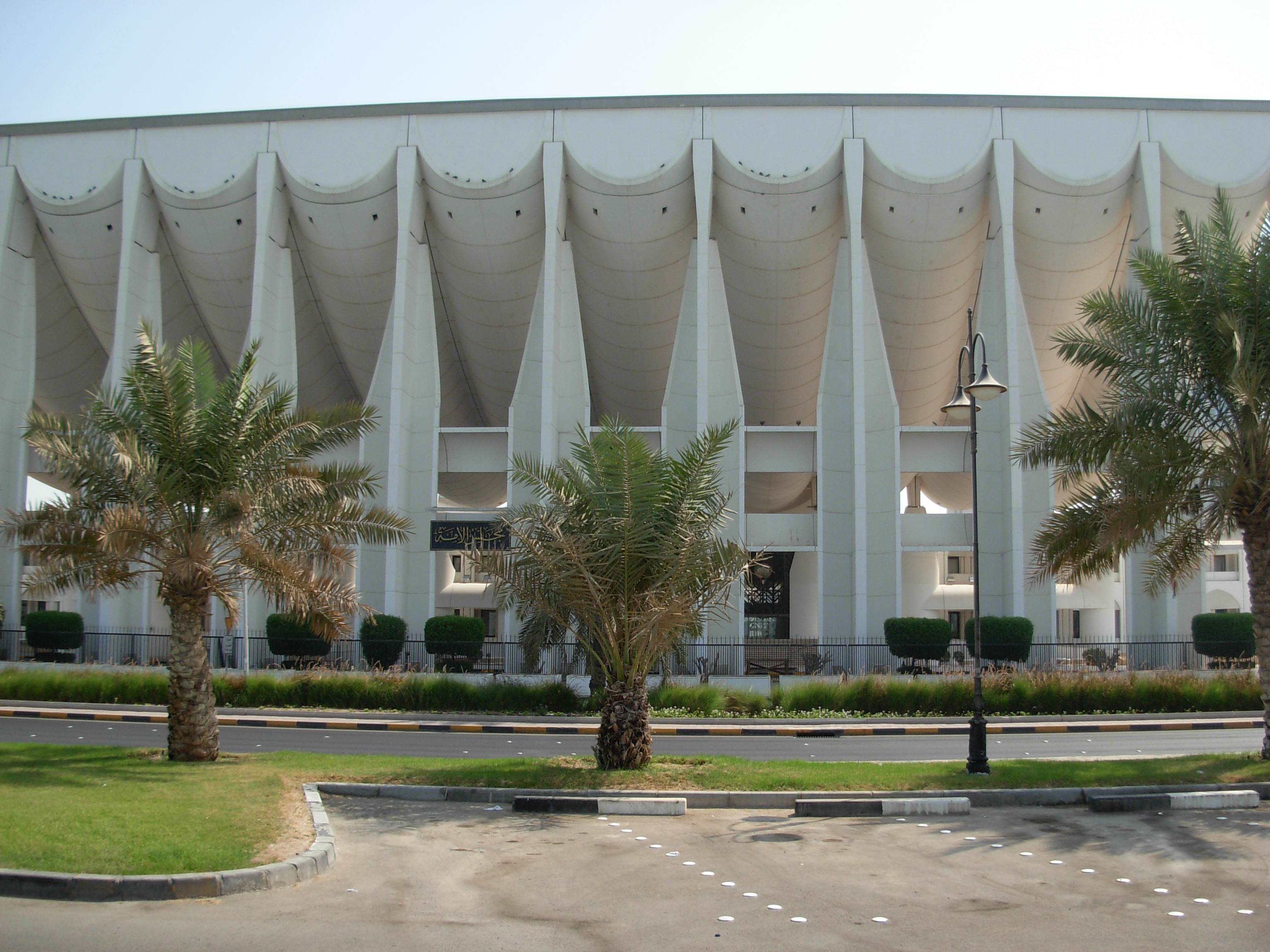
Kuwait National Assembly Building
The story goes that Jorn Utzon was working on the design for three years when he suddenly decided everything should be round. He demonstrated his new vision to his colleagues by lining up beer bottles on a table. Those improvised cylinders became the tapered concrete columns that now march through Kuwait's parliament building like a colonnade lifted from ancient Egypt, reinterpreted in prefabricated white cement. It was a gesture typical of Utzon, the Danish architect who had already proved with the Sydney Opera House that he could bend geometry to emotion. In Kuwait, he bent it to politics.
A Souk for Democracy
When Kuwait's government invited Utzon to compete for the National Assembly commission in late 1969, the newly independent nation was building institutions to match its ambitions. Utzon, living in Hawaii at the time, sent preliminary sketches to Oktay Nayman in London for construction drawings and to his son Jan in Denmark for models. What emerged was not a Western parliament in the conventional sense but a walled miniature city organized like a souk. A central hall served as the bazaar street, with government departments branching off like side alleys. The hall led to a ceremonial entrance beside a covered public square facing the Persian Gulf. In Utzon's own words, the layout followed "the bazaars in the Middle East and North Africa," where commerce and conversation happen in the same breath. He applied the same logic to governance.
Fabric Cast in Concrete
The building's most striking feature is its flowing canopy roofs, which give 18,000 square meters of reinforced concrete the appearance of draped fabric. The central walkway, 130 meters long and 10 meters wide, serves as the trunk of the complex, with corridors and stairs branching like limbs to support ministerial offices. Utzon compared the structure to a tree. The vast assembly chamber, 82 meters by 34 meters, seats 50 members with room to expand to 150, while upper tiers accommodate 1,000 observers. True to Islamic architectural tradition, the debating chamber has no windows. Offices receive light only through interior courtyards, while corridors and the library are lit by half-barrel vault skylights that punctuate the flat roof. The entire complex is assembled from 12,800 specially shaped precast concrete elements drawn from 150 basic types, all finished in smooth white cement.
Where the Ocean Meets the Building
The public square, covering roughly 40 by 80 meters, features an inclined roof that rises toward the Gulf, supported by columns with semi-cylindrical shells. Eleven inclined semi-cylinders, each 7.5 meters wide, are post-tensioned with steel cables in a configuration that has no precedent in traditional construction. Utzon intended the covered square as a place where politicians could address citizens like tribal leaders standing beneath a tent. He pushed the metaphor further, describing the relationship between the building and the sea in almost biological terms: "The hall seems to be born by the meeting between the ocean and the building in the same natural way as the surf is born by the meeting of the ocean and the beach." Max Walt, the structural engineer from Zurich whom Utzon hired after budget cuts forced him to abandon his original Danish engineer, made the audacious geometry buildable.
Burned and Rebuilt
In August 1990, Iraqi forces invaded Kuwait. Saddam Hussein declared the country Iraq's nineteenth province. When the international coalition drove Iraqi troops out in February 1991, retreating soldiers set the National Assembly Building on fire. The building that Utzon had designed as a symbol of democratic self-governance became, briefly, a casualty of authoritarian aggression. Restoration cost approximately $70 million. The work was not a perfect recreation. Changes were imposed: the central hall was interrupted to create exhibition space, grey stone cladding replaced the original finish on some columns, and the covered public square was altered with curbs, guard houses, and plantings that Utzon had not envisioned. Yet the building endured. Architectural critic Richard Weston called it "one of the few architecturally compelling achievements by a Western architect in the Middle East," comparing Utzon's fraught adventure in Kuwait to Le Corbusier and Louis Kahn's work on the Indian subcontinent.
From the Air
The Kuwait National Assembly Building sits at 29.370N, 47.964E on Arabian Coast Street along Kuwait City's waterfront, facing the Persian Gulf. From altitude, look for the distinctive white canopy roofs along the shoreline, northwest of the city center. Kuwait International Airport (OKBK) is approximately 16 km to the south-southwest. The building's sweeping concrete canopies contrast with the flat-roofed urban blocks surrounding it. Nearby landmarks include the Kuwait Towers to the northeast along the waterfront and Al Shaheed Park to the south.