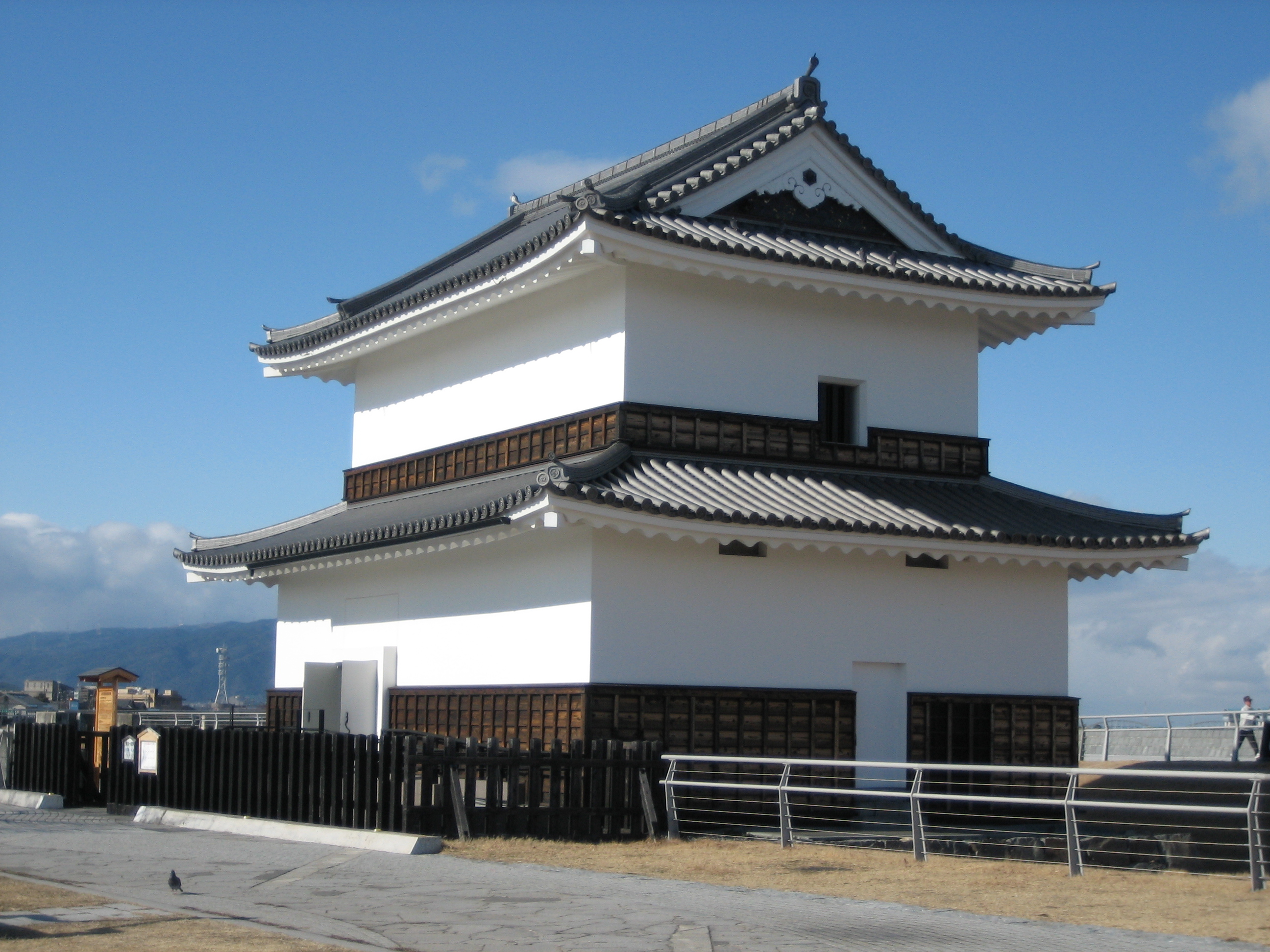
Kuwana Castle
Honda Tadakatsu never lost a battle. Known as one of the Four Heavenly Kings of the Tokugawa, he fought in over a hundred engagements and never received a serious wound. So when Tokugawa Ieyasu needed someone to build a fortress at one of the most strategically important points in Japan, the gateway where the Tokaido highway met Ise Bay, he sent Honda. The castle that rose on the banks of the Kiso River at Kuwana in northern Mie Prefecture was as formidable as the man who designed it: a triangular fortress with a six-story tower, 36 watchtowers, 46 gates, and an entire river serving as its eastern moat. For over two and a half centuries, Kuwana Castle controlled the crossing point where every traveler between Edo and Kyoto had to board a boat, because there were no bridges across the delta. Today only stone foundations and two reconstructed watchtowers remain, but the story of the castle reaches from medieval merchant guilds to the final civil war of samurai Japan.
A Thousand Houses on the Bay
Long before Honda Tadakatsu arrived, Kuwana was already important. During the Heian and Muromachi periods, the port city sat on Ise Bay and was controlled by a powerful guild of merchants. In 1515, the poet Socho described it as a major city with over a thousand houses, temples, and inns. Three fortifications, known collectively as the Three Castles of Kuwana, protected the harbor: Higashi Castle, Nishi Castle, and Misaki Castle. During the Sengoku period, the area fell under the influence of the Ikko-ikki, the militant Buddhist movement centered at nearby Nagashima. Oda Nobunaga crushed the Ikko-ikki and awarded the region to his general Takigawa Kazumasa. After Nobunaga's assassination, the area changed hands repeatedly as Toyotomi Hideyoshi and then Tokugawa Ieyasu consolidated power. By 1600, Kuwana's strategic value was undeniable: it sat at the mouth of the Nagara River, on the western edge of the delta formed by the Kiso, Nagara, and Ibi rivers, directly on the Tokaido highway that connected the shogun's capital to the imperial capital.
The Warrior's Fortress
After the Battle of Sekigahara in 1600, Ieyasu transferred Honda Tadakatsu from Otaki Castle in Kazusa Province to Kuwana with orders to build. Honda chose the site of the old Higashi Castle on the riverbank and constructed a fortress engineered for defense at every scale. The main enclosure was rectangular, measuring 150 by 60 meters, anchored by a four-roofed, six-story tenshu tower with three-story yagura watchtowers at each corner. What made Kuwana unusual was its layered design: secondary and tertiary enclosures served purely as defensive buffer zones rather than residential areas, a departure from the pattern at most Japanese castles. The Kiso River itself formed the eastern wall, while a water moat reinforced the western approach where any attack was most likely to come. Under Honda's administration, Kuwana-juku developed into a prosperous post town, a required stop for every Tokaido traveler heading to or from the ferry crossing to Owari Province.
Fire, Silence, and Surrender
In 1617, the Honda clan was transferred to Himeji Domain, and Kuwana passed to a cadet branch of the Matsudaira clan, who would hold it for the remainder of the Edo period. The castle's grandest chapter ended abruptly in 1701 when fire consumed the tenshu and most of the surrounding castle town. The Tokugawa shogunate refused permission to rebuild the tower, and what remained was restored on a much smaller scale. For the next century and a half, Kuwana Castle stood diminished, its six-story tower replaced by absence. The castle's final act came during the Boshin War of 1868-1869, Japan's last samurai civil war. Kuwana's lord, Matsudaira Sadaaki, was a key Tokugawa loyalist and the younger brother of Matsudaira Katamori of Aizu Domain. While Sadaaki fought the imperial Satcho Alliance in northern Japan, his castle was surrendered without resistance. Meiji government troops set it ablaze, and after the restoration, even the stone walls were torn down and repurposed as breakwater material at Yokkaichi Port.
What the Stones Remember
In 1928, what remained of the inner bailey and a portion of the second bailey were converted into Kyuka Park, a public green space where fragments of stone walls and moat channels still trace the castle's original footprint. The ruins were designated a Mie Prefectural Historical site in 1942. Two reconstructed yagura watchtowers stand today, their white plaster walls and dark wooden frames offering a glimpse of what once was a sprawling military complex. The castle site is a twenty-minute walk from Kuwana Station, an easy detour for anyone traveling the modern rail corridor that replaced the Tokaido highway. Standing on the old stone foundations where Honda Tadakatsu's six-story tower once commanded views of the river delta, the bay, and the distant mountains of Owari, visitors look out over the same waterway that defined Kuwana's importance for five centuries. The Kiso River still flows past, indifferent to the fortress that once claimed it as a moat.
From the Air
Kuwana Castle ruins are at 35.06N, 136.70E on the banks of the Kiso River in northern Mie Prefecture, near where the river empties into Ise Bay. The castle site is now Kyuka Park, visible as a green space with remnants of moats along the river. The triangular layout and relationship to the river are best appreciated from 2,000-3,000 feet. The Kiso, Nagara, and Ibi river delta is clearly visible from altitude as three parallel channels crossing the Nobi Plain. Nearest airports: RJGG (Chubu Centrair International Airport) approximately 25 km south across Ise Bay, RJNA (Nagoya Airfield/Komaki) approximately 30 km northeast. Kuwana Station and the city grid provide good visual reference. Clear conditions recommended.