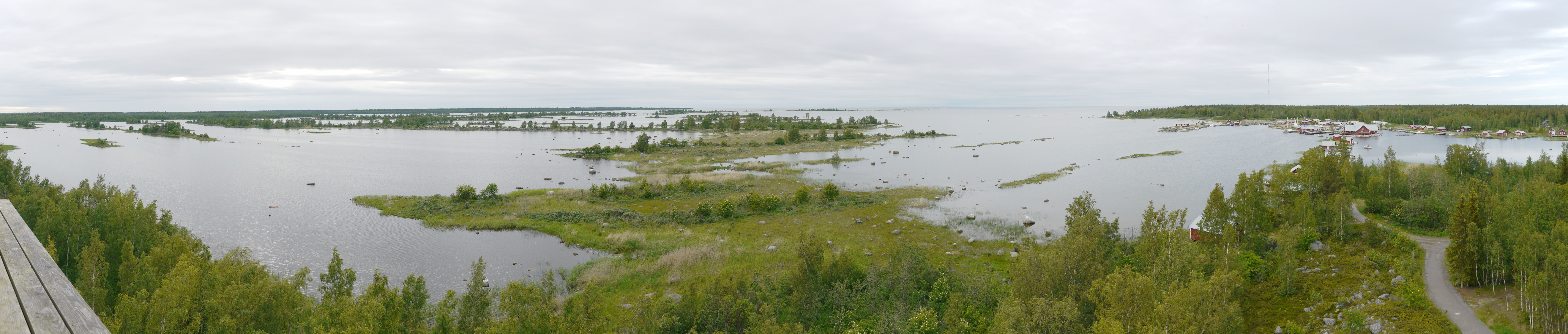
Kvarken Archipelago
New rocks appear in the Kvarken Archipelago fast enough to ruin a nautical chart. The land here rises roughly eight millimeters per year -- a rate that sounds negligible until you calculate that it produces one square kilometer of new territory annually. Islands that were open water a generation ago now break the surface. Peninsulas that were once separate islands have fused to the mainland. Boaters navigate cautiously, because skerries shoved upward by post-glacial rebound or shifted by winter sea ice can materialize where none existed the previous season. This UNESCO World Heritage Site in the Gulf of Bothnia, off the coast of the Finnish city of Vaasa, is a landscape caught in the act of becoming.
Geology in Fast Forward
The explanation lies under several kilometers of ice that no longer exist. During the last glacial period, the sheer weight of the ice sheet depressed the Earth's crust across Scandinavia and Finland. When the glaciers melted, the land began to bounce back -- a process called post-glacial rebound that continues today. The Kvarken Archipelago and Sweden's neighboring High Coast together demonstrate this phenomenon more clearly than anywhere else on Earth, which is why UNESCO inscribed them jointly as a World Heritage Site. The archipelago consists of some 6,550 islands, shaped by De Geer moraines -- ridged deposits left by the retreating ice sheet -- that give the shallow seabed a distinctive washboard texture. The largest island, Replot, is Finland's eighth largest and home to the majority of the archipelago's roughly 2,500 residents, though it technically sits just outside the World Heritage boundary. The village of Bjorkoby on the island of Bjorko sits squarely within it.
A Swedish Corner of Finland
Unlike most of Finland, the Kvarken Archipelago is exclusively Swedish-speaking -- a cultural pocket that survived in part because of its isolation. Regular ferry service did not begin until 1952, and the bridge connecting Replot to the mainland was not built until 1997. Before that, the archipelago's communities had limited contact with the broader Finnish-speaking population, and a monolingual Swedish culture persisted largely unchanged. The area belonged to the municipality of Korsholm, and the Swedish language, customs, and identity still define daily life. Summer cottagers from elsewhere in Finland are the main exception to the linguistic pattern. The isolation also shaped the economy: fishing harbors and seasonal pastures dot the islands, remnants of a subsistence culture adapted to a landscape that kept rewriting itself beneath the inhabitants' feet.
Navigating a Living Seascape
The best way to experience the heritage site is by boat, but the shallow, rock-strewn waters demand local knowledge. New obstacles appear with uncomfortable frequency, moved by ice or pushed up from below by the relentless rebound. Seasonal World Heritage Cruises operate from late June through mid-August, with advance booking required and cancellations in rough weather. The remote archipelago of Valsorarna, a rich stopover for migrating birds, is reachable only by boat and visited on some of these cruises. On land, four designated hiking trails wind through the islands, revealing both the geological story and the human one -- former fishing harbors, abandoned pastures, and shorelines that have shifted noticeably within living memory. Kayaking along the coast offers an intimate view of the shallow seas, and the Terranova exhibition at the Ostrobothnian Museum in Vaasa provides essential geological context before venturing out.
Light, Wind, and Sea Buckthorn
The archipelago is one of Finland's sunniest locations, a fact that surprises visitors expecting Nordic gloom. At this latitude, summer nights barely darken -- the sun skims the horizon and the sky holds a pale luminosity through the small hours. Wind, however, is the constant companion. The open sea funnels gusts across the low islands with enough force that a warm jacket is wise even in July. The Valsorarna-Bjorkogrunden nature reserve protects much of the archipelago, with strict rules during nesting season from May through July, when landing is prohibited except at designated spots. A seal reserve west of Valsorarna keeps boats at a minimum one-kilometer distance. For those who time their visit to late August or September, the sea buckthorn berries are worth seeking out -- small, tart, thorny to pick, and rich enough in flavor to justify the effort. Replot's church village offers a grocery store and gas station, and cafes operate in Bjorkoby and at the guest harbor, but provisions are otherwise scarce. This is a place where you plan ahead or go without.
From the Air
Located at 63.27N, 21.38E in the Gulf of Bothnia off the coast of Vaasa, western Finland. The archipelago is a UNESCO World Heritage Site visible from altitude as a vast scatter of low islands and skerries in shallow water. The Replot bridge connecting the largest island to the mainland is a distinctive landmark. Nearest airport is Vaasa Airport (EFVA), approximately 15 km to the southeast. The flat, island-dotted seascape contrasts with the Swedish High Coast visible across the gulf to the west. Best viewed at 5,000-10,000 feet where the full extent of the archipelago and its De Geer moraine patterns become apparent.