Kvernes Stave Church
Fifty meters is all that separates Norway's seventeenth-century past from its nineteenth-century present. On the shores of the Kvernesfjorden in Averoy, two churches stand side by side: the newer Kvernes Church, built in 1893, and its predecessor, a white wooden stave church built around 1631-33. The older building is so small that its nave measures just sixteen meters long, making it the only stave church in Norway built after the Reformation -- a remarkable anomaly, using a medieval building technique more than a century after the style had died out elsewhere. Yet within those modest dimensions, nearly four hundred years of worship, war, and national transformation have left their mark.
Timber and Faith on the Fjord
The earliest written records mentioning Kvernes Stave Church date to 1400, but dendrochronology research completed in 2020 established that the church was built in 1631-33 -- well after the Reformation and long after stave construction had ceased elsewhere in Norway. It belongs to the More type of stave construction, a regional style characterized by central posts set into the external walls and joined by crossbeams rather than the free-standing internal columns found in grander stave churches like Borgund or Urnes. The result is an intimate, low-ceilinged space where the structure itself seems to draw close around its congregation. When the church was completed, workers placed the front entrance on the southern side and built the choir in a new timber-framed style. A bell tower was repaired in 1648, a porch added between 1661 and 1663, and a sacristy constructed around 1689. Each generation left its fingerprint on the building without destroying what came before.
Where Norway Voted for the First Time
In 1814, Norway found itself in the middle of a constitutional revolution. After centuries under Danish rule, the country seized the opportunity created by the Napoleonic Wars to draft its own constitution. More than three hundred parish churches across Norway served as polling stations for elections to the Constituent Assembly at Eidsvoll Manor, and Kvernes Stave Church was among them. Fishermen, farmers, and local leaders gathered in this small wooden building to choose electors who would represent their county at the assembly. It was Norway's first national election, a foundational moment in the country's democratic history, and it happened in a church barely large enough to seat two hundred people. The Constitution of Norway, written at Eidsvoll later that year, remains in force today, one of the oldest written constitutions still in use.
Saved by Strangers
By the late nineteenth century, the old stave church had been eclipsed. The parish built its new church in 1893 just fifty meters to the south, and the older building was retired from regular worship. What might have become a story of demolition or slow decay instead became one of preservation. In 1894, a group of private citizens purchased the disused church and donated it to the Society for the Preservation of Ancient Norwegian Monuments. The society undertook careful restoration work, stabilizing the structure while respecting its layered history. Today the building operates as a museum, its altar and baptismal font still in place, its walls carrying the quiet authority of a space that has served its community for nearly four centuries.
The Weight of Small Things
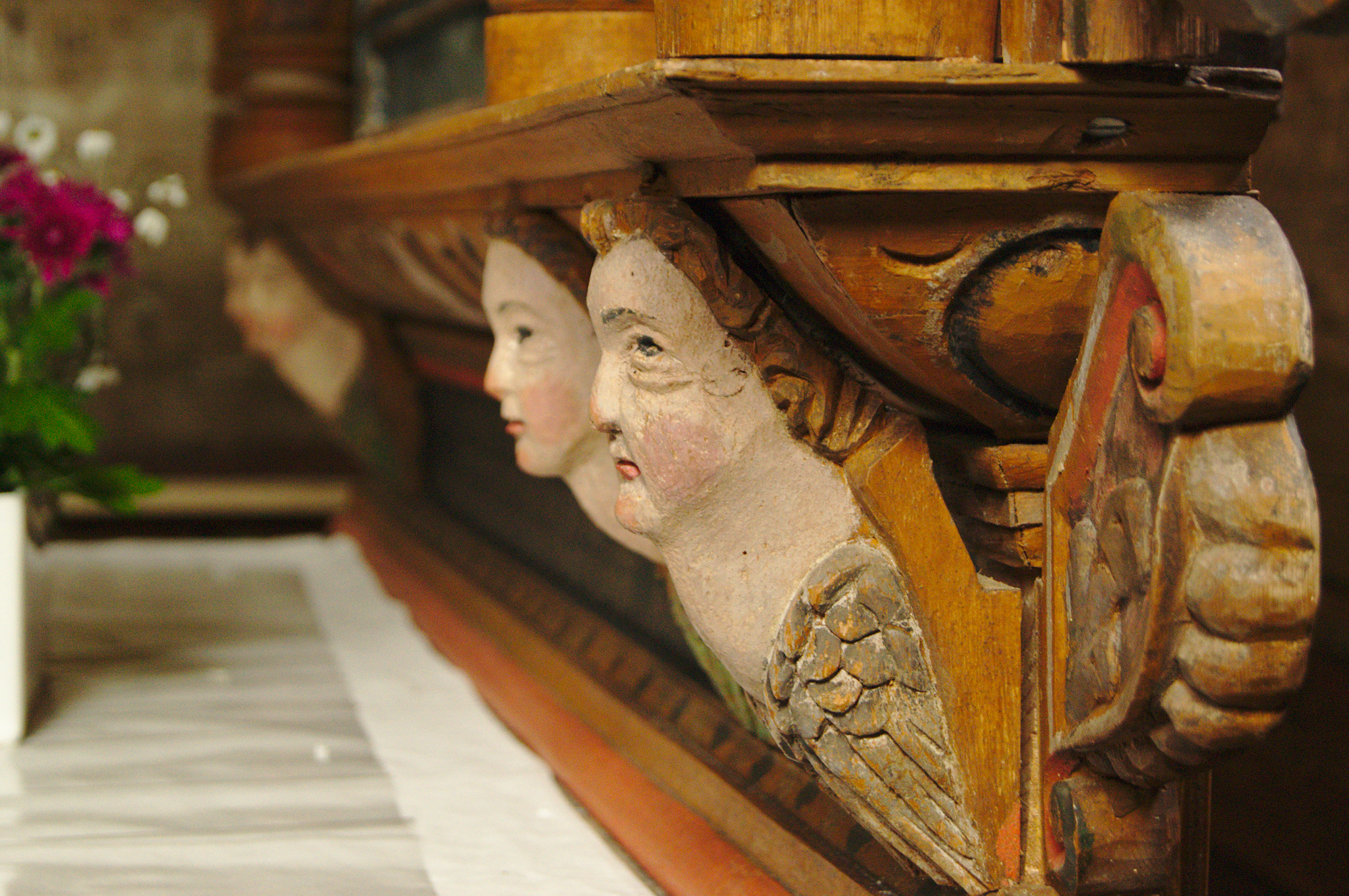
Stave churches were once common across medieval Scandinavia. Estimates suggest that more than a thousand were built in Norway alone. Fewer than thirty survive. Kvernes endures not because it was the grandest or the most architecturally innovative, but because someone in the 1630s chose to build a stave church -- an obsolete technique by then -- when a simpler log construction would have sufficed. Its pulpit, its carved woodwork, the worn surfaces of its baptismal font all carry the accumulated touch of generations. Standing inside, you can trace the blend of stave construction in the nave and timber-frame work in the choir, a snapshot of a tradition that the builder refused to abandon. The light through the windows falls on seventeenth-century wood shaped by hands that knew an older craft, and the silence has a particular depth that modern buildings rarely achieve.
From the Air
Kvernes Stave Church sits at 63.005N, 7.722E on the northern shore of Kvernesfjorden in Averoy, More og Romsdal county, Norway. From above, look for the distinctive white wooden church alongside its newer 1893 neighbor near the village of Kvernes on the island of Averoy. The nearest airport is Kristiansund Airport, Kvernberget (ENKB), approximately 15 km to the northeast. Best viewed at 1,500-3,000 ft AGL in clear conditions. The surrounding landscape of fjords and islands provides excellent visual reference points.