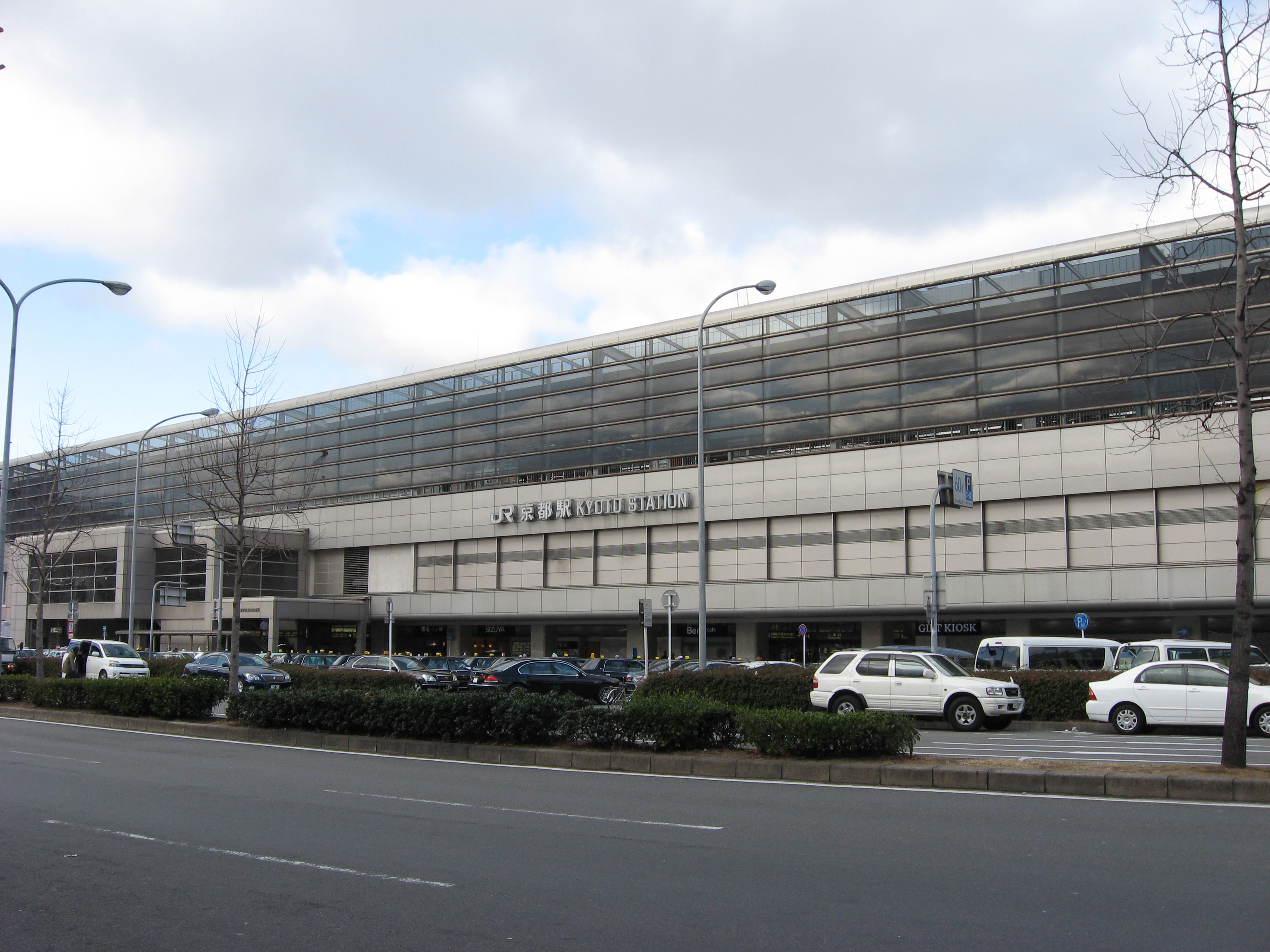
Kyoto Station
On January 8, 1934, a few thousand people crowded into Kyoto Station's second-generation building to bid farewell to naval recruits departing for service. In the crush, 77 people were killed. The elegant Renaissance-inspired station, designed to handle large crowds, had met a catastrophe no architect could have foreseen. That station would burn to the ground sixteen years later, but the tragedy etched into Kyoto's memory a truth about this place: it is not merely a transit hub but a gathering point for the emotions, ambitions, and farewells of an entire city.
The Emperor's Decree
Kyoto Station traces its origins to September 5, 1876, when the governmental railway line from the east first reached the ancient capital. The tracks were ready, but the station was not. A makeshift facility on Omiya Street served passengers until Emperor Meiji formally decreed the opening of the permanent station on February 5, 1877. By 1889, the line had become part of the Tokaido Main Line connecting Kyoto to Tokyo, and the station soon grew as two private railways terminated there: the Nara Railway in 1895 and the Kyoto Railway in 1897. What began as a single stop on an imperial rail line was becoming the nerve center of the Kansai region.
Four Lives, One Location
Few stations anywhere have been rebuilt as many times as Kyoto Station. The original 1877 building gave way to an elegant Renaissance-styled structure in 1914, complete with a grand square facing Shichijo Avenue that served as the backdrop for imperial motorcades when Emperor Showa traveled between Kyoto and Tokyo. After the 1950 fire, a utilitarian concrete replacement appeared in 1952, built for function over beauty. Then came the Shinkansen era in 1964, adding elevated platforms on the south side, followed by an underground shopping mall called Porta when the subway arrived in 1981. Each rebuilding reflected the priorities of its age: imperial grandeur, wartime pragmatism, high-speed modernity, and consumer convenience.
A Futurist Gamble
When architect Hiroshi Hara's design was selected for the station's fourth incarnation, Kyoto was still one of the least modern-looking cities in Japan, its skyline defined by temple roofs and traditional wooden structures. Hara's vision was deliberately provocative: a 70-meter-tall, 470-meter-wide glass-and-steel structure with a total floor area of 238,000 square meters, its facade an irregular cubic grid of plate glass that looked like nothing the ancient capital had ever seen. Locals were deeply skeptical. The station opened in 1997, timed to commemorate Kyoto's 1,200th anniversary as a city, and its futuristic profile ignited fierce debate about tradition versus progress. But the building's success triggered a wave of high-rise development in the city, culminating in the 20-story Kyocera Building.
Crossroads of a Nation
Today Kyoto Station is a world unto itself. Its JR West platforms alone see over 200,000 boarding passengers daily, making it the second busiest JR West station in the system. The Kyoto City Subway adds another 123,000 daily riders. Above the platforms, the station houses a department store, a hotel, a theater, and an art museum. Below ground stretches the Porta shopping mall. The Kintetsu Railway operates from the second floor, the Shinkansen races through on elevated tracks, and multiple bus terminals fan out from every gate. Highway buses depart for destinations as far as Sendai, Nagasaki, Kumamoto, and Miyazaki. The station even once hosted a City Air Terminal offering downtown check-in for flights out of Kansai International Airport, though the service was discontinued in 2002 for lack of ridership.
Kyoto Tower and Beyond
Step out the Karasuma Gate on the north side and the first thing you see is Kyoto Tower, the city's most recognizable modern landmark. Beyond it lies Higashi Honganji temple, one of the largest wooden structures in the world. This juxtaposition captures the essential tension of Kyoto Station's existence: it is a monument to velocity and connection set down in a city that has spent centuries perfecting stillness and contemplation. The station has also left its mark on popular culture, serving as the backdrop for the climactic battle in the 1999 film Gamera 3: Revenge of Iris and appearing in Sofia Coppola's 2003 film Lost in Translation, where Bill Murray's character is glimpsed on its Shinkansen platforms.
From the Air
Located at 34.985N, 135.758E in the heart of Kyoto, Japan. The massive station building stretches 470 meters east to west, making it visible from moderate altitude. Kyoto Tower (131 meters) stands immediately north of the station as a useful visual reference. The nearest general aviation airport is RJOY (Yao Airport) approximately 40km south, while Kansai International Airport (RJBB) lies roughly 90km to the southwest and Osaka Itami Airport (RJOO) is about 40km south. Best viewed at altitudes of 3,000-5,000 feet for the urban grid context.