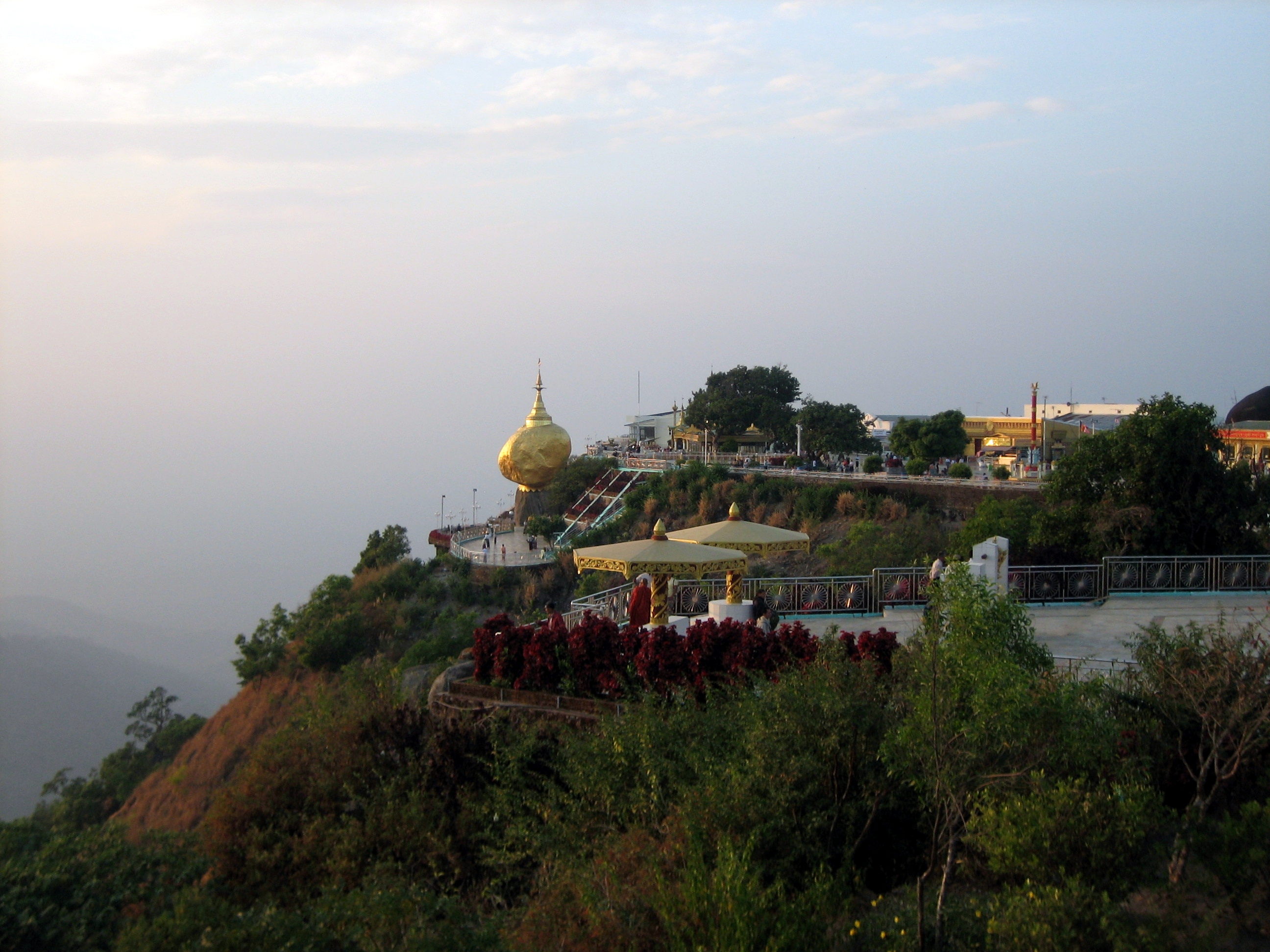
Kyaiktiyo Pagoda
A single strand of hair holds a 25-foot granite boulder in place. That is the claim, at least, and standing on the narrow platform at 1,100 meters above sea level, watching the Golden Rock catch the last light of day while pilgrims press gold leaf to its surface, the explanation feels no less plausible than the geological one. Kyaiktiyo Pagoda, perched on the eastern edge of Mon State's Kelasa hills, is one of Myanmar's most sacred Buddhist pilgrimage sites -- a place where physics appears to have made an exception for faith.
A Hermit's Head in Stone
The name itself carries the legend. In the Mon language, 'kyaik' means pagoda, 'htiyo' means carried on a hermit's head, and 'ithi' derives from the Pali word for hermit. Kyaiktiyo: the pagoda upon a hermit's head. According to the story, the Buddha gave a strand of his hair to a hermit named Taik Tha, who tucked it into the knot of his own hair for safekeeping. Taik Tha later entrusted the strand to a king whose lineage was already steeped in the supernatural -- his father was Zawgyi, an accomplished alchemist, and his mother a naga serpent princess. The king wished to enshrine the hair in a boulder shaped like the hermit's head, and with the help of Thagyamin, the king of Tawadeintha Heaven, he found the right stone at the bottom of the sea. That stone now sits on a cliff edge in southeastern Myanmar, apparently defying gravity. The boat that carried it turned to stone itself, and pilgrims still venerate it as the Kyaukthanban Pagoda, roughly 300 meters from the Golden Rock.
The Climb to Devotion
The pilgrimage begins at Kinpun, a village 16 kilometers from the summit. Open-sided trucks grind up a steep mountain road, passengers swaying through switchbacks as the Dawna Range opens below. At Yatetaung, vehicles stop. From here, the final 1.2 kilometers must be covered on foot -- and barefoot, in keeping with Burmese custom. The paved track, built in 1999, climbs steeply between kiosks selling offerings, food, and devotional trinkets. Granite boulders appear along the mountainside, many perched at their own improbable angles, as though the whole ridge were in on the balancing act. Near the summit, two stone lions guard the entrance. Beyond them, the Golden Rock reveals itself: smaller than photographs suggest, but more startling. Its entire surface is layered in gold leaf applied by generations of male devotees, giving the rough granite an almost organic shimmer, as though the stone were slowly transforming into something else entirely.
Gold Leaf and Candlelight
Only men are permitted to approach the rock and press gold leaf to its surface. Women worship from a platform several meters away. This tradition has shaped the boulder's appearance over centuries -- the gold is uneven, thicker in some places, curling at the edges in others, each patch the mark of an individual act of devotion. The pagoda itself is modest: a small stupa perched on top of the boulder, dwarfed by the rock it crowns. But modesty of architecture is not the point. On the full moon day of Tabaung in March, the platform surrounding the pagoda blazes with ninety thousand candles. Devotees arrive with fruit, incense, and food, filling the mountain air with smoke and chanting. The candlelight catches the gold leaf and the boulder seems almost to glow from within, as though the strand of hair it is said to contain were generating its own faint light.
Between Heaven and the Eastern Yoma
Kyaiktiyo sits on the Paung-laung ridge of the Eastern Yoma mountains, 210 kilometers from Yangon and 140 kilometers north of Mawlamyine, the capital of Mon State. The surrounding hills are dense with forest, and recently built temples and pagodas dot neighboring summits, connected by foot tracks that pilgrims and tourists share. The setting reinforces the sense of a landscape organized around faith -- each hilltop claimed by a stupa, each trail worn by devotion. Legend holds that pilgrims who trek from Kinpun base camp to the summit three times in a single year will be blessed with wealth and recognition. Whether or not the reward materializes, the repetition builds its own kind of understanding. Each ascent reveals the mountain differently: morning mist erasing the valley, midday heat sharpening every rock and leaf, dusk turning the Golden Rock into a dark silhouette before the candles bring it back.
From the Air
Located at 17.48N, 97.10E, on the Paung-laung ridge of the Eastern Yoma mountains in Mon State, Myanmar, at 1,100 meters elevation. The golden boulder is difficult to spot from altitude but the cleared summit area and pilgrimage infrastructure at Kinpun are visible. Nearest significant airport is Bago (no ICAO code for the nearest strip); Yangon International Airport (VYYY) is roughly 210 km to the southwest. Mawlamyine Airport (VYML) lies about 140 km to the south. Best visibility in the dry season (November to March).