Kylemore Abbey
Mitchell Henry fell in love twice in Connemara -- first with Margaret Vaughan, whom he married, and then with the landscape itself, which he encountered on their honeymoon in the 1840s. He was a wealthy London doctor from a Manchester textile family, and when he decided to build a castle for his wife in the wilds of County Galway, he built one that would take a hundred men four years to complete. It had seventy rooms, a 142-foot facade of granite hauled by sea from Dalkey, and walls three feet thick. It was, by any measure, a monument to devotion. Margaret died in 1874, and the monument became a memorial.
A Castle for Margaret
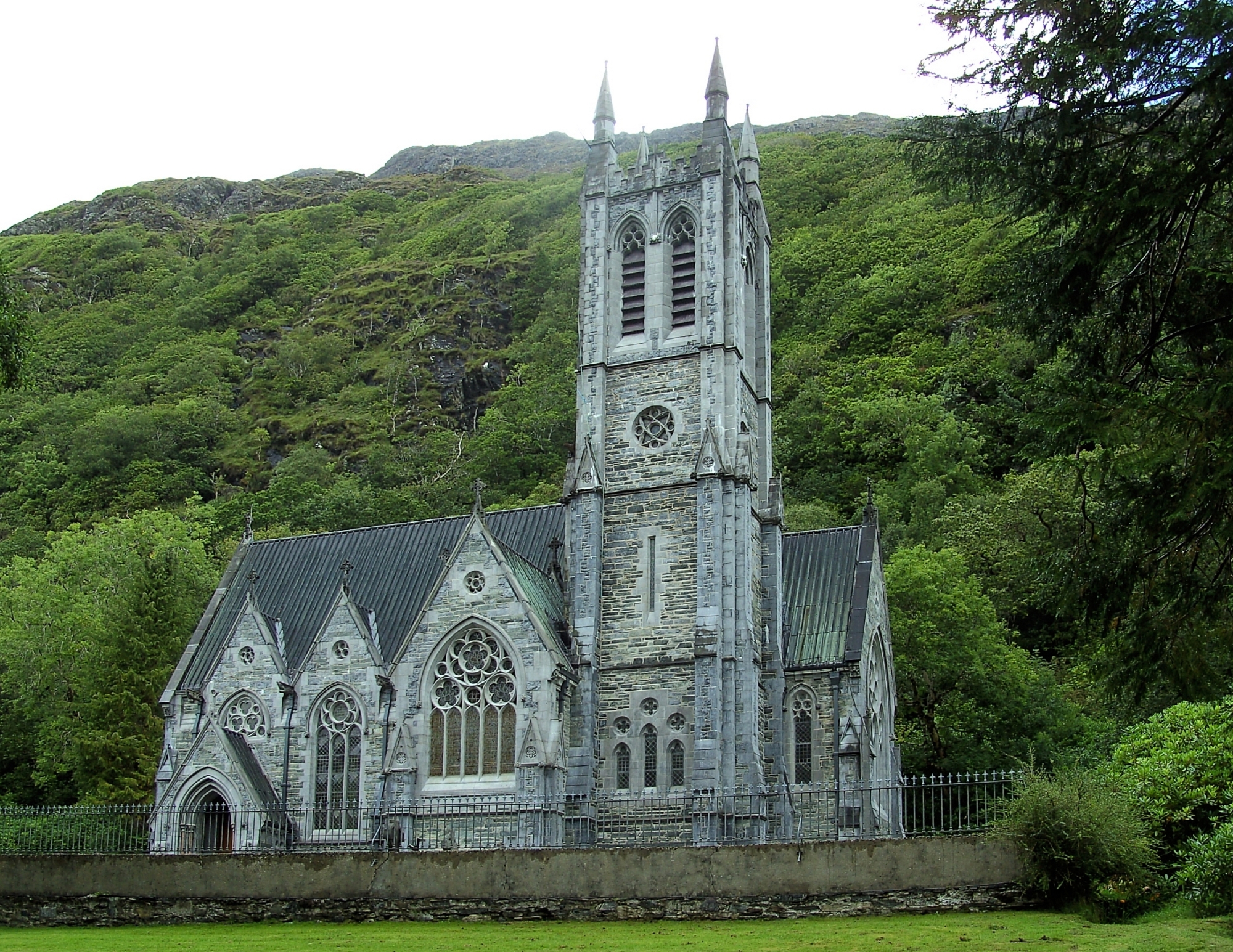
Construction of Kylemore Castle began in 1867, designed by architect James Franklin Fuller. The granite for its facade was shipped by sea to Letterfrack; limestone came from Ballinasloe. Inside were thirty-three bedrooms, a ballroom, billiard room, library, and quarters for a full complement of domestic staff. Mitchell Henry, who served as MP for County Galway from 1871 to 1885, divided his time between politics and his Connemara estate. But when Margaret contracted a fever during a visit to Egypt in 1874 and died, the castle's purpose shifted. Henry built a Gothic chapel and family mausoleum on the grounds, a miniature cathedral in the wilderness that still stands as one of the most poignant monuments in Ireland. He gradually withdrew from Connemara and eventually returned to England, leaving the castle in the hands of his estate.
Gamblers, Nuns, and the Ruins of Ypres
The castle's next chapter was less romantic. In 1903, the Duke and Duchess of Manchester purchased the property, then lost it to gambling debts. The estate might have continued to change hands among the Anglo-Irish gentry indefinitely, but World War I intervened. In Ypres, Belgium, a community of Irish Benedictine nuns had maintained an abbey for several hundred years -- their order tracing back to a house founded by Lady Mary Percy in Brussels in 1598. When the bombardment of Ypres destroyed their abbey, they were rescued by soldiers of the 8th Battalion of the Royal Munster Fusiliers and evacuated to England. In 1920, the nuns purchased Kylemore Castle and its grounds, transforming a rich man's folly into a working monastery.
Eight Hundred Years of Prayer
The Benedictine community at Kylemore brought with them a tradition centuries older than the castle. They ran a farm, raising livestock and vegetables. In 1923, they opened a boarding school for girls that served students from Renvyle, Letterfrack, and beyond for nearly a century before closing in 2010. The nuns restored the Victorian walled gardens -- originally laid out by head gardener James Garnier in 1870 -- beginning a complete restoration in 1995 that transformed them into one of Ireland's most visited garden attractions. In 2015, the University of Notre Dame established a partnership with the abbey, hosting academic programs for American students in the restored spaces. In 2022, Kylemore was accepted into the English Benedictine Congregation, formally joining a network of monasteries that spans from Sweden to Australia.
Stone and Silence on the Lakeshore
Kylemore Abbey sits at the base of Druchruach Mountain, its facade reflected in the still waters of Lough Pollacappul. From the air, the castle is unmistakable: a sprawling Gothic Revival structure of pale granite set against dark green hillsides, with the miniature Gothic church and walled gardens visible nearby. The estate encompasses some of the wildest landscape in Connemara, and a biodiversity stewardship program launched in 2021 with the University of Galway documents the species that share these grounds with the remaining Benedictine community. The contrast at Kylemore is always between scale and intimacy -- the grandeur of Henry's vision against the quiet persistence of monastic life, the vastness of the Connemara mountains against the careful geometry of the walled garden. It is a place where grief built something beautiful, and where faith has sustained it.
From the Air
Located at 53.56°N, 9.89°W on the shore of Lough Pollacappul in Connemara, County Galway. The abbey is a large Gothic Revival structure visible from moderate altitude, its pale granite facade distinctive against the surrounding bogland. The miniature Gothic church and walled gardens are visible nearby. Nearest airports: Connemara Regional Airport (NNR), approximately 15 km southwest; Galway Airport (EICM), approximately 70 km southeast. The abbey sits at the base of Druchruach Mountain in the Twelve Bens range.