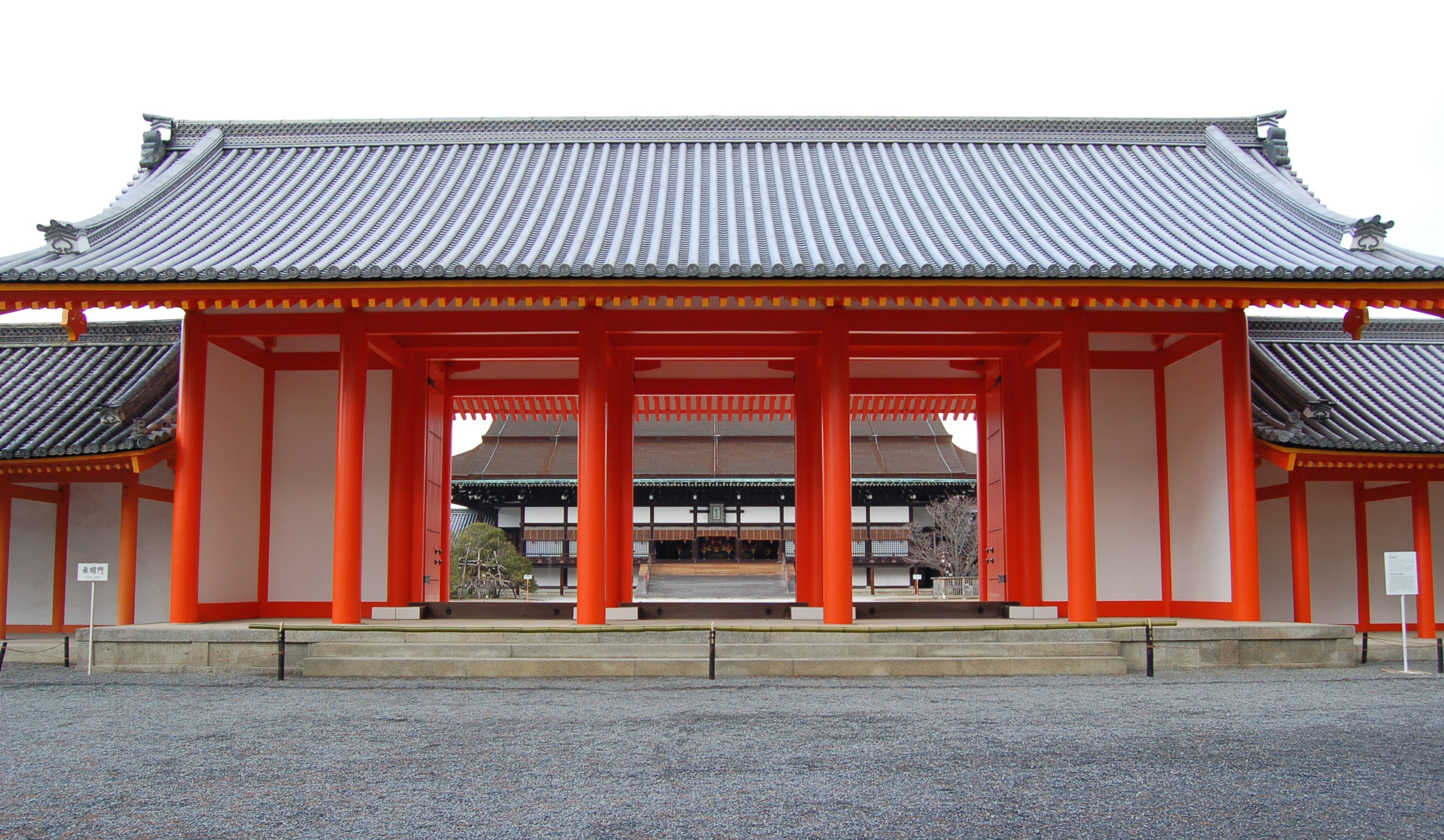
Kyoto Imperial Palace
Three rooms, three ranks, three grades of tatami. In the Shodaibu-no-ma waiting hall of the Kyoto Imperial Palace, visitors were sorted by status before they could proceed a single step further. The highest-ranking court nobles sat in the Tiger Room on finely patterned korai-beri mats. Mid-ranking courtiers waited in the Crane Room. And those of the lowest permitted rank were confined to the Cherry Blossom Room, whose red-bordered mats and walled north side made one thing perfectly clear: you would go no further. This obsessive choreography of rank and space defined imperial life in Kyoto for over five centuries, and the palace that remains today preserves it all in exquisite, unforgiving detail.
A Temporary Palace That Lasted Five Centuries
The Kyoto Imperial Palace was never meant to be permanent. When the Northern Court's Emperor Komyo occupied the Tsuchimikado Higashinotoin mansion on September 26, 1337, it was supposed to be a stopgap while a proper imperial palace was rebuilt. The original Heian Palace, constructed when the capital moved to Kyoto in 794, stood 1.7 kilometers to the west along Senbon-dori Street, but it had been abandoned since the late 12th century. The Northern Court planned a full reconstruction multiple times, but progress never materialized. Emperor Go-Kogon eventually accepted reality and made the Tsuchimikado mansion the permanent seat of power. It served five Northern Court emperors before a fire destroyed it in 1401. The shogun Ashikaga Yoshimitsu then rebuilt it at eight times its original size, modeling the new complex on the grandeur of the ancient Heian Palace.
Eight Fires, Eight Rebirths
During the Edo period alone, the palace was rebuilt eight times: in 1613, 1642, 1655, 1662, 1675, 1709, 1790, and 1855. The 1790 reconstruction was particularly significant. Shogun Tokugawa Ienari ordered the palace rebuilt according to a scholarly text called Daidairi Kosho by Uramatsu Kozen, which recorded the details of the original Heian-era imperial residence. This deliberate archaeological approach produced a palace that was both new and ancient, its architecture consciously reaching back across centuries to recover what fire had taken. When fire struck again in 1854, the 13th Tokugawa Shogun, Iesada, ordered yet another reconstruction at the request of Emperor Komei. The version standing today was completed between 1855 and 1866, covering approximately 13,000 square meters.
The Throne Behind the Screens
The Shishinden, the most important ceremonial hall, holds the Takamikura -- the Imperial Throne. The present throne was constructed in 1915 for the enthronement of Emperor Taisho, modeled on designs used since the enthronement of Empress Genmei in 707. It is a chair of black lacquer set beneath an octagonal canopy resting on a three-tiered vermilion-railed dais. A gold phoenix statue crowns the canopy, surrounded by eight smaller phoenixes, jewels, and mirrors. Beside the throne sits the Michodai, the slightly smaller August Seat of the Empress, topped by the mythical bird rancho. Both thrones remain hidden behind bamboo screens called misu when not in ceremonial use. The Shishinden hosted enthronement ceremonies from Emperor Meiji through Emperor Showa, and in 1868, it was here that the Charter Oath -- the five-article declaration that launched Japan into the modern era -- was proclaimed.
Where Shoguns Walked on Foot
The palace's hierarchy was architectural. Only the highest court nobles could enter through the Okurumayose, the curved-gable Carriage Porch, and even among them, only the most privileged could bring their vehicles to the entrance. When Shogun Tokugawa Iemochi visited in 1863 -- the first shogunal visit in roughly 230 years -- he was required to exit his palanquin at the Gishumon Gate and walk on foot to the Okurumayose. On his second visit the following year, his treatment was upgraded, and he was permitted to ride his palanquin directly to the entrance. Such minute adjustments in protocol carried enormous political meaning, each step a negotiation between imperial prestige and shogunal power.
An Emperor's Lament
When Emperor Meiji departed for Tokyo in 1869 as part of the Meiji Restoration, the palace lost its primary function. Within a decade, the grounds had deteriorated badly. Returning to Kyoto, Emperor Meiji was reportedly dismayed by the condition of his former home and in 1877 ordered the Imperial Household Ministry to preserve the palace and maintain its original appearance. In 1883 he issued a decree designating Kyoto as the permanent location for enthronement and Daijosai ceremonies. Today the palace, the neighboring Sento Imperial Palace gardens, and the surrounding Kyoto Gyoen National Garden are open to the public, with the Imperial Household Agency conducting tours several times daily through halls where the annual Aoi Matsuri procession still departs each May from the Kenreimon Gate.
From the Air
Located at 35.025N, 135.762E in the Kamigyo-ku ward of Kyoto, Japan. The palace sits within the rectangular Kyoto Gyoen park, an unmistakable green rectangle visible from altitude in the dense urban grid. The park measures approximately 1,300 meters north-south and 700 meters east-west. Doshisha University lies just north across Imadegawa Street. Nearest airports are RJOO (Osaka Itami, approximately 40km south) and RJBB (Kansai International, approximately 90km southwest). RJOY (Yao Airport) offers general aviation access about 45km south. Best viewed from 3,000-5,000 feet to appreciate the park's scale against the surrounding city.