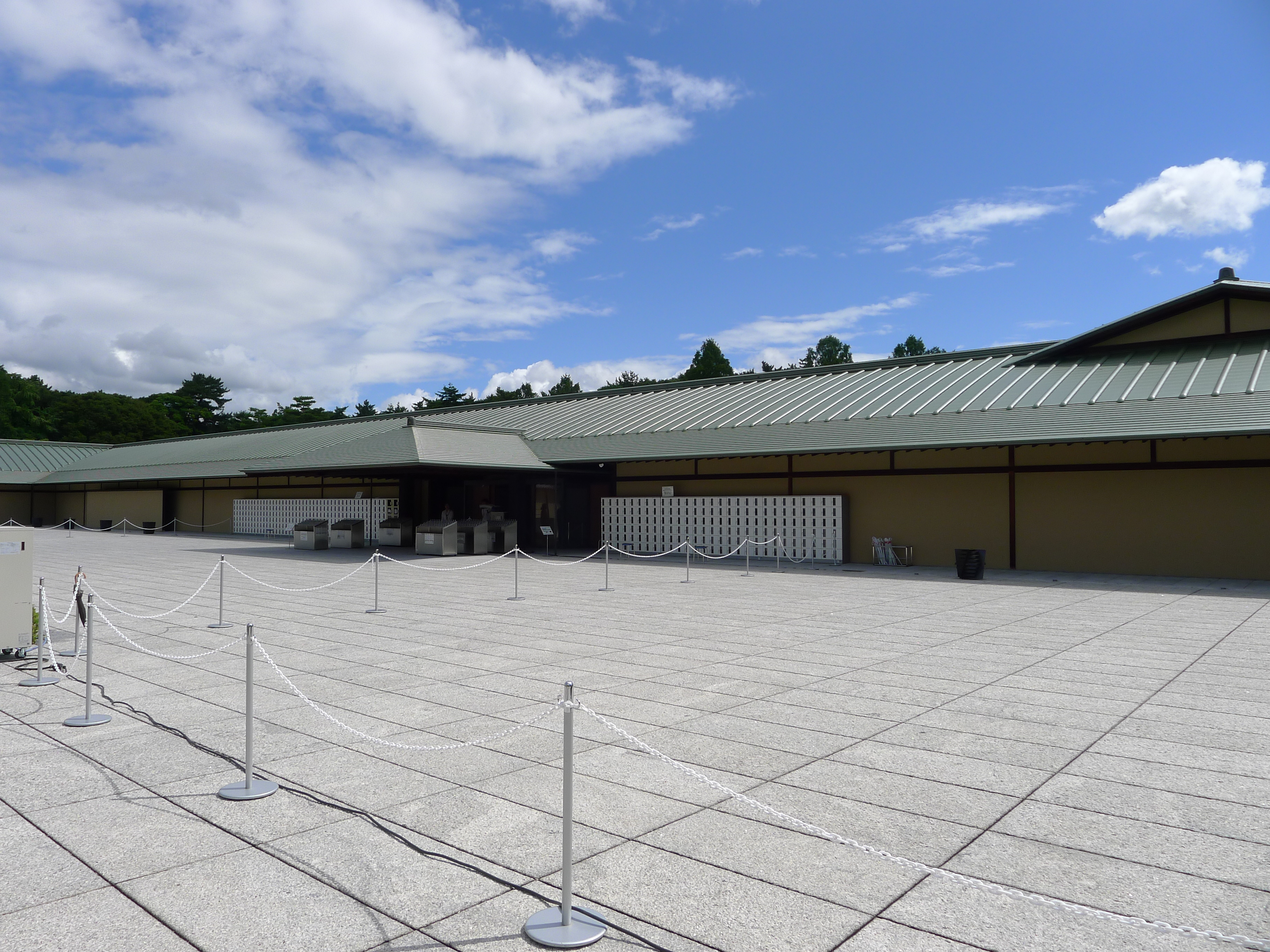
Kyoto State Guest House
A twelve-meter lacquered dining table, carved from a single slab of wood and adorned with paulownia flowers in maki-e lacquer, sits at the heart of one of Japan's most exclusive buildings. The Kyoto State Guest House is not a palace in the European sense -- it has no marble columns, no gilded ceilings. Instead, it practices the art of restraint, channeling centuries of Kyoto craftsmanship into spaces where presidents and prime ministers sit on tatami-edged floors, look out through deep wooden eaves, and contemplate gardens designed to blur the boundary between inside and out. Opened in April 2005 within the grounds of the Kyoto Gyoen National Garden, it stands as one of only two state guest houses operated by the Government of Japan, alongside the Western-style Akasaka Palace in Tokyo.
Born from a 1,200-Year Anniversary
The guest house owes its existence to a celebration. In 1994, Kyoto marked the twelve-hundredth anniversary of the founding of Heian-kyo, the ancient capital established in 794 that gave the city its cultural identity. The anniversary stirred a desire for something lasting -- a place that could showcase Japanese hospitality to the world. That October, the Cabinet of Japan approved construction of a guest house facility within the Kyoto Gyoen National Garden, the 65-hectare park surrounding the Kyoto Imperial Palace. The site was steeped in history: during the Edo period, aristocratic families like the Yanagihara and Kushige had maintained mansions on this very ground. Construction began in March 2002, and the 16,000-square-meter facility was completed in February 2005, opening its doors on April 17 of that year. Its first state guest would not arrive until November 2007, when Vietnamese President Nguyen Minh Triet became the inaugural visitor.
Where Garden and Building Become One
The architectural firm Nikken Sekkei designed the guest house around a philosophy called teioku-ichinyo -- the oneness of house and garden. The result is a building that does not merely look out onto its gardens but dissolves into them. Deep eaves extend the roof line over covered walkways, framing views of three distinct garden spaces: the "true garden" (shin no niwa) at the entrance, the "row garden" (gyo no niwa) in the central hall, and the "grass garden" (so no niwa) facing the guest rooms. Master gardener Sano Toemon, working under the supervision of landscape scholar Hiromasa Amagasaki, created a modern Japanese garden using materials and techniques native to Kyoto's climate. The building itself wears an irimoya-style roof and sukiya-style exterior, traditional residential forms that harmonize with the park's historic landscape rather than competing with it.
A Living Museum of Kyoto Craft
Walk through the guest house and you encounter an anthology of Kyoto's traditional arts. Sukiya carpenters shaped the wooden structures using centuries-old joinery techniques. Plasterers applied earthen walls by hand. Weavers from the Nishijin district produced brocade textiles for furnishings, continuing a silk-weaving tradition that dates to the fifteenth century. Kirikane artisans applied cut gold leaf in delicate patterns, a technique originally developed for Buddhist statuary. Lacquer workers created surfaces finished in urushi, the natural lacquer harvested from trees. The effect is not a museum display but a functioning diplomatic space where every surface tells a story of human skill. The contrast with the Akasaka Palace in Tokyo is deliberate and total: where Akasaka embraces European neo-baroque grandeur, the Kyoto Guest House speaks in the quiet, textured language of Japanese tradition.
Opening the Doors
For its first eleven years, the guest house served exclusively as a diplomatic facility, closed to the general public. That changed in July 2016, when year-round public opening began. Visitors can now walk the same corridors that have hosted heads of state, peer into the banquet hall with its famous lacquered table, and stroll through the gardens that were designed to impress diplomats accustomed to the grandest settings on Earth. The opening reflected a broader shift in how Japan presents its cultural heritage -- not as something locked away for elites, but as a living tradition available to anyone willing to stand in line. The guest house sits on a 20,140-square-meter lot within the larger Kyoto Gyoen, meaning visitors can combine a tour with a walk through the park that also contains the Kyoto Imperial Palace and the Sento Imperial Palace gardens, creating a corridor through centuries of Japanese architecture and landscape design.
From the Air
Located at 35.025N, 135.766E within the Kyoto Gyoen National Garden, northeast of central Kyoto. The guest house is not visible as a standalone structure from altitude but sits within the large green rectangle of the Kyoto Gyoen park, which is clearly identifiable from above. Nearest airports: Osaka Itami (RJOO, 36 km southwest) for domestic flights and Kansai International (RJBB, 77 km south) for international. Best viewed at 3,000-5,000 ft to appreciate the park layout against Kyoto's grid street pattern. The surrounding mountains frame the Kyoto basin distinctly.