Kyoto Tower
Step off the train at Kyoto Station and look up. There it is -- white, tapering, unmistakable -- a 131-meter steel candle rising from the rooftop of a nine-story building directly across the street. Kyoto Tower has been the first thing visitors see when they arrive in Japan's ancient capital since December 28, 1964, and for just as long, people have been arguing about whether it belongs there. In a city of wooden temples, moss gardens, and strict building height limits, a modernist steel tower shaped like a Buddhist candle was never going to be uncontroversial. Yet the tower endures, the tallest structure in Kyoto, offering 360-degree views from its observation deck at 100 meters to the million-plus visitors who rode its elevators in that triumphant first year.
A Candle for the Olympic Year
The tower was conceived in the early 1960s as Kyoto's answer to a national mood of transformation. Japan was racing to prepare for the 1964 Tokyo Summer Olympics, and cities across the country were building symbols of their ambitions. Kyoto's would rise from the site of the city's former central post office, directly facing the main train station. Architect Mamoru Yamada designed the tower with engineering guidance from Makoto Tanahashi, a doctor of engineering at Kyoto University. The shape was deliberate: a traditional Japanese candle, the kind used in Buddhist temples, tapering gracefully toward its tip. Construction began in 1963, and the tower was completed by year's end in 1964, just in time for the Olympic moment to have passed -- but the symbolism stuck. Kyoto had announced that it could be both ancient and modern.
Steel Skin, No Skeleton
What makes Kyoto Tower remarkable as engineering is invisible from the ground. The 800-ton structure uses a monocoque design -- the same principle that holds together aircraft fuselages and racing cars. Rather than hanging from an internal steel skeleton, the tower's outer shell of specially shaped steel sheets bears its own weight. This is exceptionally rare in tower construction. The approach gave Tanahashi the structural integrity he needed to meet Japan's demanding seismic and wind standards. The tower is rated to withstand winds of up to 90 meters per second -- roughly 200 miles per hour -- and to survive earthquakes exceeding the magnitude of both the Great Kanto earthquake of 1923 and the Great Hanshin earthquake of 1995. Sitting atop its nine-story base building, which houses a hotel and retail shops, the tower achieves its full height of 131 meters without a single internal column.
The View from 100 Meters
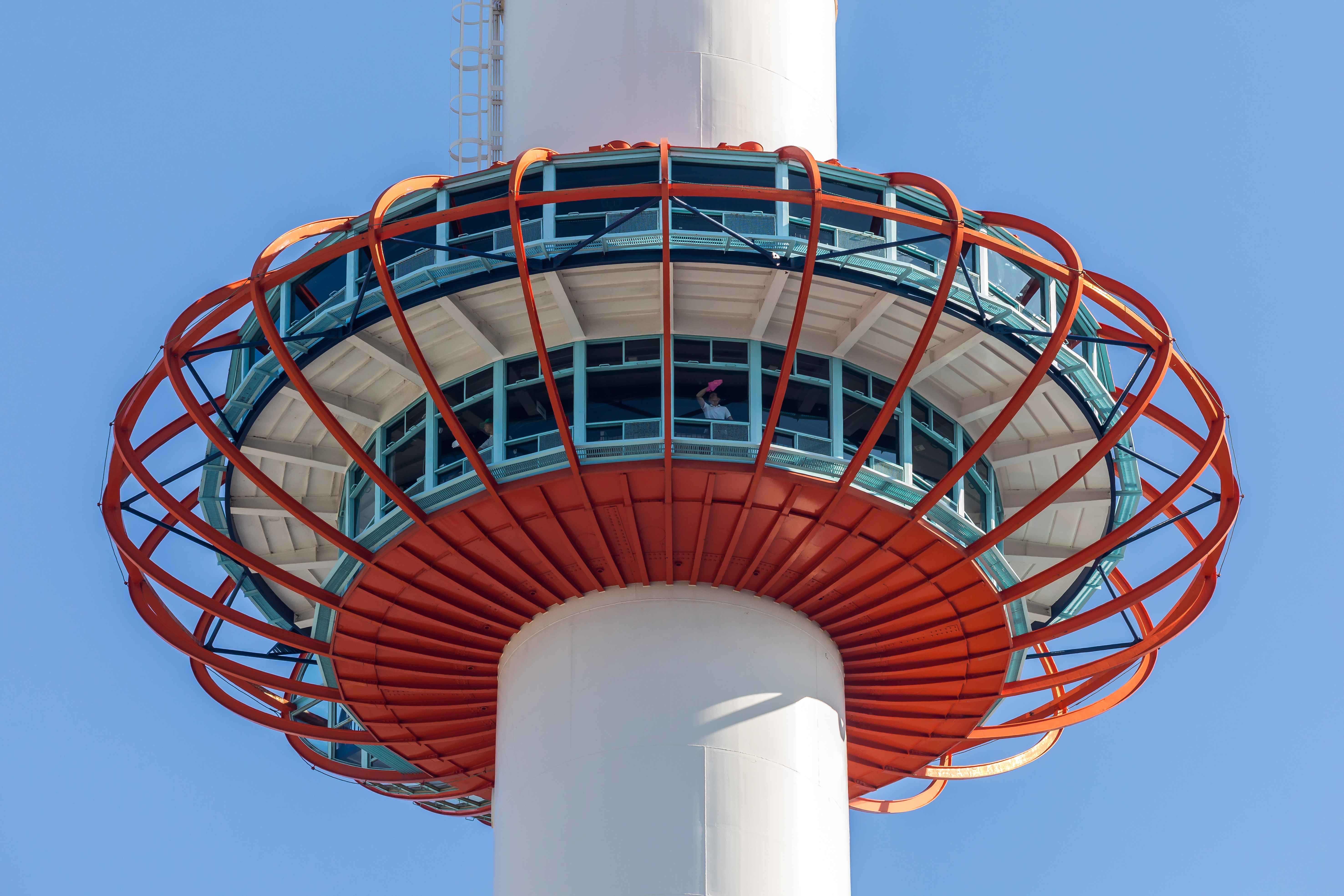
Nine elevators carry visitors to the observation deck, a circular platform at the 100-meter mark that accommodates up to 500 people. Free telescopes line the windows, and on clear days the view stretches from the forested eastern hills -- where Kiyomizu-dera and the Philosopher's Path wind through maple groves -- across the grid of Kyoto's streets to the western mountains beyond Arashiyama. Looking north, you can trace the dark green band of the Kyoto Gyoen and pick out the Imperial Palace grounds. Looking south, the modern sprawl of the Kyoto Station complex spreads out below, its futuristic glass-and-steel architecture by Hiroshi Hara forming an almost comical contrast with the tower's mid-century optimism overhead.
Fading Glow, Lasting Presence
The tower drew a million visitors in its first year. By 1999, annual ticket sales had dropped below 400,000 -- about 1,100 people a day. The decline tracked a broader trend: observation towers everywhere struggled as urban skylines grew taller and attractions multiplied. Yet Kyoto Tower has something that newer, flashier structures lack -- it has become inseparable from the city's identity, even for those who once opposed it. It appears on postcards, in films, and in the memories of generations of travelers who stepped off the Shinkansen and looked up. The tower is often lit in different colors for seasonal events and holidays, its candle-flame silhouette glowing against the dark outline of the eastern hills. Love it or not, it remains the beacon that marks arrival in one of the world's great cities.
From the Air
Located at 34.988N, 135.759E, immediately north of Kyoto Station. The tower stands 131 meters tall and is the tallest structure in Kyoto, making it readily identifiable from the air. Look for it as a white vertical needle rising from the cluster of buildings around the main rail station. Nearest airports: Osaka Itami (RJOO, 36 km southwest) and Kansai International (RJBB, 77 km south). Best viewed at 2,000-4,000 ft altitude. The tower stands out against the low-rise cityscape of central Kyoto. On approach, note the contrast between the dense station area and the open green space of Kyoto Gyoen to the north.