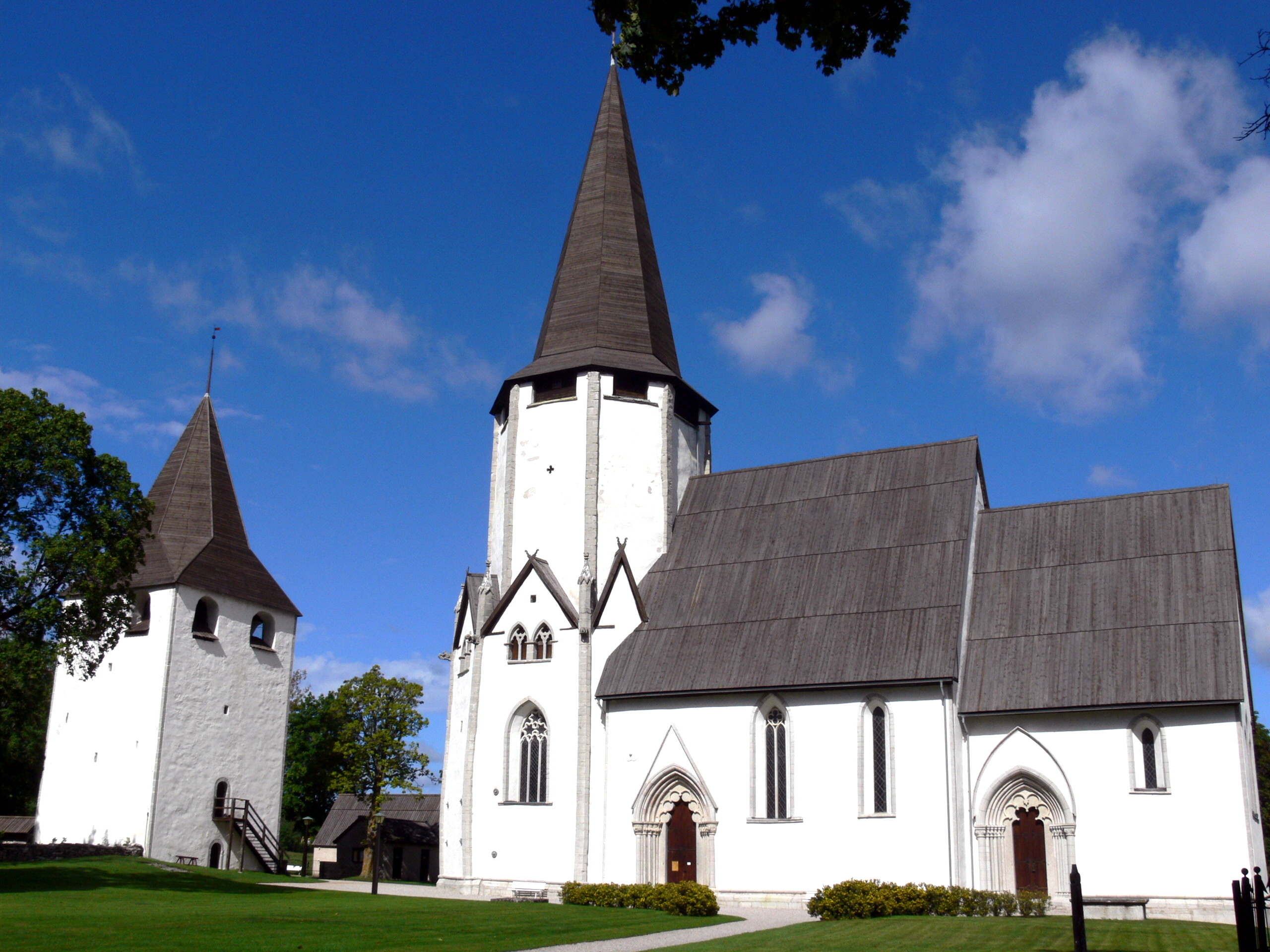
Larbro Church
The octagonal tower rises like nothing else on Gotland. Among the nearly hundred medieval churches scattered across this Swedish Baltic island, Larbro Church stands apart. Its eight-sided tower, built in the 1340s, breaks every convention of local architecture. The rest of the church follows the expected patterns: Gothic nave, traditional chancel, familiar limestone construction. But that tower demanded something extraordinary of its builders, perhaps a reference to distant Nidaros Cathedral in Norway, where the relics of Saint Olaf rest in an octagonal shrine. The mystery of why medieval craftsmen chose this singular form adds to the weight of what already stands as a place where centuries of history have accumulated in stone.
Guarding the Crossing
Long before the church, this spot held strategic value. The valley that runs past Larbro was once swampy terrain, and archaeologists have uncovered the remains of two ancient causeways that allowed passage across the wetlands. A fortified defensive tower, or kastal, still stands adjacent to the church, dating from the 11th or 12th century. Five stories tall, built of stone, it represents medieval security architecture at its most pragmatic. The original entrance sat at ground level, but defenders could pull up the ladders connecting the floors, turning the tower into an impregnable refuge. Barrel vaults support the ceilings on the ground and top floors; traces of an original dansker, a latrine projecting from the wall, remain on the third floor. The church that eventually rose beside this defensive tower inherited its strategic importance and transformed it into sacred space.
The Eight-Sided Enigma
The octagonal tower at Larbro is one of only three octagonal ecclesiastical structures on Gotland, the others being the ruined Helgeand church in Visby and the side towers of Visby Cathedral, built around the same time. Pinnacles and gargoyles adorn its limestone corners, clearly modeled on the cathedral's ornamentation. Inside, an eight-celled vault covers the ground floor, flooding the space with light from large windows and creating an unusually lavish atmosphere. The portal displays relief sculptures of Saints Peter, Paul, and Olaf, along with a fourth unidentified figure. Local legend connects Saint Olaf to the Larbro area, and the most accepted theory holds that the tower served as a chapel dedicated to the Viking king who became Norway's patron saint. If so, its octagonal form may deliberately echo the saint's burial chapel at Nidaros Cathedral in Trondheim.
Paintings That Breathe With the Walls
Medieval murals decorate the nave and chancel of Larbro Church, dating from the 13th and 14th centuries when the current building took shape. What makes these paintings unusual in Sweden is how they incorporate the architecture itself into their designs. In one remarkable example, a corbel, a stone bracket projecting from the wall, becomes the head of a painted dragon. The creature's body flows across the wall while its three-dimensional head snarls from the stone support. Other murals depict the Crucifixion and various saints in more conventional compositions, but that dragon, breathing stone fire from medieval imagination, stays with visitors long after they leave. The altarpiece, too, survives from around 1400, showing Mary surrounded by the Twelve Apostles, though an 18th-century rearrangement scrambled the figures and left incorrect labels that persist today.
Refuge and Remembrance
The church grounds hold a more recent history of profound significance. During World War II, Sweden built a field hospital at Larbro, completing it in 1942 as one of the most modern medical facilities in the country. Sweden remained neutral, so the hospital never treated Swedish casualties. Instead, it received refugees fleeing the Baltic states, wounded German soldiers, and, most poignantly, approximately 500 survivors from the Nazi concentration camps at Auschwitz and Bergen-Belsen. Not all survived their liberation. Forty-five graves in the cemetery date from this period, including nine Jewish victims. The Stockholm Jewish community erected a memorial stone here, and in 2010, the Polish ambassador dedicated a marker to the Polish citizens who died despite reaching neutral ground. In 2019, Larbro Church became one of the first 56 sites in Sweden marked with the blue and white shield of the Hague Convention, acknowledging its status as protected cultural heritage in the event of armed conflict.
From the Air
Located at 57.79N, 18.79E on the Swedish island of Gotland, approximately 30 kilometers north of Visby. The church stands in the village of Larbro, just west of a small valley. The distinctive octagonal tower is the primary visual identifier from altitude, appearing as an unusual polygonal form among Gotland's more typical rectangular church towers. The adjacent defensive kastal tower provides additional identification. Visby Airport (ESSV) lies about 25 kilometers to the southwest. The relatively flat terrain of northern Gotland makes the church spire visible from considerable distance. Best viewing altitude 1,500-3,000 feet for architectural detail.