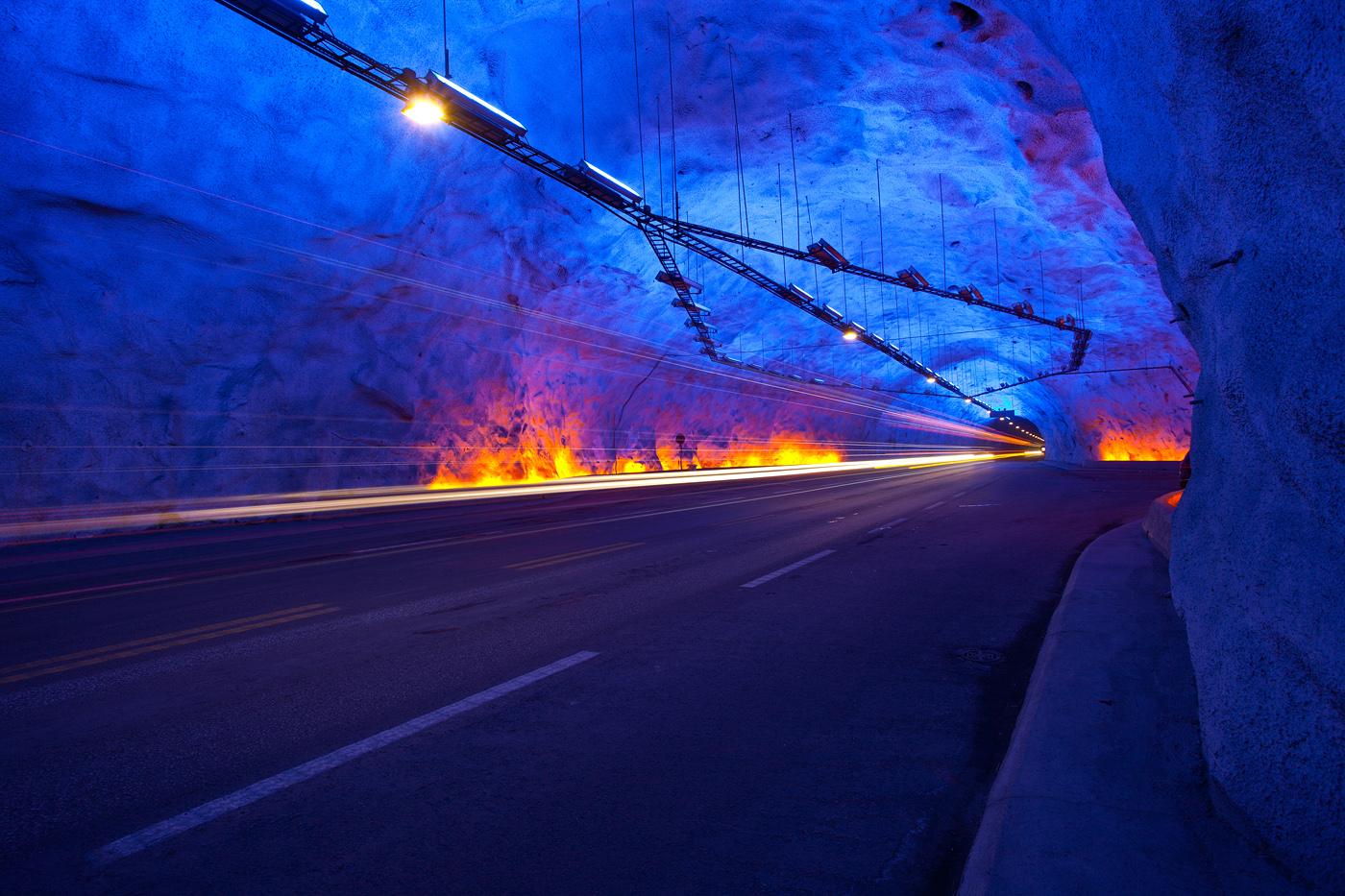
Laerdal Tunnel
Twenty minutes. That is how long it takes to drive through the Laerdal Tunnel, and the engineers who designed it understood that twenty minutes underground, in a straight tube through a mountain, could unravel a driver's composure. So they built three enormous caverns inside the mountain, spaced at six-kilometer intervals, and lit them with blue light fading to yellow at the edges to create the impression of sunrise. The caverns break the tunnel into four psychological segments, each short enough to feel manageable. They serve as turnaround points, rest areas, and antidotes to claustrophobia. At 24.51 kilometers, the Laerdal Tunnel is the longest road tunnel in the world, a distinction it has held since opening on 27 November 2000. It connects Laerdal Municipality and Aurland Municipality in Vestland county, carrying two lanes of the European Route E16 under a mountain range that would otherwise require a ferry crossing or a treacherous winter mountain road.
The Missing Link Between East and West
Norway's geography is an engineer's nightmare. Mountain ranges, deep fjords, and harsh winters have historically made overland travel between the country's major cities an exercise in patience and ferry timetables. The road between Oslo and Bergen, Norway's two largest cities, was one of the most problematic. In 1975, the Norwegian Parliament decided the main route would pass through the Filefjell mountain area, and in 1992, Parliament confirmed that the connection would require a tunnel between Laerdal and Aurland. Construction began in 1995. Over the next five years, workers excavated 2.5 million cubic meters of rock to create the passage. The tunnel opened in November 2000 at a cost of 1.082 billion Norwegian kroner, roughly 113 million US dollars. For the first time, drivers could travel between Oslo and Bergen without boarding a ferry or crossing a mountain pass that closed every winter.
Engineering Against Human Nature
The tunnel's most innovative feature is its acknowledgment of human psychology. Long tunnels are monotonous, and monotony leads to fatigue, distraction, and accidents. The three internal caverns, each large enough to park in, use lighting designed to mimic the transition from night to day: deep blue on the ceiling and walls, warming to golden yellow at the edges. The effect is surprisingly convincing, a brief moment of spaciousness and color after kilometers of white-lit concrete. The tunnel itself begins just east of Aurlandsvangen and ends 5.5 kilometers south of Laerdalsoyri, passing under a mountain range with no natural light for its entire length. Speed cameras have been installed because the arrow-straight roadway and absence of cross-traffic tempt drivers into speeds that the tunnel's geometry was not designed to handle. There are very few completely straight roads elsewhere in this region of Norway, making the tunnel's straightness both its engineering achievement and its behavioral challenge.
Breathing Underground
Air quality inside a 24-kilometer tube full of car exhaust is an obvious concern, and the Laerdal Tunnel was the first in the world to address it with an air treatment plant built inside the mountain itself. Located in a 100-meter-wide cavern about 9.5 kilometers from the Aurland end, the plant draws tunnel air through two large fans, removes particulates with an electrostatic filter, and strips nitrogen dioxide with a carbon filter. Additional ventilation fans pull fresh air in through both portals, while a shaft in the middle of the tunnel vents stale air up through the mountain to the valley of Tynjadalen above. The system was unprecedented when the tunnel opened and has since become a model for other long-tunnel projects. Despite these measures, the air inside still carries a faint mineral tang, a reminder that you are driving through the interior of a mountain that was solid rock five years before the tunnel opened.
A World Record Under Maintenance
Beginning in 2025, the Laerdal Tunnel entered a years-long period of nightly closures for upgrades to comply with updated EU safety regulations. For approximately four years, the tunnel closes for fourteen hours each night, forcing drivers onto alternative routes such as Road 50, which are slower and often impassable in winter. The closure underscores the paradox of the tunnel's existence: it solved the problem of connecting east and west Norway so completely that its closure immediately creates the same isolation it was built to eliminate. The tunnel remains the world's longest road tunnel, a title it has held for over two decades. Its nearest competitors, the Tianshan Shengli Tunnel in China and WestConnex in Australia, are shorter and newer. The blue caverns, the air treatment plant, the speed cameras, the twenty-minute drive through darkness punctuated by artificial sunrise: the Laerdal Tunnel is not just infrastructure. It is an argument that engineering can make even the inside of a mountain navigable.
From the Air
Located at 60.97N, 7.37E, connecting Aurland and Laerdal municipalities in Vestland county. The tunnel runs entirely underground and is invisible from the air, but both portal locations are identifiable: the Aurland end near Aurlandsvangen village on the Aurlandsfjord, and the Laerdal end near Laerdalsoyri. The E16 highway and the Sognefjord are major landmarks. Nearest airports: Sogndal/Haukasen (ENSG) approximately 40 km north, Bergen/Flesland (ENBR) approximately 170 km southwest. The tunnel connects to the Flam Railway area at the Aurland end.