La Belle (ship)
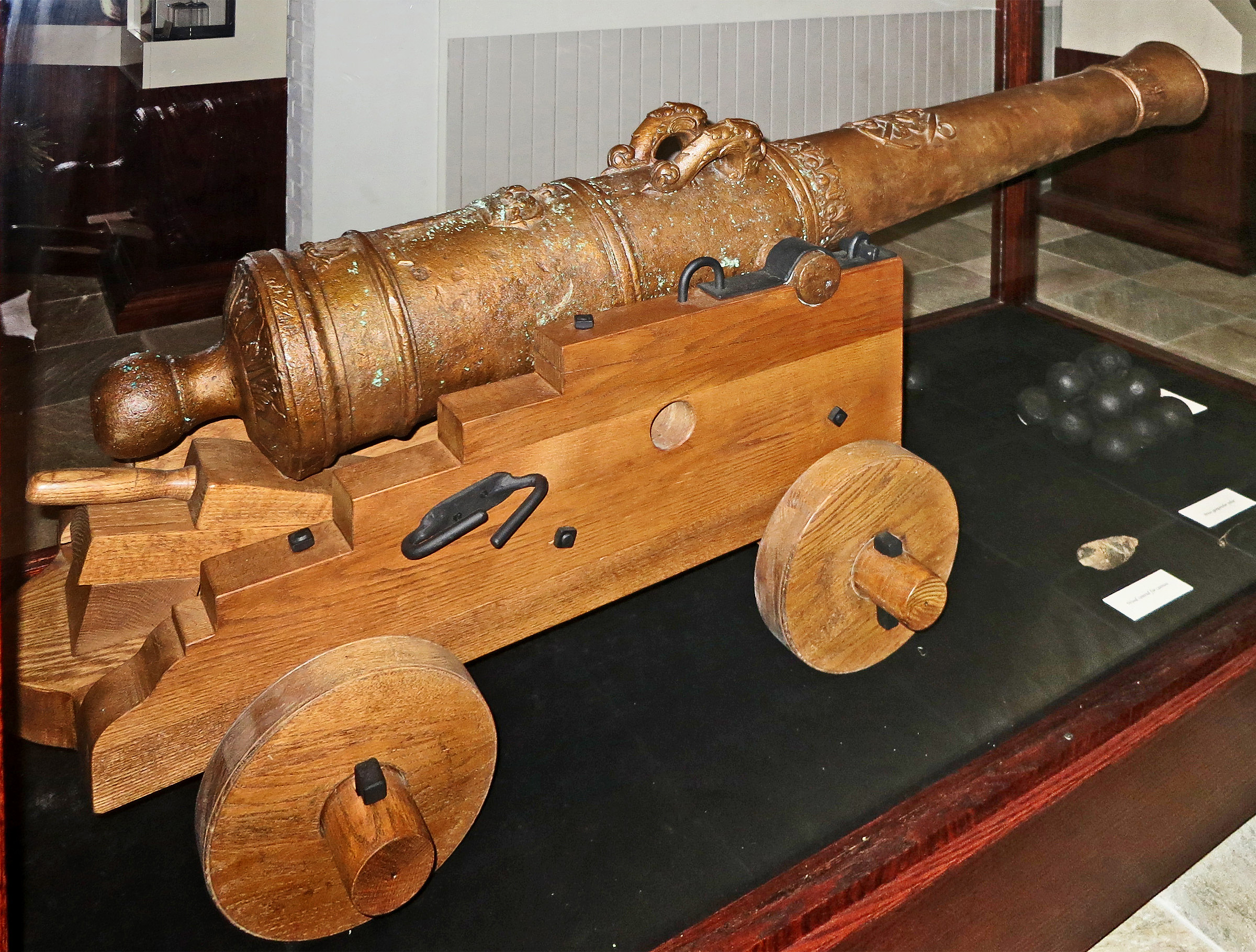
On July 5, 1995, a diver descending into the murky waters of Matagorda Bay felt something smooth and round beneath his fingers: musket balls, scattered across the seafloor. On his next dive, archaeologist Chuck Meide brushed silt from an ornately decorated bronze cannon bearing the crest of Louis XIV and the Count of Vermandois, Admiral of France. After three centuries in the mud, La Belle -- the last ship of the doomed French explorer Robert de La Salle -- had been found. It was, by any measure, one of the most significant archaeological discoveries in Texas history, a time capsule from the chaotic moment when European empires collided on the Gulf Coast and a single shipwreck doomed an entire colony.
A Ship Built Like a Kit
La Belle was never meant to sail these waters. Louis XIV gave the three-masted barque-longue to La Salle for an expedition to establish a French colony at the mouth of the Mississippi River, part of a strategic plan to split Spanish Florida from New Spain. The ship was built as a kit -- her frames divided into four quadrants and numbered sequentially so they could be disassembled, loaded onto the larger vessel Le Joly, carried overland, and reassembled on the Mississippi. With a shallow draft and a cargo capacity of 40 to 45 tons, she was designed for river work, not open-ocean voyaging. But when the expedition set sail from France in 1684 with nearly 300 people aboard four ships, everything went wrong. Spanish privateers captured the supply ship St. Francois in Santo Domingo. Inaccurate maps and miscalculated currents caused the remaining three ships to miss the Mississippi entirely. They landed instead at Matagorda Bay in early 1685, hundreds of miles west of their target.
Stranded on a Hostile Shore
La Salle established Fort Saint Louis on a bluff overlooking Garcitas Creek, fifty miles inland from their landing site. With Le Joly returning to France and the storeship L'Aimable wrecked in the bay, La Belle was the colony's last connection to the outside world. La Salle loaded her with the remaining supplies and set out on an overland expedition, leaving Pierre Tessier in command of the ship with a skeleton crew. Then disaster compounded. The captain who replaced the deceased original died after eating prickly pear cactus. Karankawa warriors killed the next captain and several crewmembers who had camped onshore. When Tessier sent five sailors in the only longboat to find fresh water, they were last seen struggling against the wind at dusk and were never heard from again. The remaining crew, out of water, drank wine -- which only hastened dehydration and death.
Into the Mud
Desperate, Tessier ordered La Belle to sail for Fort Saint Louis. A cold front struck as they got underway. The unskilled crewmembers could not control the ship, and with their second anchor lost, there was no way to stop her from drifting. La Belle ran aground at the southern end of the bay, a quarter mile from shore. The survivors built a raft of planks and barrels; the first attempt broke apart in the waves, drowning two men. A second, sturdier raft carried the rest to land. They managed to salvage some of La Salle's papers, barrels of flour, and casks of wine before a southerly wind drove the hull into the soft bottom, leaving only the stern deck above water. Of twenty-seven people originally assigned to the ship, six survived: Tessier, a priest, a military officer, a soldier, a servant girl, and a small boy. They waited three months on the peninsula until a canoe washed ashore, allowing them to paddle back to the fort. Their last ship was gone.
Three Centuries in the Dark
The Spanish found the wreck first. On April 4, 1687, a naval expedition reached Matagorda Bay and discovered La Belle's remains -- a "broken ship" with three fleur-de-lys on her stern. They salvaged cannons, the anchor, and the masts. Then La Belle was forgotten. In the 1970s, scholar Kathleen Gilmore of Southern Methodist University analyzed historical accounts and estimated where the wreck might lie. The Texas Historical Commission found original maps by La Salle's engineer, Jean-Baptiste Minet, which marked the resting places of both L'Aimable and La Belle. A 1978 magnetometer survey found other wrecks but not La Belle. Funding dried up for seventeen years. It was not until June 1995, armed with differential GPS technology and a new magnetometer survey, that Barto Arnold and the Texas Historical Commission finally located the ship.
Raised from the Bay
Because visibility in the bay was nearly zero, the state of Texas spent 1.5 million dollars building a cofferdam -- a double-walled steel enclosure filled with compacted sand -- around the entire wreck. When the water was pumped out in September 1996, La Belle saw air for the first time in over three centuries. The excavation, led first by Arnold and then by Dr. Jim Bruseth, lasted from July 1996 to May 1997 and recovered over a million artifacts: three bronze cannons, hundreds of thousands of glass trade beads, boxes of muskets, ceramic firepots, brass hawk bells, wooden combs, iron axe heads, and one complete human skeleton -- a middle-aged man with arthritis whose brain was partially preserved by the anaerobic mud. Serial numbers on the recovered cannons were matched to French archival records listing four bronze guns loaded onto La Belle, confirming the wreck's identity beyond doubt. Today, the reassembled hull sits at the Bullock Texas State History Museum in Austin, and France officially owns the vessel under a 2003 agreement that grants Texas day-to-day control for ninety-nine years.
From the Air
Located at 28.45N, 96.32W in Matagorda Bay, on the Texas Gulf Coast. The wreck site is in shallow bay waters near the southern end of the Matagorda Peninsula. The nearest airport is Calhoun County Airport (KPKV) at Port Lavaca, approximately 15 nm to the west. Victoria Regional Airport (KVCT) is about 35 nm to the north-northwest. Recommend viewing at 2,000-3,000 ft AGL. From altitude, look for the long barrier peninsula separating the bay from the Gulf of Mexico -- the wreck site lies in the protected waters on the bay side.