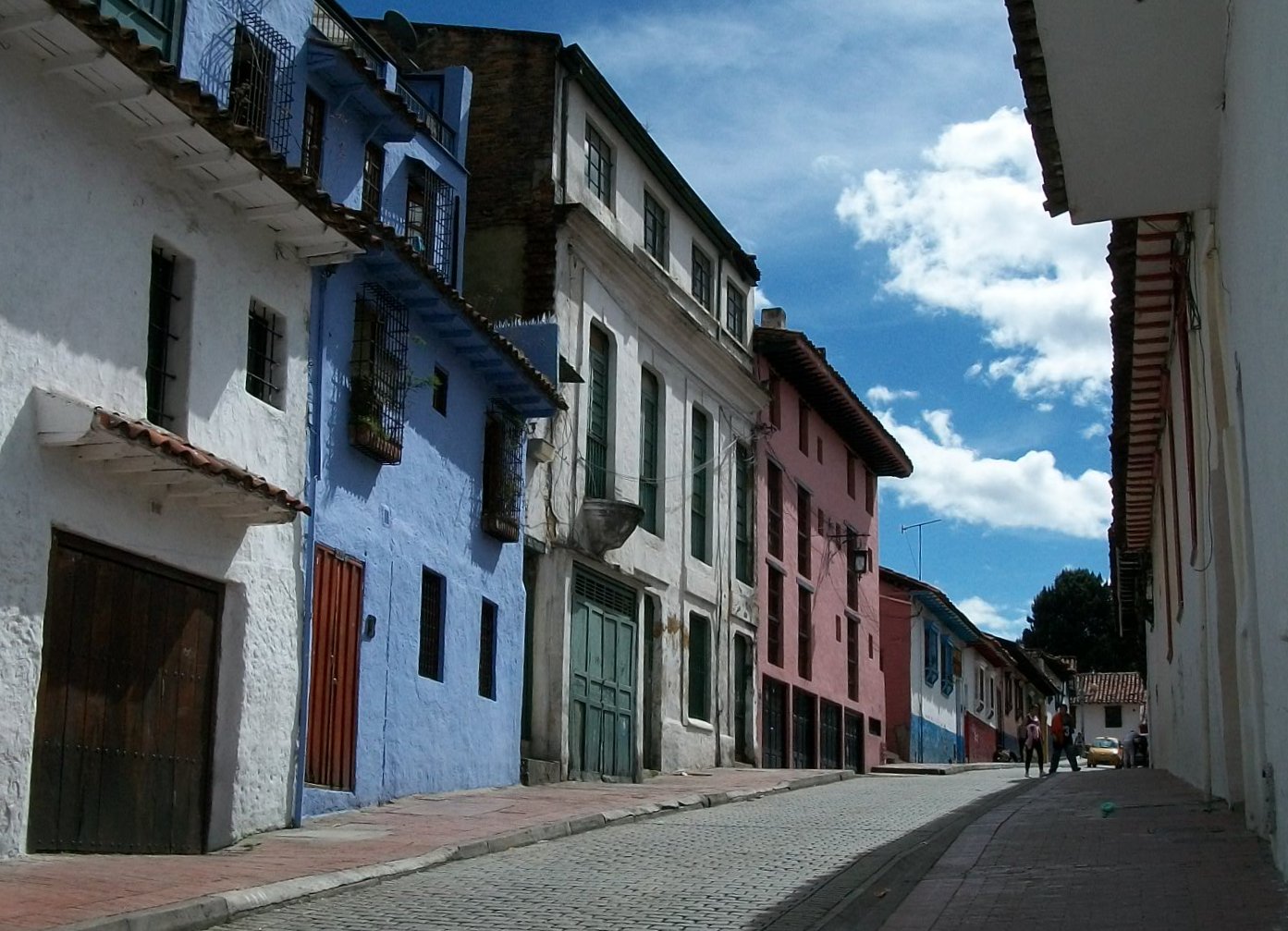
La Candelaria, Bogota
It is said that the Zipa, the main cacique of the Muisca, used to come here to rest. He would climb up from the Bogota savanna and stand at a spot now called Plaza del Chorro de Quevedo, looking out over his people's world. On August 6, 1538, the Spanish conquistador Gonzalo Jimenez de Quesada planted the formal cross of conquest on this same ground. A city was founded. The Muisca called their resting place Teusaquillo. The Spanish would name their new settlement for the small church they built nearby, Nuestra Senora de la Candelaria, Our Lady of Candlemas. Nearly five hundred years later, the neighborhood that grew around that founding still bears the church's name, and still holds the most layered collection of colonial architecture in any Colombian city.
The Founding Square
In April 1539, roughly eight months after Quesada's initial cross-raising at Teusaquillo, the formal city of Bogota was established a few blocks west, in what is today the Plaza de Bolivar. From that square and its surrounding parishes, Bogota grew outward: north, south, and west, eventually leaving the original founding site marooned inside a neighborhood rather than at its center. During the eighteenth and nineteenth centuries, the city was divided into four parishes. The Parish of San Pedro included most of what is now La Candelaria, composed of smaller quarters with names like el Principe, San Jorge, El Palacio, and La Catedral. In the 1970s, a preservation corporation was set up to protect the historic core. In 1991, La Candelaria was formally recognized as the seventeenth locality of Bogota, with its first Local Administrative Board elected that year. What had started as a city grew to enclose its own origin.
Calle del Embudo
Not every street in La Candelaria is straight. Calle del Embudo, the Funnel Street, gets its name from its shape: it narrows as it descends toward the Plaza del Chorro de Quevedo. The cobblestones are original. The walls are painted and repainted in bright murals, some of them abstract, some depicting pre-Columbian legends or figures from Muisca mythology. The Plaza del Chorro de Quevedo at the bottom takes its name from an Augustinian friar named Quevedo, who bought the site in 1832 and installed a public water fountain, a chorro, at its center. The fountain's supply was cut when a nearby building collapsed in 1896. But the name stayed, and so did the spot's claim as the birthplace of Bogota. Buildings now crowd around the square so tightly that the Zipa's view of the savanna is entirely gone. Only the legend remains.
The Gold Museum and the Botero
La Candelaria holds some of Colombia's most significant museums, nearly all of them walking distance from one another. The Museo del Oro, the Gold Museum, is property of the Bank of the Republic and holds more than 36,000 pieces of Indigenous goldwork, along with objects in wood, shell, and stone. It faces Santander Park. A few blocks south, the Museo Botero on Carrera 11 displays works by the Colombian painter and sculptor Fernando Botero, along with pieces by Monet, Picasso, and other international artists from Botero's own collection. The Luis Angel Arango Library, also owned by the Bank of the Republic, holds more than 1.1 million books and is the most visited public library in Latin America, with a concert hall and exhibition spaces occupying its lower floors. The Casa del Florero, the Museum of Colonial Art, the Museo de Bogota, the National Police Museum, the Military Museum, and the Regional Costume Museum in Manuelita Saenz's former house all sit within a few blocks of the Plaza de Bolivar.
Around the Plaza de Bolivar
The Plaza de Bolivar remains the political heart of Colombia. It is ringed by buildings that each hold a different branch of national or municipal power. To the north, the Primatial Cathedral of Bogota, seat of the country's Roman Catholic archdiocese, stands on ground where a Parish of San Pedro was established in the sixteenth century. Next to it, the Chapel of the Sagrario holds seventeenth-century colonial art, and beside that, the Archbishop's Palace. On the south side, the Capitolio Nacional houses the Colombian Congress. On the east, the Palace of Justice contains the Supreme Court, a building that itself burned and was rebuilt after the infamous 1985 siege by the M-19 guerrilla movement. The Palacio Lievano, on the west, serves as Bogota's mayoral seat. Just off the plaza, the Casa de Narino is the presidential residence, and the Palacio de San Carlos holds the Ministry of Foreign Affairs. Every significant decision the Colombian state has made has passed through a building within sight of this square.
Universities and Ink
La Candelaria is also where Colombian intellectual life compacts itself into a few square kilometers. The University of the Andes, Our Lady of the Rosary University, La Salle, Externado, La Gran Colombia, the Free University, the Central, the Autonomous, Jorge Tadeo Lozano, Francisco Jose de Caldas, and the Colegio Mayor de San Bartolome all have their headquarters here. On any weekday, thousands of students crowd the cafes and bookshops along Calle 11 and the surrounding streets. The Gabriel Garcia Marquez Cultural Center, named for Colombia's Nobel laureate, occupies a modern block opposite the old Colegio San Bartolome. The Silva Poetry House honors the nineteenth-century poet Jose Asuncion Silva, who took his own life in a room now preserved there. The birthplace of Rafael Pombo, a Colombian poet whose children's verses every Colombian child can still recite, sits nearby. Writers have always been drawn to La Candelaria because the neighborhood supplies the weight of history in small, ornate doses.
Chocolate, Tamales, and Monserrate
Right next to the presidential palace, a small unmarked shop called La Puerta Falsa has been open for about two hundred years. It specializes in chocolate and tamales. People queue around the corner. On the eastern hills above the neighborhood, the church of Monserrate sits at 3,152 meters, reachable by funicular, cable car, or on foot by pilgrims who still climb. The pilgrimage to the sanctuary of the Senor Caido, the Fallen Christ, is a practice that connects modern Bogota to its colonial devotional life. From Monserrate's terrace, the entire Sabana de Bogota spreads westward, and La Candelaria sits directly below, a compact lattice of red tile roofs and white walls at the base of the hills. Inside the neighborhood, the Teatro Colon, built by Italian architect Pietro Cantini and founded in 1892, still hosts opera and theater in its neoclassical hall for nine hundred people. The neighborhood wears its centuries like layers of glaze. The oldest sits at the bottom, and every generation adds another on top.
From the Air
Located at 4.59 degrees North, 74.07 degrees West, in central Bogota, Colombia. La Candelaria sits at roughly 2,625 meters elevation, pressed against the western slope of the Cerros Orientales (Eastern Hills), with the peak of Monserrate rising to 3,152 meters directly above the neighborhood. The Plaza de Bolivar is the geographic center. Bogota proper spreads west across the Sabana de Bogota. Nearest airport: El Dorado International (SKBO), 15 km west of the city center. Recommended viewing altitude: FL100 to FL130 for the full Sabana with the Eastern Hills rising on its east; Monserrate and Guadalupe peaks are distinct landmarks on any clear day. The Cerros sit at elevations that frequently intercept cloud cover in afternoons; mornings offer cleaner visibility for observing the colonial grid of La Candelaria against the modern city's sprawl.