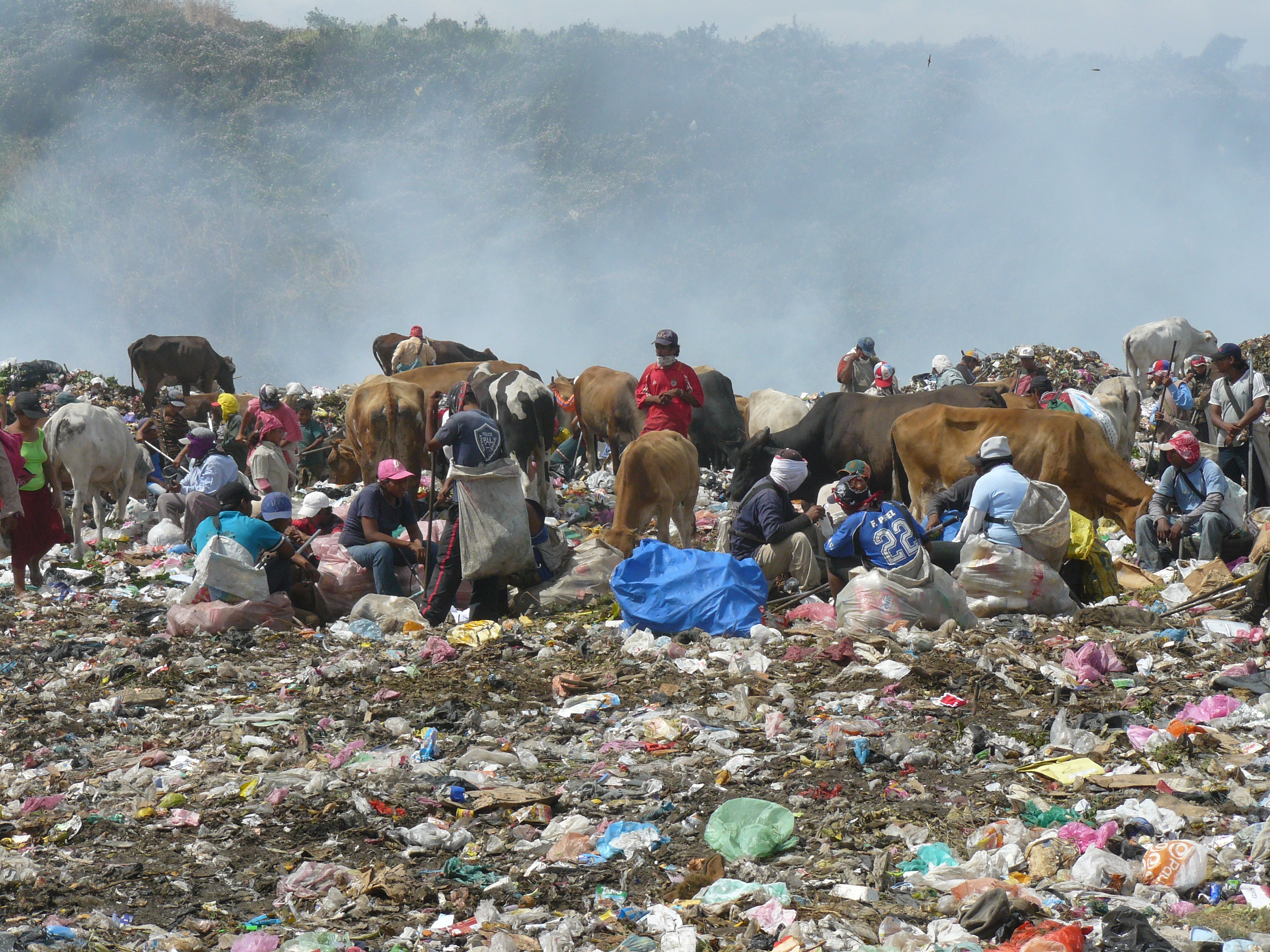
La Chureca
The word chureca is Managua slang for the city dump, and for decades the place lived up to its name in ways that no euphemism could soften. Covering 42 hectares in the northwestern corner of Nicaragua's capital, on the south shore of Lake Managua, La Chureca was Central America's largest open-air landfill. But it was also a neighborhood. Approximately 400 to 440 families — around a thousand people, half of them children — lived inside the dump, building shelters from salvaged materials and earning what they could by sorting through the 1,200 tonnes of garbage that Managua produced daily. The people who lived and worked there were called churequeros, and their story is one of resilience forged under conditions that should never have existed.
After the Earth Shook
La Chureca grew from catastrophe. On December 23, 1972, a devastating earthquake struck Managua, destroying roughly 70 percent of the city, killing thousands, and leaving tens of thousands unemployed. In the aftermath, families with no other options began scavenging the rubble for metals, building materials, and anything that could be sold or reused. Much of what they gathered ended up at the dump site. Some returned home at the end of each day. Others, left homeless by the quake, built shelters from the wreckage itself and stayed. What started as a survival strategy hardened into a permanent community. By the time the earthquake's aftershocks had faded from memory, La Chureca had become a fixture of Managua's landscape — a place the city needed for its waste but preferred not to see.
Life Among the Refuse
The churequeros developed systems. Over the years, they learned to organize the incoming waste, identifying and extracting recyclable and salvageable materials they could sell for small profits. It was grueling, dangerous work. Thick smoke from fires set by municipal authorities to reduce the volume of garbage hung over the site. The air carried the smell of burning plastic, lead, shoe glue, and human waste. Studies found elevated levels of persistent organochlorine pollutants and polybrominated diphenyl ethers in the bodies of children who lived and worked at the site. Researcher William Grisby Vergara described La Chureca as a war zone and an "enormous breeding ground for flies, microbes, rotting food, burnt trash, hundreds of plastic bags." Despite these conditions, the community endured — families raised children, maintained social bonds, and built the only lives available to them.
The Organizations That Came
La Chureca drew attention from international organizations and NGOs who built community centers, libraries, and schools within the dump. ProNica, a Quaker solidarity group, worked alongside Catholic Youth Advocates, Manna Project International, and others. FUNJOFUDESS, a local NGO, partnered with Manna Project to operate Casa Base de Salud, the only health clinic serving the community. These organizations did not pretend that their work was sufficient to transform the structural conditions that created La Chureca, but they provided education, healthcare, and community spaces that the residents would not otherwise have had. For the children especially, the schools and libraries represented a possibility that the dump itself could not offer.
Toward Dignity
The turning point came in August 2007, when Maria Teresa Fernandez de la Vega, the Vice President of Spain, visited La Chureca during an official trip to Nicaragua. What she saw prompted action. Within months, the Spanish Agency of International Development Cooperation (AECID) announced a 30-million-euro development project with three goals: close the existing dump, create a recycling industry to replace it, and provide housing and social integration for the families who had been living and working there. The project's stated purpose was straightforward: to bring dignity to people. Whether the word dignity is adequate to describe what was owed to the churequeros — people who for decades sorted through a city's waste to survive, who raised children in conditions that scientific studies documented as toxic — is a question the project's architects left to others. What they built was a beginning.
The Ground Remembers
La Chureca sits a few hundred meters from the Museo Sitio Huellas de Acahualinca, which preserves human footprints more than 2,100 years old — the oldest known tracks in Central America. The proximity is hard to ignore. In one place, the earliest evidence of human presence in this landscape, feet pressing into volcanic mud. In the other, the waste products of a modern city, and the people who made their lives within them. Both sites speak to what human beings will do to survive, and both are preserved on the same stretch of Managua's lakeshore. The footprints of Acahualinca were left by people walking steadily through uncertain ground. The churequeros did the same, in their own way, for decades.
From the Air
La Chureca is located at 12.165°N, 86.306°W, in the northwestern corner of Managua on the south shore of Lake Managua. The site is not individually distinguishable from altitude but sits within the broader urban sprawl of Managua's western neighborhoods. Augusto C. Sandino International Airport (MNMG) is approximately 10 km to the east. The lakeshore and the adjacent Acahualinca neighborhood serve as reference landmarks. Low-lying terrain, near sea level.