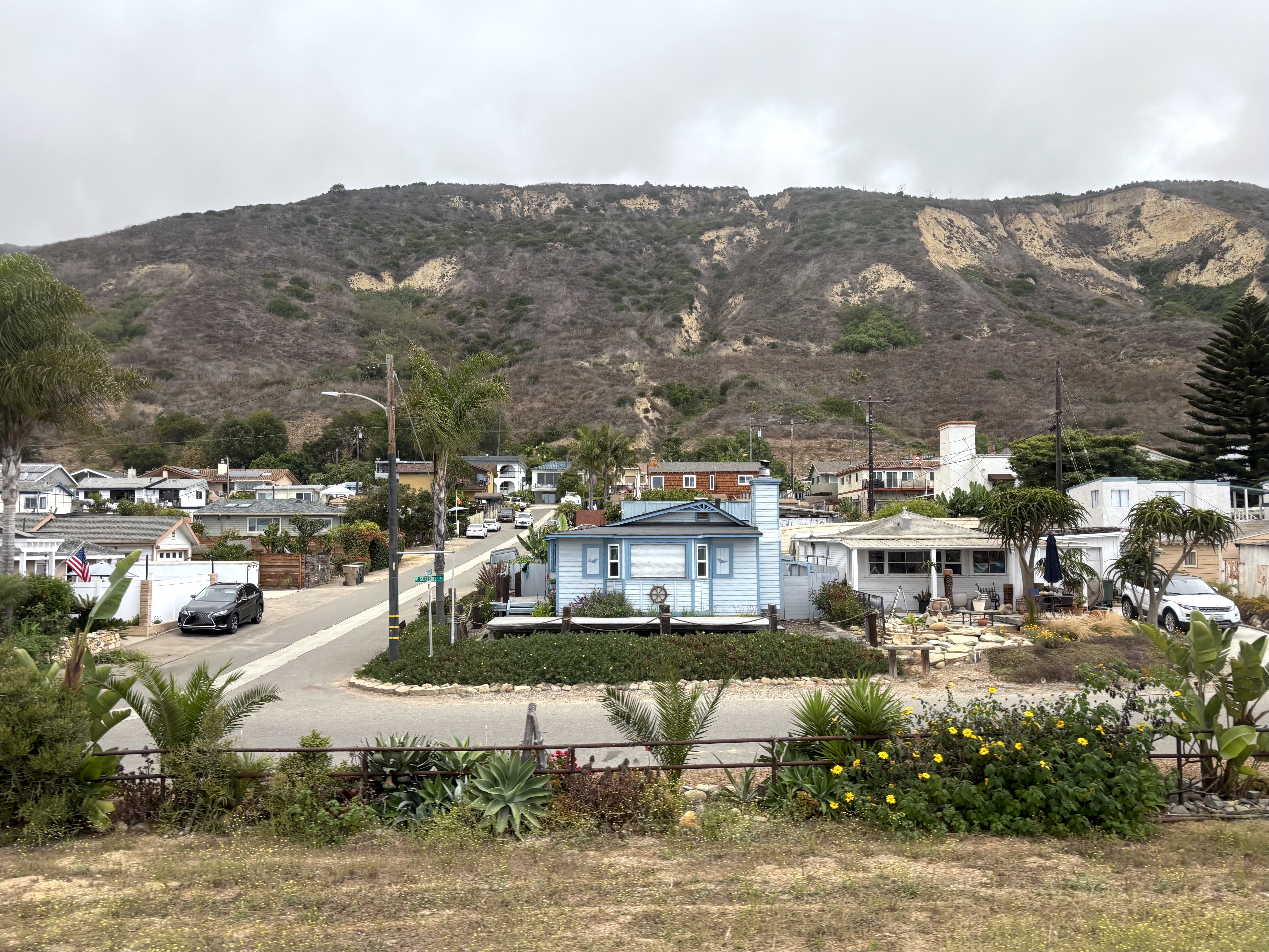
La Conchita, California
US Route 101 squeezes between the Pacific Ocean and a steep, crumbling bluff at La Conchita, leaving almost no room for the small community that has stood there for more than a century. The Spanish name — 'The Little Shell' — suggests something delicate, and it is. The hillside above has moved before and will move again. Everyone who lives there knows this.
A Narrow Strip of Coast
La Conchita occupies a strip of land so narrow that Highway 101 essentially runs through the middle of it. The community sits just southeast of the Santa Barbara county line in western Ventura County, inside area code 805 and ZIP code 93001. It is one of the last unincorporated coastal communities in the region that has resisted annexation, in part because of its small size and in part because its geological instability makes development unattractive to surrounding municipalities. The setting is remarkable — the Pacific glitters just west of the highway, and the Santa Barbara Channel opens to the south — but the hillside looming directly above the houses has always been the defining fact of life here.
The Hillside Moves
In 1995, a large section of the bluff above La Conchita gave way after heavy winter rains, destroying a number of homes. It was a warning that went only partially heeded. On January 10, 2005, after another wet season, a portion of that same bluff failed again — this time catastrophically. The 2005 landslide killed 10 people and destroyed or damaged dozens of houses. It struck in the early afternoon on a January Monday, burying a residential block within seconds. Rescue workers dug for days. The landslide recurred on the path of the 1995 slide, and geologists noted that the material remained unstable. The community was ordered to evacuate temporarily.
Those Who Stayed
After the 2005 slide, there were serious discussions about whether La Conchita should be permanently evacuated. Some residents left. Others returned. The community remained incorporated as a place people chose to call home, despite the documented risk. Property values fell, rebuilding was slow, and the hillside showed no signs of becoming more stable. The choice to stay — or return — became a statement about something: about attachment to place, about the Pacific light in the afternoons, about the particular quality of life that exists only here, between the highway and the ocean, below a bluff that has already moved twice in living memory.
Between Mountain and Sea
Geologically, La Conchita sits at the base of marine terrace deposits — layers of sediment that were once ocean floor, lifted by tectonic activity and now forming the bluffs that line this stretch of coast. These materials are inherently unstable when saturated. The Rincon Creek, a few miles to the southeast, marks the rough boundary where the landform changes character. Before the modern highway, the route through this section of coast was itself precarious, and settlers who chose this land did so knowing the mountains and the sea left little margin. The beauty and the danger have never been separable here.
From the Air
La Conchita sits at approximately 34.37°N, 119.47°W, where Highway 101 runs directly between the bluffs and the Pacific shore. From altitude, the community is identifiable as a dense cluster of small structures immediately below the steep light-colored cliffs. Nearest airports: Santa Barbara Airport (SBA) about 18 miles northwest, Oxnard (OXR) about 15 miles southeast.