La Demajagua National Park
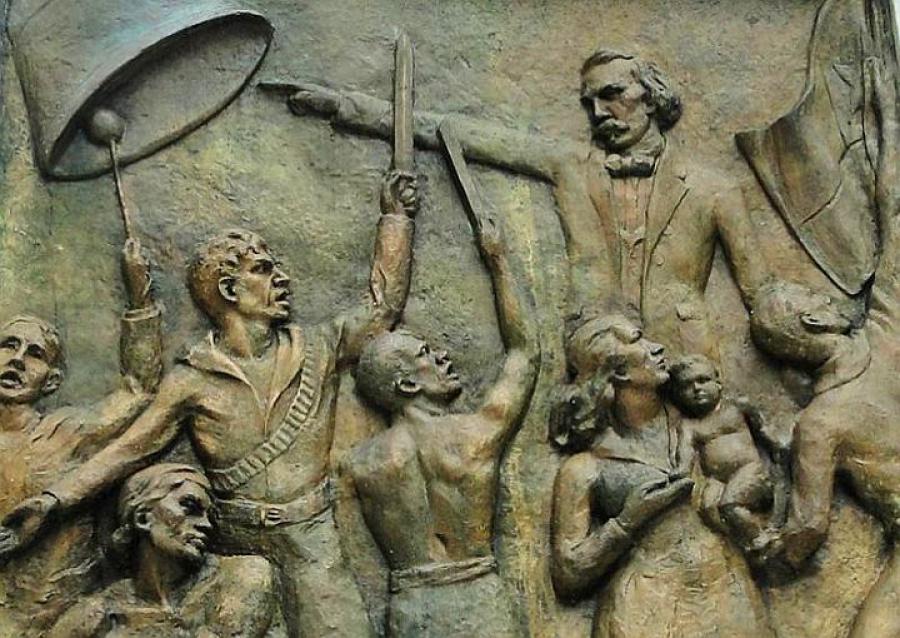
The bell rang on the morning of October 10, 1868. Miguel Garcia Pavon, acting on the orders of plantation owner Carlos Manuel de Cespedes, struck the bronze clapper again and again, sending its sound across the sugar fields and into the surrounding hills. What followed was not just an act of rebellion but a wholesale transformation: Cespedes freed the people enslaved on his plantation, gathered his followers, and declared the beginning of Cuba's fight for independence from Spain. The sugar mill where it happened, Ingenio La Demajagua, would be shelled and razed within a week. But the bell had already done its work. Today, the ruins of that mill stand twelve kilometers from the city of Manzanillo in Granma Province, preserved as one of Cuba's most sacred national sites.
Sugar, Steam, and Bondage
Before it became a symbol of liberation, La Demajagua was a working sugar estate. The Cespedes family's Ingenio La Demajagua encompassed sixteen caballerias, roughly 540 hectares, though only three were under active cultivation by 1868. The mill produced molasses rather than refined sugar, its machinery powered by a steam engine whose iron remnants still stand exposed at the site. Enslaved people worked the fields and the mill. The plantation was modest by Cuban standards, but it was built on the same foundation as every other sugar estate on the island: the labor of people who had no choice in the matter. That Cespedes chose to dismantle this system on his own property, at considerable personal cost, is what separates La Demajagua from the hundreds of other ruined mills scattered across eastern Cuba.
The Cry of Yara
Cespedes had been planning the uprising for months. On that October morning, he addressed the crowd that the bell had summoned: "Citizens, that sun you see rising over the Turquino summit comes to illuminate the first day of Cuba's freedom and independence." He freed the enslaved workers on his estate and invited them to join the fight. This moment, known as the Cry of Yara, launched the Ten Years' War, the first of Cuba's three wars for independence from Spain. The next day, Cespedes and his followers attacked the nearby town of Yara. Their numbers had dwindled to just twelve men by the time reinforcements arrived. It was an inauspicious military beginning, but the political spark had already caught. Across eastern Cuba, others took up the cause.
The Ruins of Defiance
Spain's response was swift and destructive. On October 17, just one week after the Cry of Yara, the Spanish gunboat Neptuno sailed to the coast near La Demajagua and bombarded the estate. Marines landed and razed what the shelling had left standing. The bronze bell was buried in the rubble. Cespedes was already gone, marching toward Bayamo, but the mill that had birthed the revolution was reduced to twisted metal and broken stone. The ruins lay largely untouched until 1968, when archaeological recovery on the centennial of the uprising brought the remains back to light. The heavy iron gears and engine fragments were preserved where they were found, and the site was designated a national park. A jaguey tree, its roots threaded through the old mill's foundation, became an icon of Cuban pride after a 1900 photograph of it circulated widely in the magazine Bohemia during the 1950s.
Where the Anthem Was Born
La Demajagua does not stand alone in Cuba's independence narrative. Just days after Cespedes rang the bell, the song that would become Cuba's national anthem, La Bayamesa, was first sung publicly in nearby Bayamo. The city's Casa de la Nacionalidad Cubana now hosts annual conferences on Cuban cultural heritage every October 20th, drawing a direct line from Cespedes's uprising to the broader formation of Cuban national identity. The park's annual commemorations blend political ceremony with local spiritual practices, including espiritismo de cordon, a folk tradition rooted in healing, ancestor reverence, and connection to the natural world. A small town of about 400 people, also called La Demajagua, sits within the park's borders just a few blocks from the monuments. For its residents, the history is not abstract. It is the ground they walk on.
The Bell's Long Echo
The park named itself after the majagua plant, a species of hibiscus native to Cuba whose bark is used for binding cigars and crafting rope. It is a practical, rooted name for a place whose significance is anything but ordinary. The original Bell of La Demajagua, recovered from the rubble of the Spanish bombardment, is now one of Cuba's most revered national relics. What happened here in 1868 set in motion not just the Ten Years' War but the entire arc of Cuban independence: the Little War, the War of 1895, and eventually the end of Spanish colonial rule. Standing among the rusted gears and stone foundations, with the hills of Granma Province rising to the south, you can still hear the weight of what that morning meant. A man rang a bell, freed the people who worked his fields, and told an empire he was done.
From the Air
Located at 20.28N, 77.18W in Granma Province, southeastern Cuba, approximately 12 km south of Manzanillo. The park sits in low coastal terrain near the Gulf of Guacanayabo. Look for the town of Manzanillo as a reference point on the gulf shore, then follow the road south. Nearest airports: Sierra Maestra Airport (MUSM) near Manzanillo and Antonio Maceo International (MUCU/SCU) in Santiago de Cuba, approximately 150 km east. The terrain is relatively flat sugar country rising gently toward the Sierra Maestra foothills to the south and east. Tropical conditions with generally good low-altitude visibility.