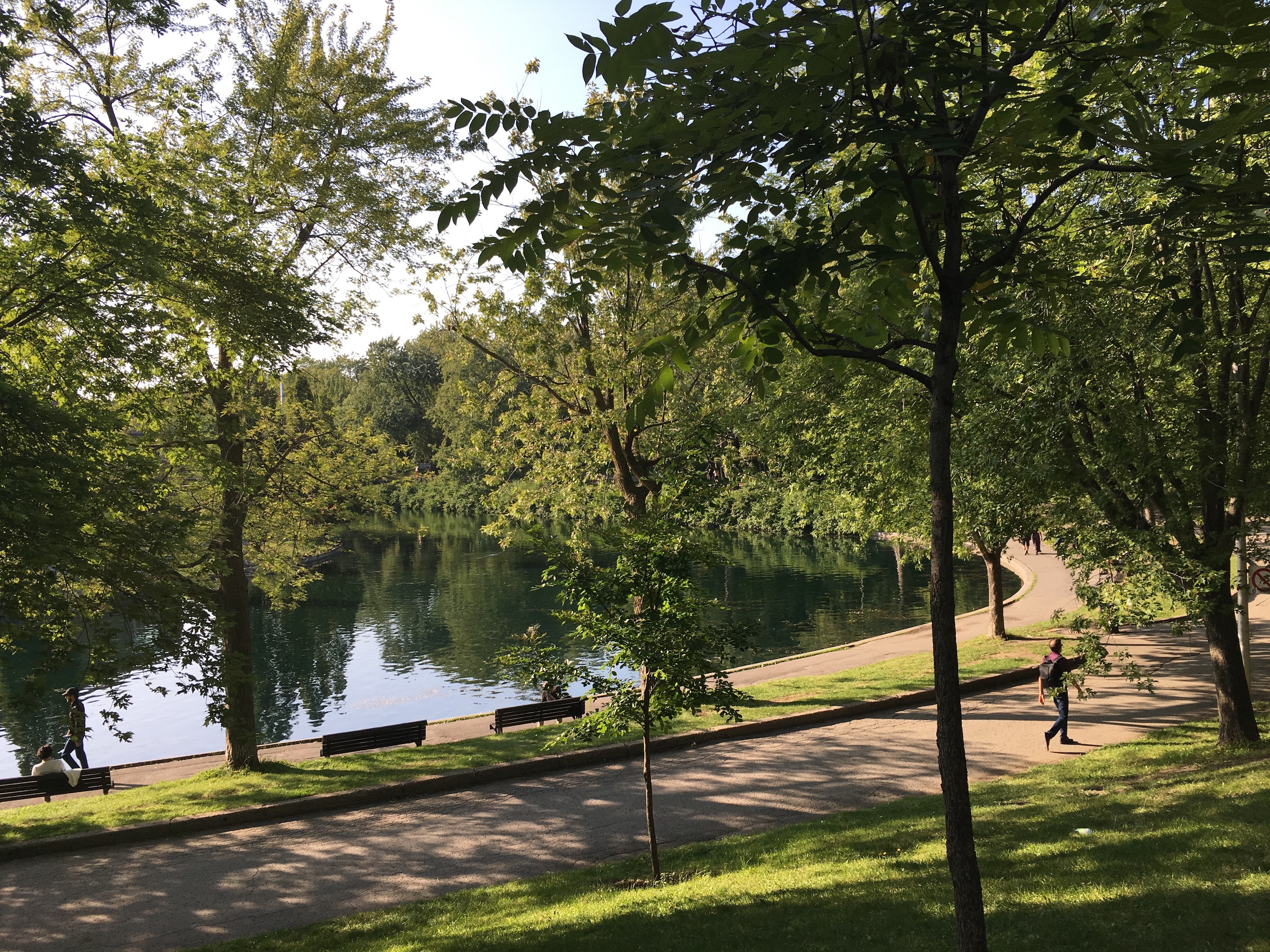
La Fontaine Park
The name is a happy accident. Visitors strolling past the illuminated fountain in the north basin naturally assume that Parc La Fontaine celebrates its own centerpiece. In fact, the park honors Louis-Hippolyte Lafontaine, the first francophone prime minister of the Province of Canada, a man whose political battles for responsible government helped define what Quebec would become. That the park bearing his name also contains one of Montreal's most beloved fountains is a coincidence too perfect for any city planner to have orchestrated. Spread across the heart of Le Plateau-Mont-Royal, bordered by Sherbrooke Street to the south and Rachel Street to the north, La Fontaine Park has spent a century and a half evolving from a military exercise ground into the place where Montreal's francophone culture comes to breathe.
From Logan's Farm to Lafontaine's Legacy
Before it was a park, this land was the Logan farm, sold in 1845 to the Government of Canada and promptly put to use as a military practice ground. Soldiers drilled here for over four decades. In 1874, the City of Montreal rented part of the property and opened it as Logan Park, planting it among the first wave of Montreal's great urban green spaces alongside Mount Royal and Saint Helen's Island. The major landscaping of 1888 gave the park its bones. Two years later, greenhouses relocated from Viger Square arrived, and for the next six decades every flower that adorned Montreal's streets grew here. In 1900, workers dug two basins at different elevations in the park's center, separated by a waterfall. French landscape architect Clovis Degrelle built a bridge over the cascade. Then came the pivotal moment: during the 1901 Saint-Jean-Baptiste Day parade, Logan Park was renamed La Fontaine Park, claiming its francophone identity for good.
A Fountain, a Chalet, and an Open Stage
The 1920s and 1930s brought the park's defining features. In 1929, the illuminated fountain designed by Leon Trepanier and commissioned by the Westinghouse Electric Company rose from the north basin, its jets catching colored light against the evening sky. A year later, sculptor Henri Hebert's bronze of Lafontaine was installed in 1930, depicting the statesman in the robes of the Court of Queen's Bench he had created. A generation later, Claude Robillard, director of the Municipal Parks Service, reimagined the entire park. After the original chalet burned in 1944, architect Donat Beaupre designed a replacement as part of an ambitious plan that included a central pavilion, a bandshell for symphony concerts, and a new amphitheater seating four thousand. Robillard's most enduring addition opened on July 8, 1956: the Theatre de Verdure, an open-air performance venue inspired by ancient amphitheaters. Under director Germaine Dugas, the theatre launched the careers of Quebec icons like Clemence DesRochers, Pauline Julien, and Yvon Deschamps. For over fifty years, it offered free programming until decay forced a closure in 2014. The architectural firm Lemay brought it back in 2022, modernized and seating twenty-five hundred.
Wonders and Wildlife in the City
Between 1957 and 1989, the park harbored a small urban zoo called the Garden of Wonders. Its buildings took their inspiration from fables and fairy tales, housing farm animals alongside more exotic creatures, including a troupe of sea lions that delighted children through Montreal's summers. The zoo's closure left a gap, but also freed space for the beautification that followed in 1990. New pathways led visitors to lookouts above the upper and lower pools. Sculptor Michel Goulet installed a set of six unmatched chairs and a table-sculpture that reproduces the park's own topography, the second part of his work Les lecons singulieres. Bronze statues of Charles de Gaulle and Quebec poet Felix Leclerc joined the landscape. Leclerc's memorial, inaugurated in 1990, stands encircled by thirty bronze plaques, each bearing a single word from one of his poems. Together they form a sentence you have to walk to read.
The Plateau's Living Room
La Fontaine Park functions as the communal living room for one of Montreal's most densely populated and culturally vibrant neighborhoods. In summer, the twin ponds fill with paddle-boaters and the grassy slopes become an impromptu patchwork of picnic blankets, drum circles, and reading groups. When winter locks the water under ice, skaters carve loops where ducks paddled months before. Bike paths trace the park's western and northern edges, connecting it to the broader cycling network that defines Plateau life. The Espace La Fontaine cultural cafe keeps the park animated year-round. Within the park grounds sit the Ecole superieure du Plateau and the Calixa Lavallee pavilion, reminders that this green rectangle has always been about community as much as nature. From the 1920 monument to Adam Dollard des Ormeaux, sculpted by Alfred Laliberte, to the most recent outdoor concert at the Theatre de Verdure, La Fontaine Park layers over a century of francophone culture in a space you can walk across in fifteen minutes.
From the Air
La Fontaine Park sits at 45.53N, 73.57W in the Le Plateau-Mont-Royal borough of Montreal. From the air, its two linked ponds and central fountain are distinctive features easily visible against the surrounding urban grid. The park is approximately 7 nm east of Montreal-Pierre Elliott Trudeau International Airport (CYUL). Recommended viewing altitude is 2,000-3,000 feet AGL. The park's rectangular shape is bounded by Sherbrooke Street (south), Rachel Street (north), Papineau Avenue (east), and Parc-La Fontaine Avenue (west). Mount Royal rises to the northwest as a prominent landmark.