La Haye Sainte
Major Georg Baring rode up to the farmhouse at 7:30 in the evening on 17 June 1815, in heavy rain, and found himself looking at a stone compound on the Brussels road that he was now expected to turn into a fortress before dawn. He had about 400 men of the 2nd Light Infantry Battalion of the King's German Legion. Most were armed with the Baker rifle, accurate at twice the range of a French musket but much slower to load. They had the night, and the rain, and the walls of a farm called La Haye Sainte — "the holy hedge," named for either Christ's crown of thorns or, more prosaically, a bramble that grew nearby. By the next afternoon they would be the cork in the centre of the Allied line, and the war would turn on how long that cork could hold.
A House on the Wrong Road
La Haye Sainte sits where the N5 road climbs the escarpment from La Belle Alliance, where Napoleon set up his headquarters that morning, toward the crossroads at the top of the ridge and on to Brussels. Wellington's army was hidden behind the ridge, sheltered from the French Grand Battery. The farm sat exposed in front of the line, the door pretty much in the face of d'Erlon's Corps. Originally built before 1536 and largely rebuilt in the 1700s, it was never meant to take cannon fire. Both commanders, in fact, misread it on the morning of the 18th. Napoleon failed to commit enough force to seize it early. Wellington only fully grasped its strategic weight when it was nearly too late. The Germans inside, drenched and digging firing positions into mud, understood the place clearest of all: if the French took the farm, they could plant artillery and infantry within easy musket range of the Allied centre.
The Long Afternoon
At one in the afternoon, the French heavy artillery opened, and d'Erlon's columns rolled forward. The 54th and 55th Ligne worked around the farm; the King's German Legion riflemen behind the walls cut into them with aimed fire. The French pressed past anyway, into the Allied centre, until Picton's division was thrown forward and the heavy cavalry brigades under Somerset and Ponsonby charged the broken French infantry. An eleven-year-old French drummer boy was captured in the chaos. The pressure on La Haye Sainte slackened, for a moment. At three o'clock Napoleon ordered Marshal Ney to take the farm. Ney instead spent his afternoon on the famous, unsupported 8,000-man cavalry attack against Allied squares on the ridge — gallant, exhausting, and beside the point. The farmhouse held. Inside, Baring's men were running through ammunition that was never going to be enough. The Baker rifle uses a different cartridge from the smoothbore Brown Bess; resupply was nearly impossible. By late afternoon the riflemen were measuring rounds the way other men measure breath.
Down to the Last Cartridge
At half past five, Napoleon ordered Ney back at the farm. By six, the marshal took personal command of the 13th Légère and a company of engineers, brought up artillery and cavalry, and assaulted in earnest. The light battalion of the German Legion, the official report drily records, "had expended all its ammunition" and had to retreat. La Haye Sainte fell. With a French garrison inside the farm, the Imperial Guard climbed the escarpment around seven o'clock and went up the ridge against the Allied line. They had the centre cracked open and the high ground in their sights. It was forty-five minutes too late. Blücher's Prussians had reached the field from the east. The final French assault broke against the British and Dutch and Hanoverian squares, became a rout by around 8:10, and as the French streamed back, the Allies retook La Haye Sainte before nine. Sometime before that hour, Blücher and Wellington met at La Belle Alliance and shook hands across the wreckage of an empire.
What Still Stands
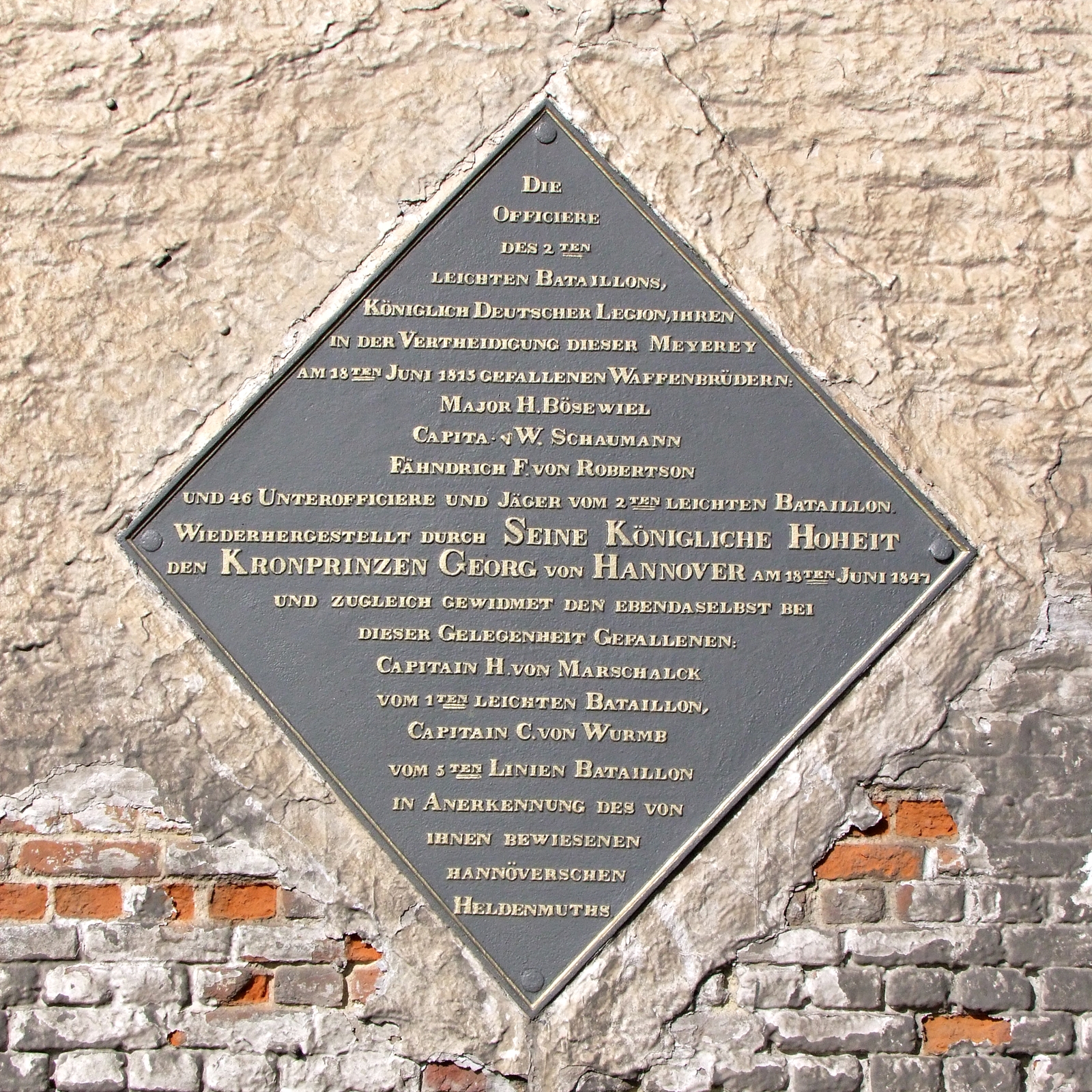
La Haye Sainte has changed very little in two centuries. It is still a working farmhouse on the same Brussels-Charleroi road, walls still pocked, gates still hung. In 1847, a plaque was set into the outer wall in honour of the King's German Legion and all those who died in the battle; another stands opposite the house. Two monuments rise alongside it — the Hanoverian Monument for the KGL, and beside it the Gordon Monument, dedicated to Wellington's aide-de-camp Sir Alexander Gordon, who died at Waterloo. The farm is privately owned and rarely open, but it sits in plain view from the road. Drive past on the way from Brussels to Charleroi and you can lean against the same wall where Baring's riflemen ran out of bullets and the centre of the line held just barely long enough.
From the Air
La Haye Sainte sits at 50.6781 N, 4.4119 E, directly on the N5 (Brussels-Charleroi road) at the south foot of the Mont-Saint-Jean escarpment. From the air, line up the modern N5 running south from Waterloo town; the farmhouse is the cluster of buildings on the east side of the road, with the Lion's Mound (40 m artificial earthwork, easy to spot) about 700 m to the west marking the Allied ridge. Hougoumont lies roughly 1.4 km west-southwest. Recommended viewing altitude 1,500-3,000 ft AGL. Nearest airports: Brussels (EBBR) about 22 km north, Charleroi (EBCI) about 35 km south. Mind Brussels TMA airspace.