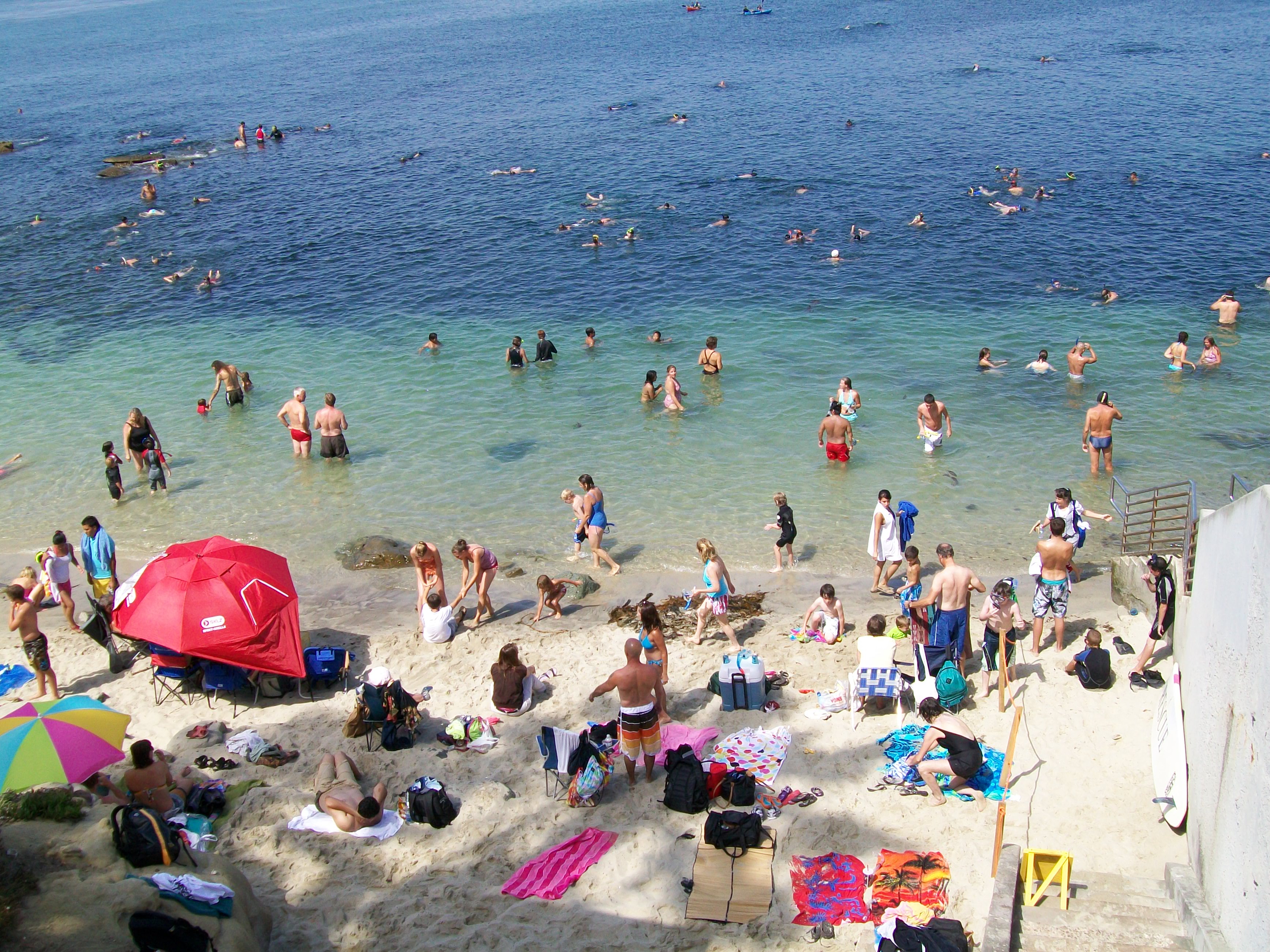
La Jolla Cove
La Jolla Cove is a small, cliff-framed inlet on San Diego's northern coast where the Pacific meets sandstone, sea lions haul out, and snorkelers drift above orange garibaldi fish in one of California's most protected marine reserves — plus a nonprofit formed specifically to complain about the smell.
The Cove Itself
La Jolla Cove is not large. It is a small bay — perhaps 50 yards across at its widest — tucked between sandstone cliffs on the coast of La Jolla, a neighborhood at the northern edge of San Diego. The cliffs rise on three sides, with the Pacific opening to the west. The water inside the cove is often calmer than the open ocean, sheltered enough for swimmers and snorkelers but connected to the same marine ecosystem that runs along California's entire coastline.
The cove sits within the San Diego-La Jolla Underwater Park, a protected marine reserve where fishing, collecting, and disturbance of marine life are prohibited. The protection has had exactly the effect such protections are intended to have: the underwater world at La Jolla Cove is richer than nearby unprotected areas, with healthier populations of fish, invertebrates, and marine plants.
Seven sea caves are carved into the sandstone cliffs north of the cove. The largest, Sunny Jim Cave, can be accessed from above through a tunnel that was hand-cut in 1902.
The Sea Lions
California sea lions began colonizing La Jolla Cove around 2013 — drawn, like the harbor seals at Children's Pool a mile to the south, by calm water and easy haul-out spots. The colony grew rapidly. Sea lions are larger and louder than harbor seals, and their presence at the cove generated both delight and complaint in roughly equal measure.
The delight came from visitors who photographed the animals at close range from the seawall, from the educational opportunity the colony created, from the basic pleasure of watching wild marine mammals in an urban setting. The complaint came from the smell.
A nonprofit called Citizens for Odor Nuisance Abatement was formed specifically to address the issue of sea lion-related odor at La Jolla Cove. The group advocated for measures to reduce the colony or mitigate the smell. The sea lions, for their part, ignored this.
The Annual Swim
The La Jolla Rough Water Swim, held annually in September, is one of the oldest ocean swimming competitions in the world. It uses the cove as its starting point, sending swimmers out into the open Pacific for courses ranging from a half-mile to three miles and back.
The race has been held continuously since 1916, interrupted only by wartime. It draws competitors from across the country and internationally, and its longevity reflects something true about La Jolla Cove: the water there, even on rough days, has a quality that makes swimming in it feel worthwhile.
The Rough Water Swim is a reminder that humans have been using this cove for athletic and recreational purposes for over a century, long before the sea lions arrived, and will presumably continue doing so long after the current state of human-wildlife negotiation at the cove reaches whatever resolution it eventually reaches.
The Garibaldi
Below the surface at La Jolla Cove, the most striking fish is the garibaldi — orange, about the size of a dinner plate, and fully protected under California law. The garibaldi is the state marine fish of California, and it is illegal to take or disturb them. Their protected status, combined with the cove's marine reserve designation, means that the garibaldi at La Jolla have grown relatively fearless.
Snorkelers and divers at the cove regularly encounter garibaldi at close range — fish that, in less protected waters, would flee immediately. The orange flash of a garibaldi moving through kelp or along the rocky bottom is one of the characteristic experiences of diving in Southern California, and La Jolla Cove is one of the best places to have it.
The reserve, the seals, the sea lions, the garibaldi, the smell, the hundred-year-old swim competition, the tourists on the seawall — La Jolla Cove is many things at once, as the most beautiful and contested places usually are.
From the Air
La Jolla Cove is located along the La Jolla coastline approximately 12 miles northwest of KSAN (San Diego International Airport). Flying along the coast at lower altitudes, the cove is visible as a small bay carved into the sandstone cliffs, with the seven sea caves visible in the cliff face to the north. The Ellen Browning Scripps Park above the cove is a green strip at the cliff edge. On clear days the kelp beds are visible through the water.