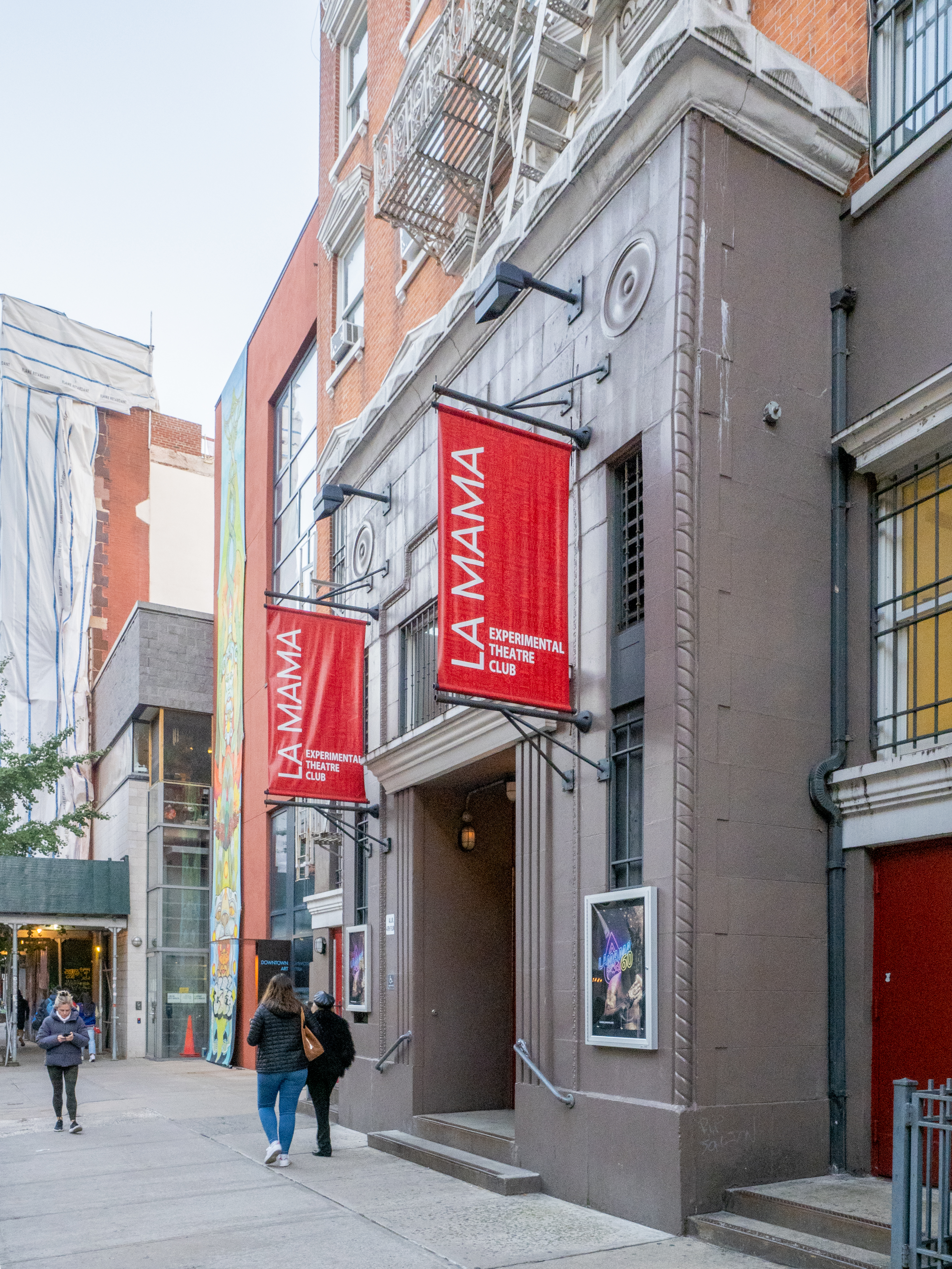
La MaMa Experimental Theatre Club
On October 18, 1961, Ellen Stewart paid fifty-five dollars in rent for a tenement basement at 321 East Ninth Street. She was a fashion designer at Saks Fifth Avenue who wanted a space to sell her clothes by day and stage plays by night -- specifically, plays by her foster brother Fred Lights and his friend Paul Foster. The inspiration came from her mentor, a Lower East Side fabric shop owner she called "Papa Abraham Diamonds," who told Stewart that everyone needs a "pushcart to serve others" alongside their own personal pushcart. Stewart took the advice literally: she opened a boutique that doubled as a theater. When the health department came knocking, the inspector happened to be a former vaudevillian. He suggested getting a coffeehouse license instead of a theater license. La MaMa became Cafe La MaMa. Coffee and cake were served, admission was free, and actors passed a hat for tips. American theater was never the same.
Mother of the Playwrights
Stewart's approach to producing theater was radically personal. She rarely read the scripts. Instead, she relied on what she called "beeps" or "clicks" -- intuitive hunches she felt when meeting artists. If the feeling was right, the play went on. In the early years, she housed and fed playwrights and directors, acting less like an impresario and more like a mother. Jean-Claude van Itallie remembered his first encounter: "She basically said to me, 'Honey, you're home. This space is for you to put on plays.'" Van Itallie recalled that Stewart "broadcast to the world that we were doing something important. We were her baby playwrights and she sat on us like eggs that would hatch." The list of artists who passed through La MaMa's doors reads like a casting call for the American cultural canon: Sam Shepard, Lanford Wilson, Adrienne Kennedy, Harvey Fierstein, Rochelle Owens, and Paul Foster among the playwrights. Robert De Niro, Al Pacino, Harvey Keitel, Bette Midler, Christopher Walken, Danny DeVito, Morgan Freeman, Nick Nolte, and Whoopi Goldberg among the performers.
Four Core Theaters, One Survivor
The Off-Off-Broadway movement of the 1960s coalesced around four theaters: Caffe Cino, Judson Poets' Theater, Theater Genesis, and La MaMa. Each had a distinct identity. Caffe Cino cultivated atmosphere and community; Judson worked from a church; Theater Genesis operated out of St. Mark's Church-in-the-Bowery. La MaMa's distinction was its focus on the playwright and Stewart's insistence on international reach. While the other three venues were content to serve their neighborhoods, Stewart wanted global recognition for her artists. She took La MaMa productions on European tours during the 1960s, a bold strategy for a basement theater that American critics sometimes dismissed for its "hit or miss quality." Of those four founding theaters, La MaMa is the only one still operating, staging over one hundred productions with more than four hundred performances each season from its current home in the East Village.
Expanding the Pushcart
La MaMa's physical footprint grew as its reputation spread. In 1971, Stewart acquired 236 East 3rd Street and other abandoned Lower East Side buildings, turning them into community art spaces with workshops that ranged from children's programs led by avant-garde jazz drummer Charles "Bobo" Shaw to a budding Hispanic theater center. Throughout the 1970s, the 3rd Street location became a hub of the Loft Jazz movement; in 1979, trumpeter Lester Bowie rehearsed his 59-member Sho'Nuff Orchestra there. The Nuyorican Poets Cafe purchased the building in 1981, but La MaMa had already planted the seed. In 1974, Stewart purchased 66 East 4th Street, two doors down from her existing space. The Comprehensive Employment and Training Act provided crucial funding in the late 1970s, enabling an ambitious mounting of Goethe's Faust I with 22 actors, an 8-person chorus, 6 musicians, and an 18-member crew.
The Basement That Changed Broadway
In 2005, a $20 million Carnegie Corporation grant, funded by Mayor Michael Bloomberg, reached La MaMa along with 405 other New York arts institutions. The recognition was fitting for a theater that had been shaping American culture for over four decades while operating on margins that would terrify a Broadway producer. Stewart continued as artistic director until her death on January 13, 2011, at age 91. Finding a successor was significant -- "Ellen is La MaMa," as one observer put it -- but the institution survived the loss of its founder as it had survived every other challenge. The La MaMa Archives now contains approximately 70,000 items: posters, programs, scripts, costumes, puppets, masks, instruments, photographs, and videos documenting work by artists from more than seventy nations. It is a record of what happens when someone decides that a basement on East Ninth Street is exactly the right place to reinvent the American stage. The pushcart, it turned out, could carry more than anyone imagined.
From the Air
Located at 40.7266N, 73.9901W in Manhattan's East Village, on East 4th Street between Bowery and Second Avenue. The theater occupies converted tenement buildings in the dense grid of the East Village, not readily distinguishable from altitude but situated in the cultural heart of downtown Manhattan. Look for the intersection of Bowery and East 4th Street as a reference point. Nearby landmarks include Cooper Union, Tompkins Square Park to the east, and the Bowery corridor. Closest airports: KJFK (John F. Kennedy International, 13 nm SE), KLGA (LaGuardia, 8 nm NE), KEWR (Newark Liberty, 10 nm W). Best viewed at 1,500-2,000 ft AGL for neighborhood context.