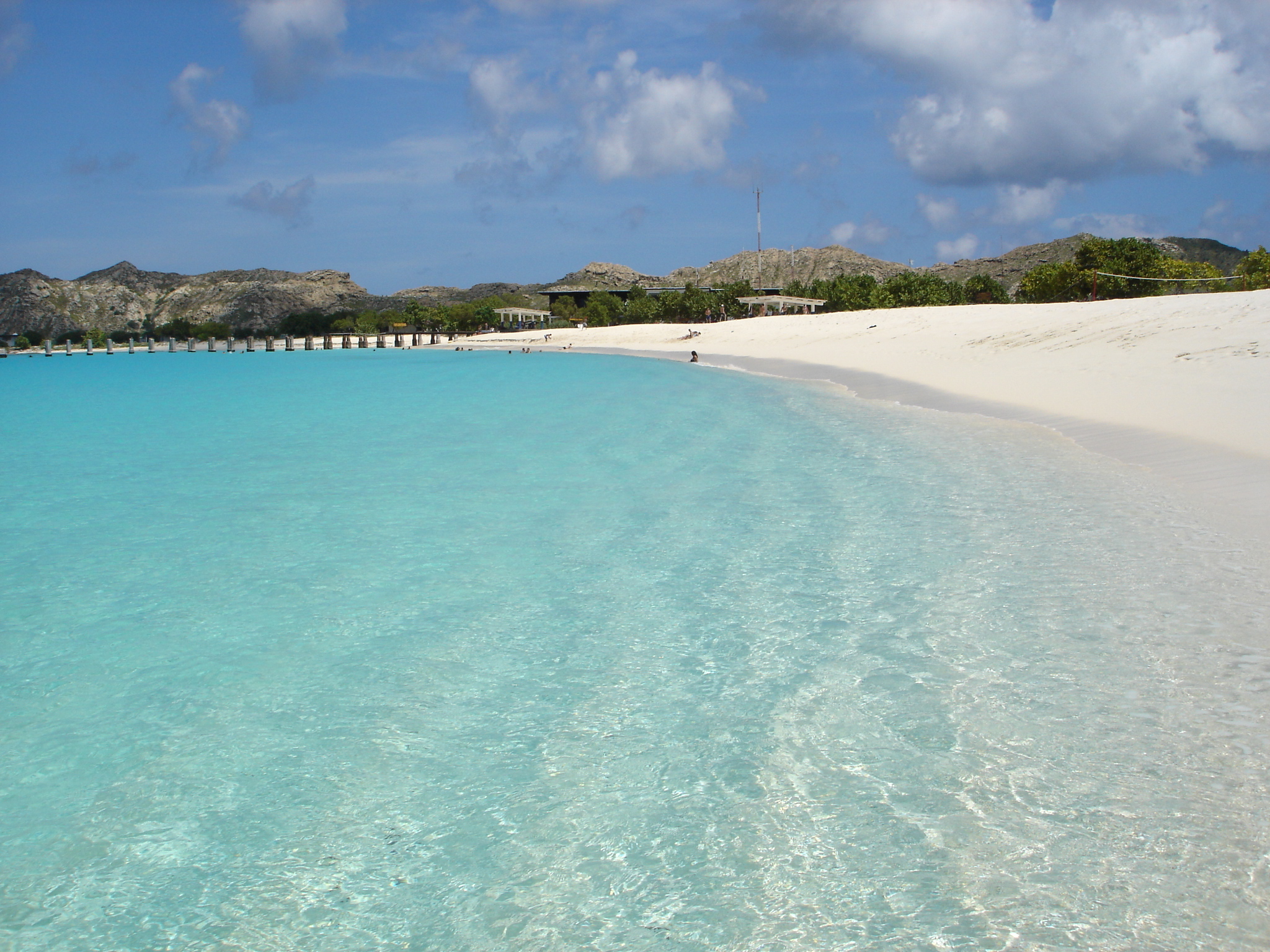
La Orchila Island
The name comes from a plant. Orchilla is the Spanish word for the lichen once harvested across the island in such quantities that the 16th-century explorer Alonzo de Santa Cruz described it as the defining feature of the place -- "there is a lot of Orchilla, of which we speak long in the islands of Canaria." Today, La Orchila Island sits 150 kilometers north of Caracas in the Caribbean Sea, and the lichen is long gone. What replaced it tells the story of Venezuela itself: colonial claims and counter-claims, guano fortunes, military installations, presidential luxury, a coup, and the shadow of great-power rivalry.
Claimed by Everyone, Settled by No One
In 1589, Spanish governor Diego de Osorio formally took possession of La Orchila along with Los Roques and other offshore islands. The Dutch disagreed. Writing in 1836, M.D. Teenstra listed "Orchilla" among the islands belonging to Curacao, though he admitted the place was "of too little importance to justify any dispute with Spain." Venezuela's coastal guard thought otherwise, regularly chasing away Curacaoan fishermen who came for shellfish, firewood, turtles, and bird eggs. Around 1870, the American-owned Philadelphia Guano Company arrived to extract the accumulated bird droppings, building a factory that operated for years before being abandoned. In 1871, the island was folded into the Territorio Colon under President Antonio Guzman Blanco. By the time it became part of Venezuela's Federal Dependencies in 1938, La Orchila had been claimed or used by Spain, the Netherlands, the United States, and Venezuela, yet none had ever established a permanent settlement.
The General's Retreat
Until the 1950s, roughly 121 people lived on La Orchila. General Marcos Perez Jimenez, who ruled Venezuela from 1952 to 1958, changed the island's character entirely. The inhabitants were evicted. Military installations rose on the cleared ground, along with about thirty small houses and a presidential residence designed by architect Julio Barreiro Rivas. The complex became a private retreat for the general and his inner circle -- a Caribbean getaway accessible only to those in power. Successive presidents maintained the tradition. Social democrat Carlos Andres Perez used it during both his terms (1974-79 and 1989-93). The residential buildings reserved for military personnel still consist mainly of elevated wooden-log houses, connected by unpaved but well-maintained pathways. There is even a court for bolas criollas, the traditional Venezuelan bowling game. One beach on the island, Arena Rosada, is notable for its distinctly pink sand.
A Coup and a Prison
In April 2002, a coup briefly removed President Hugo Chavez from power. The military officers who overthrew him needed a place to hold the deposed president away from his supporters and the press. They chose La Orchila -- remote, restricted, and controlled entirely by the armed forces. Chavez was imprisoned on the island for a short period before loyalist troops restored him to office. The episode turned La Orchila into a symbol of political volatility, an island whose isolation made it useful not just for leisure but for the hard mechanics of power. In 1978, Venezuela and the Kingdom of the Netherlands had formally established the maritime boundary between the Federal Dependencies and the Dutch Antilles in the surrounding Caribbean waters, settling the colonial-era ambiguity that had lingered for centuries.
Bombers and Geopolitics
La Orchila made international headlines twice more in the 21st century. In March 2009, Russian Air Force Major General Anatolii Zhikharev announced that Venezuela had offered Russia the use of the Antonio Diaz Naval Air Station on the island to base strategic bombers. Chavez denied the claim, and Kremlin official Alexei Pavlov walked it back, saying the military had merely discussed "technical possibilities." The story resurfaced in 2018 when the Russian military released a plan to deploy supersonic Tupolev Tu-160 strategic bombers to the island. Colonel Eduard Rodyukov of Russia's Academy of Military Sciences told the newspaper Nezavisimaya Gazeta that the deployment would be "a signal to Trump" about the consequences of abandoning nuclear disarmament treaties. In October 2011, La Orchila and its surrounding islets were formally integrated into the Francisco de Miranda Island Territory, an administrative subdivision of the Federal Dependencies with its capital in the Los Roques Archipelago. The island remains a military installation, closed to civilian visitors -- a Caribbean outpost where Venezuela's internal politics and the world's strategic tensions converge on a strip of pink sand.
From the Air
La Orchila Island is located at approximately 11.80N, 66.14W, roughly 150 km north of Caracas in the Caribbean Sea. The island is a restricted military zone with the Antonio Diaz Naval Air Station. From altitude, the island is visible as a low, elongated landmass with beaches and sparse vegetation. It lies east of Los Roques Archipelago. Nearest civilian airports: Simon Bolivar International (SVMI/CCS) on the mainland to the south. Note: the island's airspace may be restricted due to its military status.