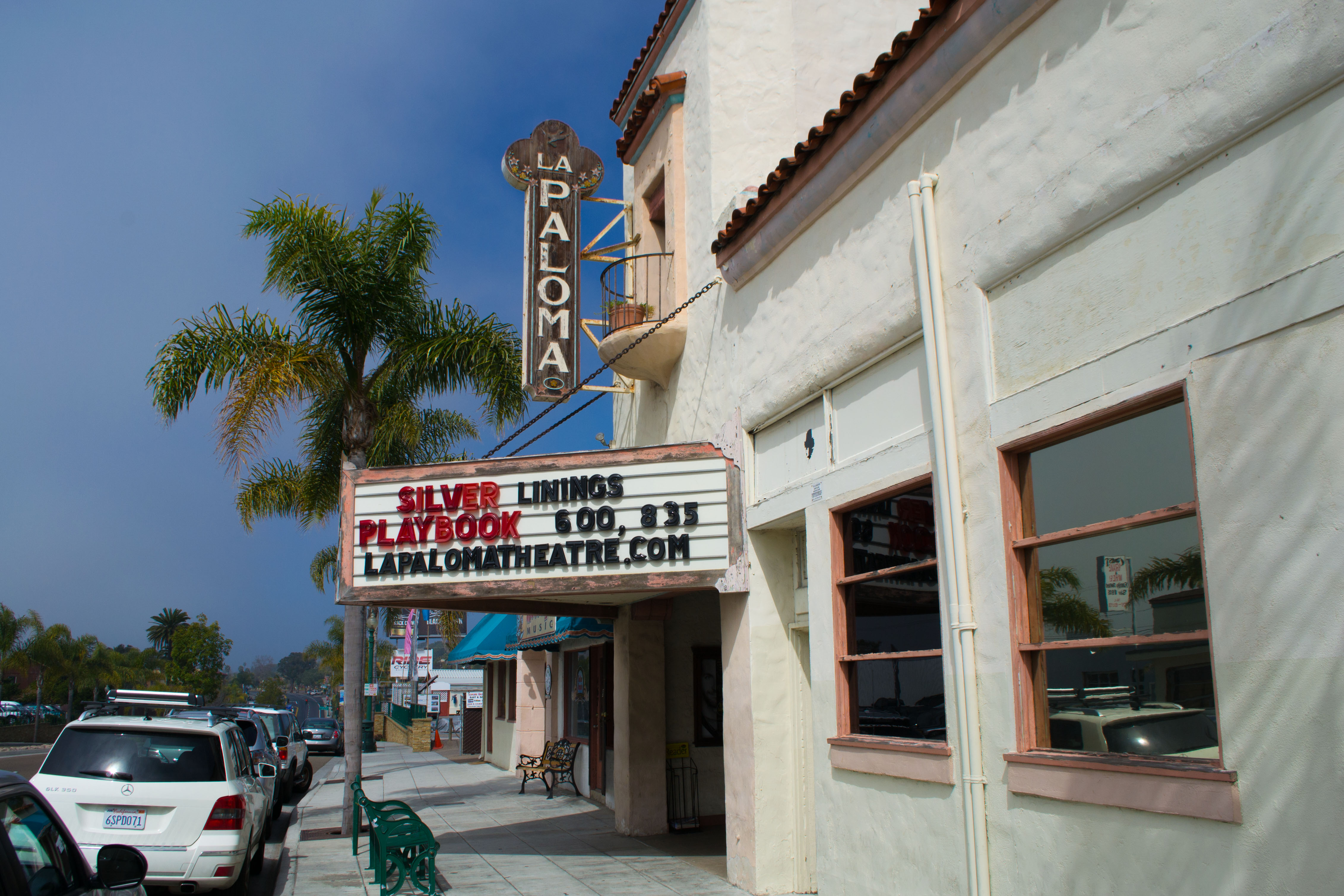
La Paloma Theatre
Most movie theaters from 1928 are gone — demolished for parking lots, converted to retail, or simply left to deteriorate until demolition became inevitable. The La Paloma Theatre in Encinitas is still standing, still showing films, and still hosting the Rocky Horror Picture Show on weekend nights when audiences dress up and shout at the screen. It opened on February 11, 1928, with the film 'The Cohens and Kelleys in Paris,' and Mary Pickford — one of the most famous actresses in the world at that moment — was in the audience. Nearly a century later, the theater is still the La Paloma, which is Spanish for 'the dove.'
Opening Night, 1928
Frank E. Brown commissioned the theater and Edward J. Baum designed it in the Spanish Colonial Revival style that was fashionable for California public buildings in the 1920s. The architectural vocabulary — arched openings, tile roofs, stucco walls, ornamental ironwork — referenced California's Spanish and Mexican past while providing a formal grandeur that distinguished a theater from an ordinary commercial building. Baum's design for La Paloma placed it within a local tradition of civic architecture that took seriously the idea that public entertainment deserved beautiful settings.
The floor tiles, made by Claycraft Potteries, add a detail worth noticing: Claycraft was a Los Angeles manufacturer whose tiles appear in many significant California buildings from the early twentieth century, their handmade quality giving the theater's floors a warmth and irregularity that machine-made materials cannot replicate.
Mary Pickford's presence at opening night was not accidental or routine. Pickford was a superstar of the silent film era — co-founder of United Artists, one of the founding members of the Academy of Motion Picture Arts and Sciences, a woman whose face was recognized across the world. Charlie Chaplin also performed at La Paloma in its early years. For a small coastal town that had only recently connected to the broader California economy via the railroad, attracting this level of attention reflected genuine civic ambition.
Where the Sound Era Began
The La Paloma opened at precisely the moment when motion picture technology was undergoing its most dramatic transformation. Sound film — 'talkies' — had been commercially introduced in 1927 with 'The Jazz Singer,' and the industry was scrambling to retrofit theaters with sound equipment and audiences were scrambling to understand what this new medium would become. La Paloma was among the first theaters in the region to show sound films, positioning it at the cutting edge of the medium during one of the most exciting periods in cinema history.
For most of the twentieth century, the theater operated as a single-screen venue showing first-run and revival films, the kind of neighborhood movie house that was once the primary entertainment infrastructure of American communities. The transition to multiplex theaters, which offered more screens and more showtimes in suburban shopping centers, squeezed single-screen venues out of the mainstream exhibition market. Many closed. La Paloma found other ways to remain relevant.
The Show That Never Ends
The La Paloma's most reliable ongoing program is the Rocky Horror Picture Show, screened on weekend nights by a group called Crazed Imaginations. Rocky Horror — the 1975 cult horror-comedy musical — has been shown continuously at various theaters around the world since 1975, making it the longest-running theatrical release in cinema history. Audiences participate actively, shouting responses to the dialogue, throwing props at the screen, and dressing as characters from the film. The experience is communal, irreverent, and genuinely participatory in a way that distinguishes it from conventional moviegoing.
The theater underwent restoration in 2016, work that refreshed the physical fabric of the building while preserving its historic character. The restoration effort reflected the community's recognition that La Paloma is not just a business but an institution — one of the last single-screen movie theaters on the California coast still operating in its original form, in a building that predates the sound era, in a room where Mary Pickford once sat and watched a film.
South Coast Highway 101, where La Paloma sits, has become one of the more deliberately preserved commercial streets in North County San Diego — a corridor where the city of Encinitas has chosen to favor independent businesses and historic structures over the chain development that characterizes most California arterials. The theater anchors this stretch of the highway as both a working venue and an artifact, evidence that some things from 1928 are still worth keeping.
From the Air
La Paloma Theatre is located at 33.05°N, 117.29°W on South Coast Highway 101 in Old Encinitas. From altitude heading south along the California coast, Encinitas is visible as a beach community between Carlsbad and Cardiff-by-the-Sea. The theater itself is too small to identify from cruising altitude, but the characteristic coastal grid of Old Encinitas along Highway 101 is discernible in clear weather. Nearest airports: KCRQ (McClellan-Palomar, Carlsbad, 5 miles north) and KMYF (Montgomery-Gibbs Executive, 18 miles southeast). Best viewed at 2,000–4,000 feet MSL on coastal approach.