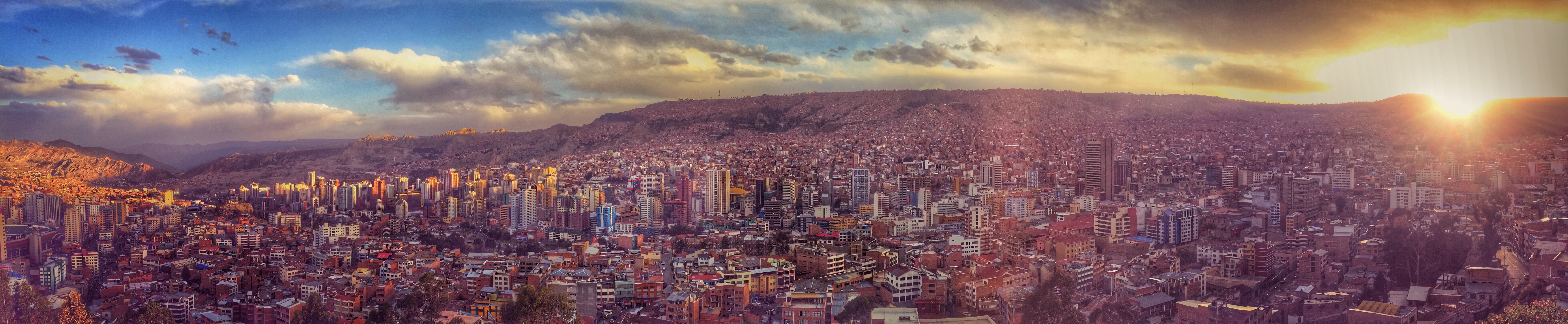
La Paz
Flying into El Alto, you see the sprawling brick shantytowns first -- mile after mile of low buildings spread across the altiplano at 4,058 meters. Then the ground drops away, and La Paz appears below, clinging to the sides of what looks like a gash in the earth. The canyon created by the Choqueyapu River falls nearly a thousand meters from rim to floor, and Bolivia's administrative capital fills it completely, a cascade of buildings tumbling downhill toward the wealthier, milder neighborhoods at the bottom. It is the highest national capital in the world, a city where geography dictates social order with a literalness unusual even in South America: the lower you live, the richer you are, because the lower you go, the warmer the air and the easier the breathing.
A City Built by Gravity
La Paz was founded in 1548, and the logic of its layout has not changed since. The Choqueyapu River -- now mostly built over -- runs northwest to southeast through the canyon, and the main thoroughfare follows it, changing names along its length. The central section, a tree-lined boulevard called the Prado, serves as the city's spine. Above the Prado, the surrounding hillsides are covered with makeshift brick houses belonging to those who hope, as the local saying goes, to one day reach the bottom. Below it, middle-class residents live in high-rise condominiums, and the truly affluent occupy lower neighborhoods southwest of downtown, where the weather is noticeably milder. El Alto, the satellite city on the altiplano above, once housed airport and railway workers. Today it is larger than La Paz itself, mostly inhabited by Aymara people, and significantly poorer. The altitude there -- 4,058 meters -- makes life harder in every measurable way.
Gondolas Over the Canyon
The Mi Teleferico cable car system has transformed how La Paz moves. Ten lines connect El Alto with downtown and beyond, soaring over the canyon in gondolas that the locals keep in immaculate condition and where passengers greet each newcomer who steps aboard. A ride costs three bolivianos and saves the hours that taxis and minibuses lose in traffic that sometimes seems permanent. Taking the red line up to 16 de Julio station in El Alto provides a panoramic view of the entire city -- the canyon walls, the towers of downtown, the brown sprawl of the altiplano, and beyond it all, the snow-capped mass of Mount Illimani. Riding five connected lines forms a complete circle around the city, a ninety-minute tour for fifteen bolivianos that no tourist brochure could improve on. Below the gondolas, the streets belong to three types of shared transport: regular buses called micros, shared vans whose fare collectors hang from the doors yelling routes in rapid-fire Spanish, and shared taxis called trufis that follow set routes advertised on the windshield.
Thursdays at Sixteen Thousand Feet
Every Thursday and Sunday, the Feria de 16 de Julio takes over entire neighborhoods of El Alto. It is one of the largest open-air markets in the world, a mostly Aymara bazaar where a person can find software, high-quality used clothing from Europe and North America, furniture, car parts, plants, and food -- all at prices that make expatriates furnish entire houses here. The market sprawls along the railroad tracks from the Ceja to Plaza Ballivian, and the standard advice for newcomers is to leave cameras and phones behind and keep money inside clothing. Sunblock is also recommended -- at this altitude, the equatorial sun burns fast. Reaching the market by cable car means arriving early, because by ten in the morning the queue at the red line station can look like an hour's wait, though it usually moves faster. The market is an attraction independent of anything it sells: the density of people, the volume of commerce, the Aymara grandmothers in bowler hats negotiating with absolute authority.
The Altitude Tax
La Paz extracts a physical price from everyone who arrives from lower ground. At 3,627 meters -- and substantially higher if you venture to El Alto -- the air is thin enough to make healthy people wake gasping in the night. Mate de coca, the coca leaf tea sold everywhere, is the traditional Andean remedy, though clinical studies have not confirmed its effectiveness. Pharmacies sell soroche pills that may help. The real treatment is patience: moving slowly, eating lightly, sleeping as much as possible for the first day or two. Marathon runners have been struck down here while sedentary travelers have walked through unaffected -- altitude sickness plays no favorites. Despite sitting near the equator, La Paz occasionally sees snow in the middle of the year, and warm clothing is essential regardless of season. The city compensates for the discomfort with views that altitude alone can provide: Avenida Camacho points straight at Illimani's glaciated peak, framed by skyscrapers in a juxtaposition that captures everything strange and compelling about this place.
From the Air
Located at 16.50S, 68.13W in the Bolivian Andes. The city fills a dramatic canyon visible from altitude as a distinct depression in the altiplano, with El Alto spread across the flat plateau above. El Alto International Airport (SLLP) sits at 4,061 meters on the altiplano rim, one of the highest commercial airports in the world. Mount Illimani (6,438 meters) dominates the southeastern skyline. The Mi Teleferico cable car lines are visible as thin threads crossing the canyon.