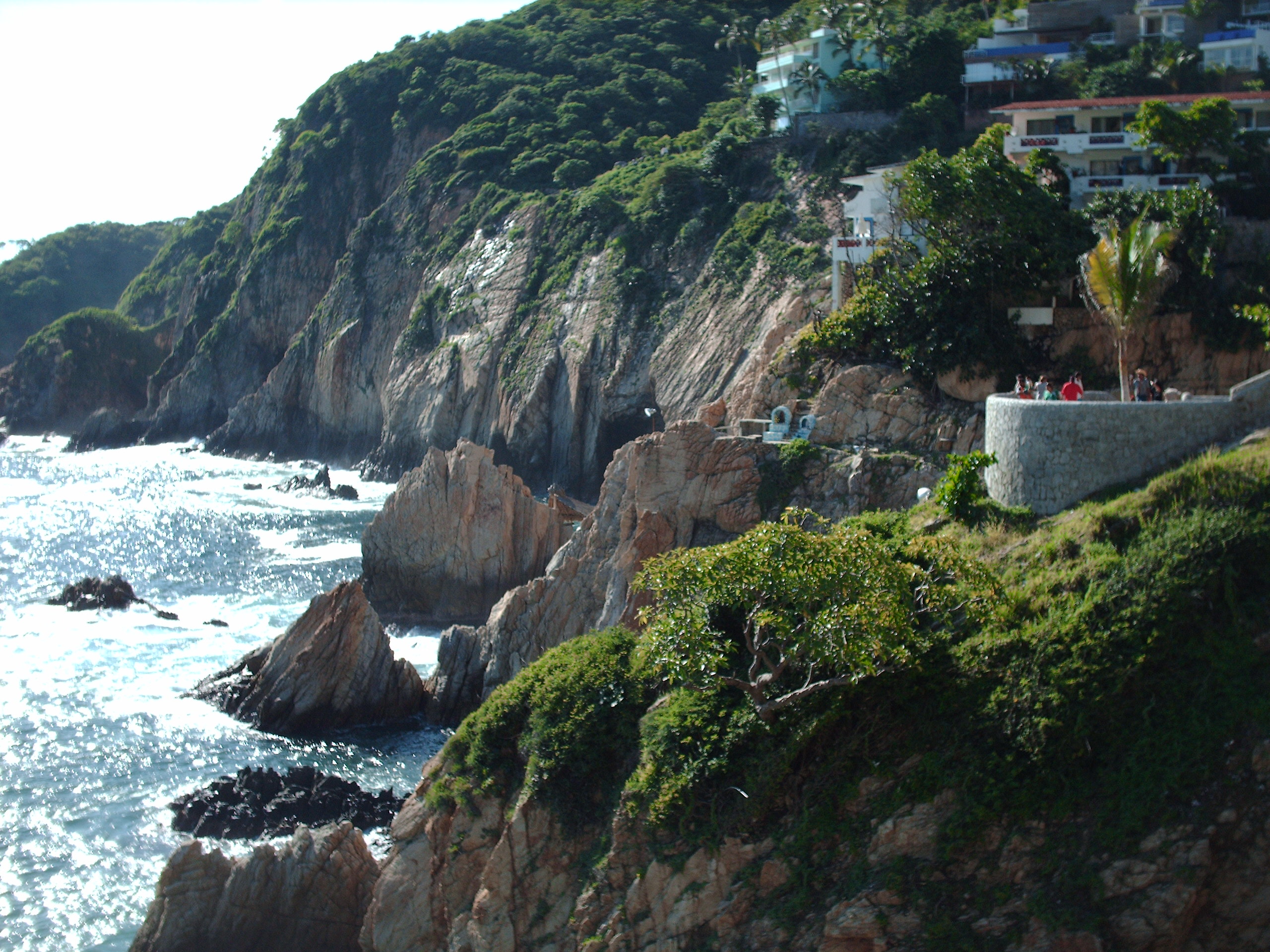
La Quebrada: Where Gravity Meets the Tide
The math is brutal. An 80-foot drop into a channel barely 12 feet deep, where the water surges in and drains out with each wave. Jump too early, the rocks are exposed. Jump too late, the water is already receding. The divers of La Quebrada have been calculating this equation with their bodies since the early twentieth century, launching themselves from the lip of a narrow ravine on Acapulco's western coast and entering the Pacific at roughly 55 miles per hour. There is no margin for error, no safety net, and no technology involved - just a human being reading the ocean's rhythm and trusting it with their life.
An Unfinished Cut in the Rock
La Quebrada exists because two ambitious engineering projects failed. In 1799, Dr. Francisco Javier Balmis, physician to the Spanish Crown, proposed cutting a channel through the coastal cliffs to ventilate Acapulco's sweltering port, where concentrated heat bred cholera and scurvy among the population. He called the project the Abra de San Nicolas. Workers began blasting and chipping at the rock, but the money ran out before the channel broke through. Nearly eight decades later, in 1876, Colonel Jose Maria Lopetegui revived the effort. His soldiers removed thousands of cubic meters of stone in what contemporaries described as heroic labor, grinding away at the cliff face for the public health of the port below. But again, the terrain proved too stubborn and the budget too thin. The work stopped, leaving behind a dramatic man-made ravine - a quebrada, a broken place - that would find a purpose its engineers never imagined.
The Leap and the Wave
Locals had been diving from the cliffs for years before anyone formalized it, but in 1934 the La Quebrada Cliff Divers were officially established as a performing group. The cliff offers two launch points: a lower ledge at 40 feet and the top platform at 80 feet. From the higher point, a diver falls for roughly two and a half seconds before impact. The channel below is narrow and shallow enough that timing is everything - divers must launch at the precise moment an incoming wave fills the gap with enough water to cushion their entry. Misjudge it and the consequences range from broken bones to death. Before each dive, the performers climb the rock face, pause at a small shrine carved into the cliff to pray, then step to the edge and wait. They watch the swells, counting the rhythm. When the right wave begins its approach, they go. Some dive with flaming torches held overhead, tracing arcs of fire against the twilight sky - a spectacle that has become one of Acapulco's most enduring images.
A Family Tradition in Freefall
Cliff diving at La Quebrada is not a career you apply for. Most of the divers come from within a network of families who have been leaping from these rocks for generations, passing down the knowledge of wave timing, body position, and nerve that no training manual can fully capture. Young divers begin on the lower ledge and work their way up over years, learning to read the specific behavior of waves in this particular channel - knowledge that is local, physical, and earned through repetition. The audience watches from a walkway cut into the opposite cliff wall and from a restaurant perched above the ravine, sharing the viewpoint with pelicans that dive for fish in the same waters below. The parallel is not lost on anyone: both the birds and the humans plunge from height into the same surge channel, though only one species does it for an audience.
Acapulco's Stubborn Icon
Acapulco has reinvented itself several times - from colonial trading port to mid-century glamour destination to modern city grappling with security challenges and hurricane damage. Through each transformation, La Quebrada has endured as the city's most recognizable attraction, unchanged in its essential drama. No infrastructure improvements can alter the physics of the dive, and no marketing campaign can manufacture the genuine tension of watching a human body fall eight stories toward rock and surf. The ravine itself, that unfinished ventilation project from two centuries ago, remains exactly as the soldiers left it - a broken place that became, against all intention, something extraordinary. Tourists crowd the viewing path at sunset for the evening performances, cameras raised, while below them the Pacific keeps sending waves into the gap, each one a brief window of possibility that closes as quickly as it opens.
From the Air
Located at 16.846N, 99.916W on the western edge of Acapulco's peninsula, facing the open Pacific. The narrow cliff ravine is visible from low altitude as a sharp notch in the rocky coastline west of Acapulco Bay. Look for the cluster of buildings and viewing platforms along the cliff edge near the Mirador La Quebrada restaurant. Nearest airport: General Juan N. Alvarez International Airport (MMAA/ACA), approximately 22 km southeast. Best viewed at 1,500-3,000 feet on approach from the west. The contrast between the rocky cliff face and the white surf below makes the site identifiable even from moderate altitude.