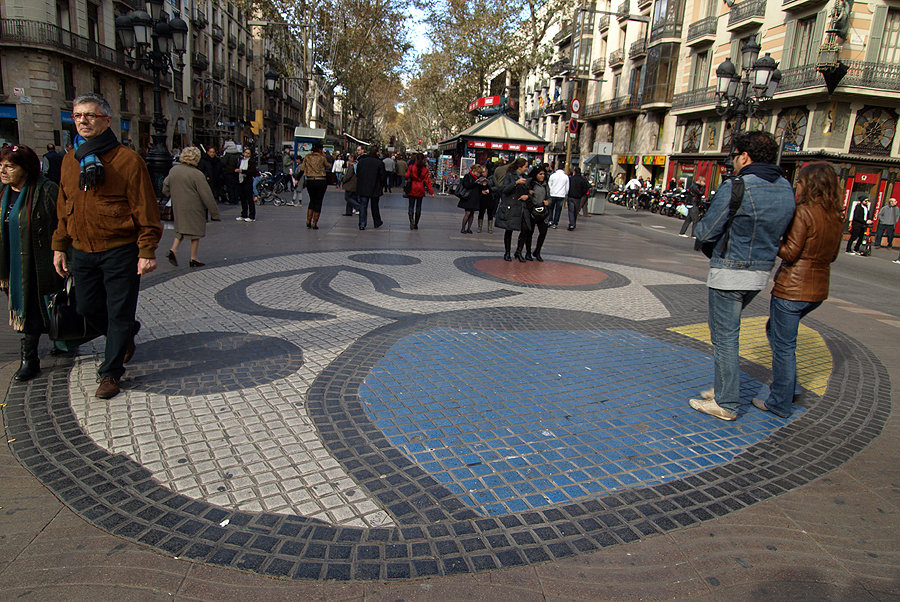
La Rambla, Barcelona
The word rambla comes from the Arabic raml, meaning sand. Before it was a boulevard, La Rambla was a wadi -- a dry streambed that carried rainwater from the Collserola hills to the sea, separating the walled city from the settlements of El Raval. In 1377, Barcelona began extending its walls to encompass the stream. By 1440, the water had been diverted, and the sandy channel started its long transformation into what the poet Federico Garcia Lorca reportedly called the only street in the world he wished would never end. Today, the tree-lined pedestrian promenade stretches 1.2 kilometers from Placa de Catalunya to the Christopher Columbus Monument at Port Vell, and it carries the weight of everything Barcelona has been.
Layers Beneath the Pavement
The paving design of La Rambla's central promenade appears to ripple like water, an acknowledgment of what flows beneath the surface. The street is actually a series of shorter segments, each with its own name -- hence the plural form Les Rambles in Catalan, or Las Ramblas in Spanish. Over the centuries, religious establishments lined its length: the Jesuit Bethlehem monastery and college, founded in 1553; the Carmelite St. Joseph's monastery, whose site now holds the Boqueria market; and a Capuchin monastery at the street's lower end. During the St. James's Night riots of 1835, revolutionaries burned these monasteries and churches and killed a number of friars. The Spanish Civil War brought further destruction when anarchists controlled Barcelona and again targeted religious buildings, while pro-Franco artillery and air attacks damaged the surrounding area.
Fortunes Built on Suffering
In the late nineteenth century, Catalans who had made fortunes from slave plantations in Spanish America returned to Barcelona after the abolition of slavery in 1886. Several invested their wealth in constructing opulent mansions along La Rambla and in neighboring streets. German historian Michael Zeuske has argued that the boulevard was "built on the backs of slaves," a claim The Guardian characterized as an exaggeration but one that reflects an uncomfortable truth about the sources of the wealth that shaped the street's architecture. The grand facades that visitors admire today were, in many cases, financed by the labor of enslaved people thousands of miles away in Cuba and other Caribbean colonies. Barcelona is increasingly reckoning with this history, which complicates the picturesque narrative of a beloved promenade.
Kiosks, Mosaics, and Mirrors
Walking La Rambla today, you pass flower kiosks that have been selling blooms from the same spots for generations, newspaper stands, and pavement cafes where the price of a coffee includes unlimited people-watching. Near the Pla de l'Os, a circular pavement mosaic by Joan Miro, installed in 1976, decorates the ground beneath thousands of passing feet. The Font de Canaletes, a fountain and legendary meeting point, sits near the top of the street -- tradition holds that anyone who drinks from it will return to Barcelona. Along the way stand the Palau de la Virreina, a Baroque palace hosting exhibitions, and the Gran Teatre del Liceu, Barcelona's opera house since 1847. Until 2010, the Rambla dels Estudis hosted an open-air market for caged birds and small animals, a tradition ended by animal protection legislation after years of legal disputes.
The Street That Absorbs Everything
On 17 August 2017, a van was deliberately driven into pedestrians on La Rambla, killing fourteen people and injuring over one hundred thirty in a terrorist attack. The boulevard has absorbed this trauma as it has absorbed every other upheaval in its history -- the medieval floods, the anticlerical fires, the civil war bombardments, the decades of Franco-era repression. In 2017, Barcelona approved a redevelopment plan for the street with an estimated budget of forty-five million euros, intended to reduce car traffic, expand pedestrian space, and create more green areas. The ambition is to make La Rambla more welcoming to the residents who live along it, not just the tourists who pass through. It is a street that has been continuously reinvented for six centuries, and the reinvention continues -- built on sand, shaped by water, defined by the people who walk it.
From the Air
Located at 41.38N, 2.17E, La Rambla is the central tree-lined axis running northwest to southeast through Barcelona's Ciutat Vella district, clearly visible from the air as a green corridor between dense urban blocks. It connects the large Placa de Catalunya roundabout to the Columbus Monument at the harbor. Nearest major airport is Barcelona-El Prat (LEBL), approximately 13 km southwest. Best viewed at 2,000-5,000 feet AGL. Port Vell and the harbor are prominent visual references at the boulevard's southern terminus.