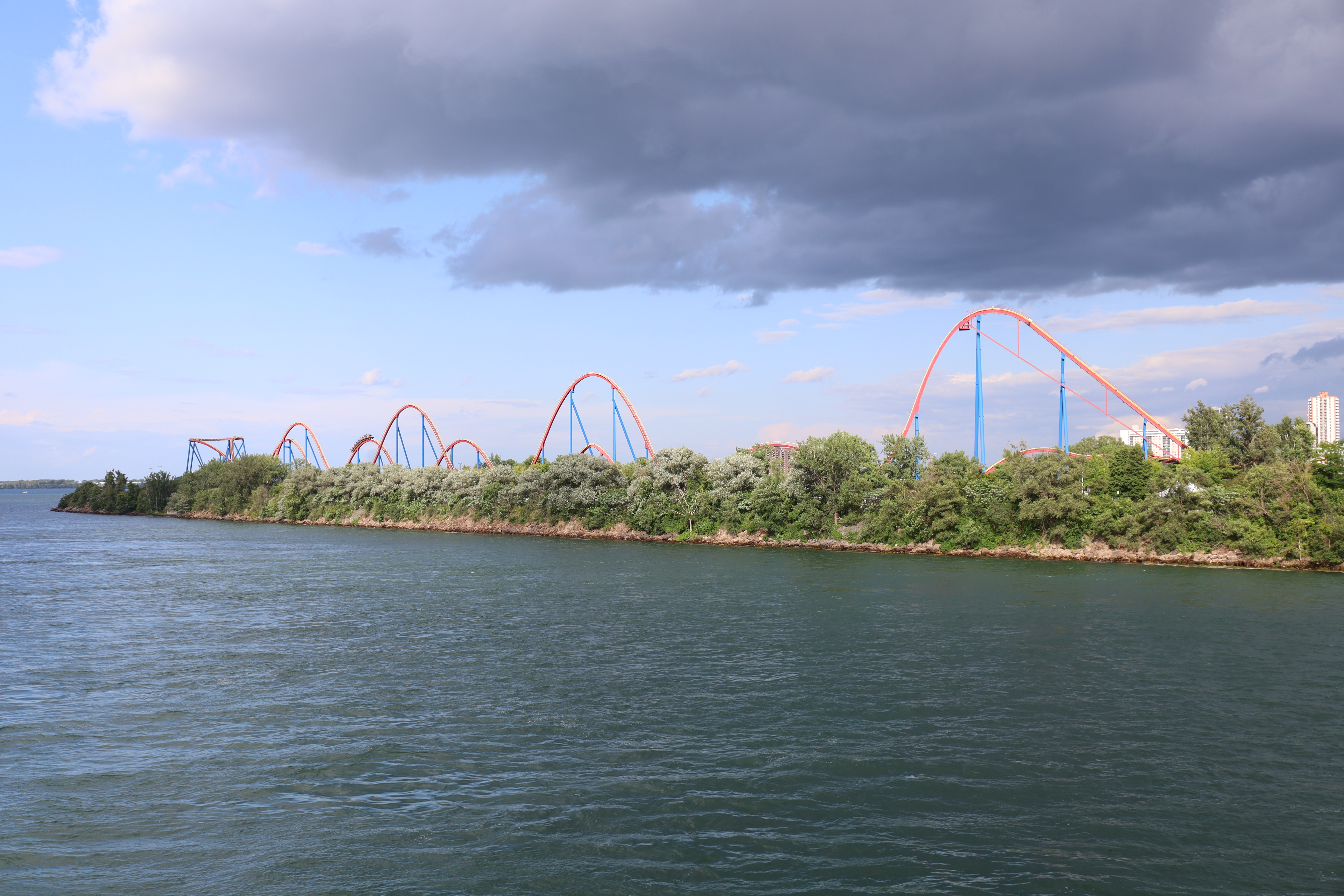
La Ronde
When the rest of Expo 67 closed at ten-thirty each night, the party was just getting started at La Ronde. The rides, restaurants, and beer halls on the northern tip of Saint Helen's Island kept spinning until two-thirty in the morning, a raucous afterparty for the most celebrated World's Fair of the twentieth century. The fair ran from April to October 1967. La Ronde never left. What began as a temporary entertainment complex on a man-made extension of an island in the Saint Lawrence River became Quebec's largest amusement park, the second largest in Canada, and a fixture of Montreal's skyline for generations. Its story winds through world's fair ambition, civic tragedy, corporate reinvention, and the slow disappearance of the original rides that once dazzled fifty million visitors.
An Island Conjured for a Fair
La Ronde occupies ground that barely existed before the 1960s. The park sits on a man-made extension built onto the northern tip of Saint Helen's Island, in the vicinity of where the smaller Ronde Island once rose from the Saint Lawrence. That granite islet, which gave the park its name, was destroyed by blasting during construction. The resulting crater filled with water and became Dolphin Lake, the body of water the park now encircles. To the south lies Jean-Drapeau Park, the former Expo 67 grounds, the Jean-Drapeau Metro station, and the Montreal Biosphere museum. Access from the city comes primarily via the Jacques Cartier Bridge, or through Cite du Havre and the Concordia bridge at the island's opposite end. When the City of Montreal kept running the amusement park after Expo 67 closed, few imagined it would still be operating more than half a century later.
Ghosts in the Lake
Dolphin Lake has a dark history that shadows the park's carnival atmosphere. On July 8, 1973, two police officers drowned after attempting to rescue an intoxicated woman who had fallen in. Six years later, on the same date, three people died when "The Mississippi," a tour boat carrying up to sixty passengers, capsized. Two weeks after that, a fourth drowning occurred when a man attempted to swim across the lake at night. The tragedies continued in 1980 when blue-collar workers at La Ronde's Alcan Aquarium went on a forty-one-day strike, refusing to enter the building. Abandoned by their trainers, three dolphins starved to death in isolation. The aquarium never recovered from the scandal and permanently closed in 1991. These events cast long shadows, but the park pressed forward, and by the late 1990s, the City of Montreal began exploring a sale that would transform La Ronde entirely.
Six Flags Plants Its Northernmost Flag
On May 4, 2001, Six Flags acquired all of La Ronde's assets for twenty million dollars, beating out bids from Paramount Parks, Cedar Fair, and France's Parc Asterix. The American chain signed a long-term emphyteutic lease with Montreal that runs until 2065 and poured roughly ninety million dollars into new rides and improvements. The first major investment arrived in 2002: Le Vampire, a Bolliger and Mabillard inverted roller coaster that mirrors the Batman: The Ride installations found at other Six Flags parks, though without the Batman branding since the Warner Bros. license did not extend to unbranded parks. In 2006, the park opened Goliath, a Bolliger and Mabillard mega coaster that became the fourth tallest and fourth fastest roller coaster in Canada. As of 2025, the park operates thirty-seven rides including eight roller coasters. Le Monstre, the park's towering wooden coaster, holds the record for the highest double-tracked roller coaster in the world.
The Last Rides of Expo 67
One by one, the original attractions from the World's Fair have vanished. La Pitoune, the beloved water log ride that dated back to opening day, ran its final season in 2016 and was dismantled the following year, announced on the park's fiftieth anniversary. The Minirail, the last vestige of the monorail system that once ran three separate circuits across both Saint Helen's and Notre Dame Islands, went out of service in 2019 and was demolished in November 2022. The Galopant carousel, built in 1885 and a fixture at La Ronde since Expo 67, was quietly retired in 2023 when it disappeared from the park map. Heritage groups raised alarm as its nineteenth-century music organ had already fallen silent decades earlier and the carousel sat deteriorating. In November 2025, Spirale, which had not operated since 2018, was demolished after standing as a fixture of the city's skyline for nearly sixty years. Each removal strips another layer of the fair's physical memory from the island.
Fireworks Over the River
Beyond the coasters and the vanishing history, La Ronde anchors one of Montreal's signature summer traditions: the Montreal International Fireworks Festival, a pyrotechnic competition that draws teams from around the world. On summer nights, explosions of color bloom above the Saint Lawrence while crowds gather on the Jacques Cartier Bridge and along the waterfront. The park operates from mid-May through late October, with peak season in July. Each October, Fright Fest transforms the grounds with four haunted houses and costumed performers stalking the paths. For a place born as one section of a six-month exhibition, La Ronde has proven remarkably durable, its lease stretching decades into the future, its roller coasters replacing the gentle rides of 1967 with steel and speed, its island perch in the river making it visible from downtown Montreal and unforgettable from the air.
From the Air
La Ronde sits at 45.52N, 73.53W on the northern tip of Saint Helen's Island in the Saint Lawrence River, east of downtown Montreal. From the air, the park's roller coasters, especially Le Monstre's double wooden tracks and Goliath's steel loops, are clearly visible against the river. The adjacent Biosphere dome and Jacques Cartier Bridge serve as unmistakable reference points. The park is approximately 5 nm east-southeast of Montreal-Pierre Elliott Trudeau International Airport (CYUL). Recommended viewing altitude is 2,000-3,000 feet AGL. The Circuit Gilles Villeneuve wraps around Notre Dame Island just to the south.