La Selva Biological Station
In the beginning, reaching La Selva required a long dirt road and a four-kilometer dugout canoe ride. That remoteness was the point. When the Organization for Tropical Studies purchased 1,536 hectares of lowland tropical rainforest in northeastern Costa Rica in 1968 for fifty thousand dollars, they were buying something that money can't easily replace: an intact forest, undisturbed enough to serve as a baseline for understanding how tropical ecosystems actually work. Nearly six decades later, La Selva Biological Station hosts approximately 300 scientists and 100 university courses every year, making it one of the most productive field stations in the world for tropical forest research. The canoe ride is no longer necessary, but the forest remains.
A Census of Green
The numbers are staggering. More than 5,000 species of vascular plants grow within the reserve and its connection to Braulio Carrillo National Park, spanning four major tropical life zones. Over 700 of those species are trees, and one dominates in a way that puzzles botanists: Pentaclethra macroloba occurs in unusual abundance, its feathery compound leaves forming a significant fraction of the canopy. Walking palms (Socratea exorrhiza) stand on their stilt roots like tripods, and the understory drips with epiphytes - mosses, ferns, bromeliads, and climbing aroids that stack themselves on every available surface. The sheer density of life here isn't just scenic; it's the reason scientists keep coming back. Each species interacts with dozens of others in ways that take decades of observation to untangle.
The Fragmentation Problem
Since 1960, most of the forest surrounding La Selva has been converted to agriculture. The station is no longer at the center of an unbroken wilderness but at the edge of one, connected to Braulio Carrillo National Park by a biological corridor that allows species to migrate between habitats. That corridor matters enormously, because habitat fragmentation hits some species harder than others. Insectivorous birds are particularly sensitive - their specialized diets and foraging behavior require large, continuous tracts of forest understory. Mixed-species flocks, which roam over wide areas, lose cohesion when the forest breaks apart. The San Juan-La Selva Biological Corridor was proposed to bridge remaining habitat gaps, but deforestation and wetland loss continue to threaten connectivity in the region.
What the Scientists Study
The research here ranges from army ants and their uninvited guests to the carbon budgets of entire rainforest ecosystems. David Clark and Deborah Clark established the TREES project in 1983, running annual censuses of tropical tree performance until 2015 - over three decades of continuous data on how individual trees grow, reproduce, and die in their specific microsites. Other projects have tracked bat eye sizes, spider web architecture, deforestation rates, and the behavioral ecology of mantled howler monkeys. The station functions as both laboratory and library: every study builds on the work of predecessors, and the accumulation of long-term datasets gives La Selva a scientific depth that newer research stations cannot replicate. This is the value of patience applied to complexity.
Living Alongside the Forest
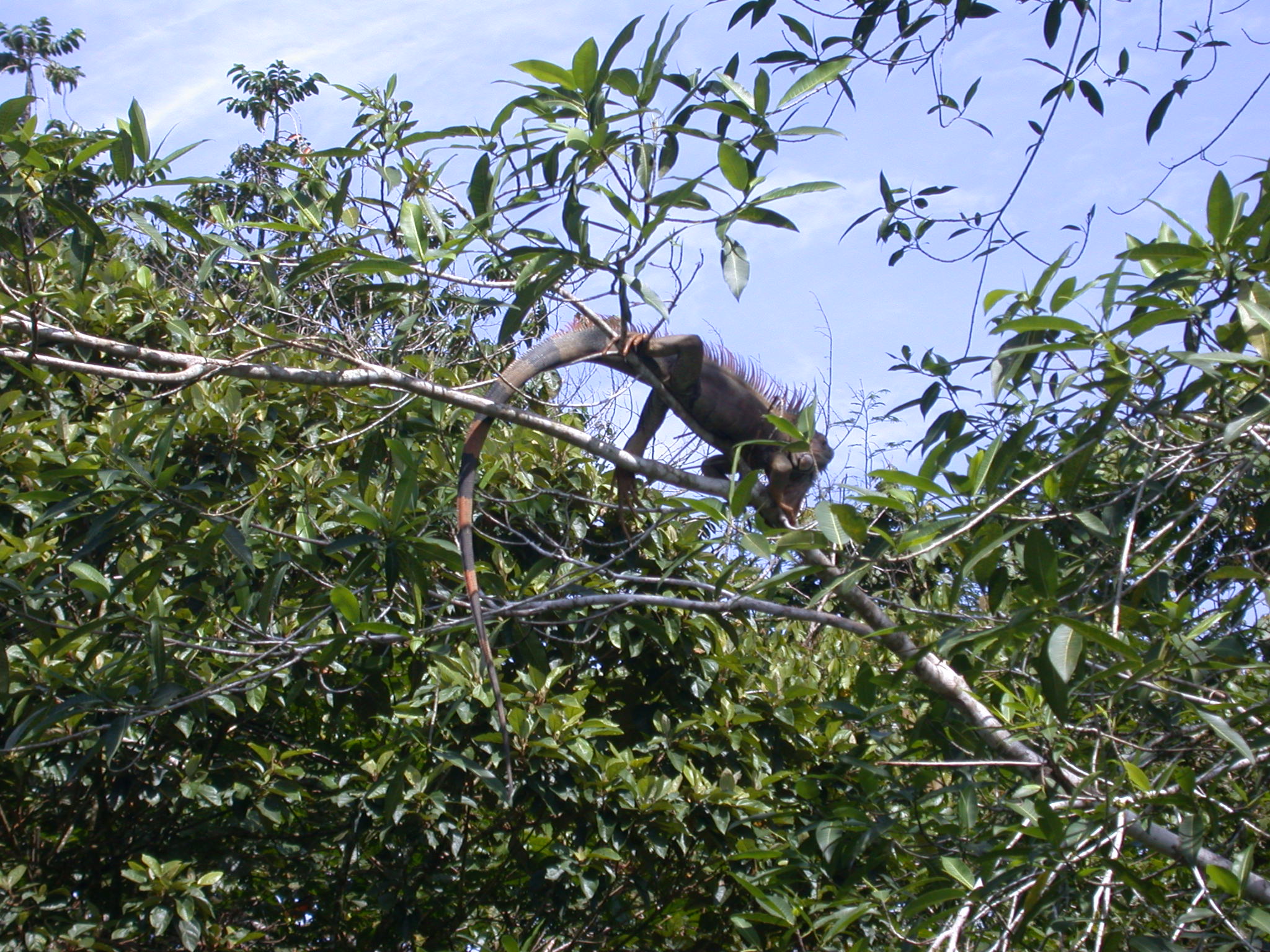
La Selva is not empty of people. Permanent residents live within and around the reserve, and their relationship with the forest is complicated. A survey of local residents found that 4% admitted to hunting within the reserve in the previous year, targeting iguanas, deer, tinamous, bobo fish, and pacas. The numbers suggest that illegal hunting, while not rampant, persists as a low-level threat. Meanwhile, the conversion of surrounding land to plantations and cattle farms has altered what the forest contains. Bird species lists have shifted over the decades - forest understory insectivores have declined, and their absence may be triggering trophic cascades that alter arthropod and plant communities in ways researchers are still working to understand.
Red-Eyed Tree Frogs and Walking Palms
For all its scientific gravitas, La Selva delivers the raw wonder that draws people to the tropics in the first place. Red-eyed tree frogs cling to broad leaves, their emerald bodies and crimson eyes looking painted on. White-faced capuchin monkeys swing overhead. Hoffmann's two-toed sloths hang motionless, their algae-stained fur blending into the canopy. Venomous pit vipers coil at the forest edge, their camouflage so effective that researchers sometimes map them by accident. The main path through the station crosses the Puerto Viejo River on a bridge that puts you eye-level with the forest midstory. Below, jungle streams cut through terrain that hasn't fundamentally changed since before the canoe was the only way in.
From the Air
Located at 10.42N, 84.02W in northeastern Costa Rica, in the Caribbean lowlands at the base of the Cordillera Central. The station is visible from altitude as a patch of intact forest surrounded by agricultural land, connected northward to the larger Braulio Carrillo National Park. Juan Santamaria International Airport (MROC/SJO) is approximately 80km to the southwest. The Puerto Viejo River runs through the station grounds. From the air, the contrast between the dark, unbroken canopy of the reserve and the lighter patchwork of surrounding farms is distinctive.